

Offshore Foundations and Trusts: A Guide to Asset Protection
Private Interest Foundations and offshore trusts are the two most powerful legal instruments for international asset protection, estate planning, and the legal separation of ownership and control of assets. A foundation is an autonomous legal entity (a separate legal person) under civil law that holds assets on behalf of its beneficiaries. A trust is a fiduciary relationship under common law in which a trustee holds and administers assets on behalf of the beneficiaries according to the instructions in the trust deed.
This guide provides a comprehensive comparison of private interest foundations and offshore trusts : legal structure, available jurisdictions, level of asset protection, privacy, costs, taxation, CRS, and compliance requirements—and when to choose one or the other based on your specific situation.
Studio Panama Italia has been operating since 2010 (license no. 14465 in Panama) with offices in San Francisco and Miami Beach. We establish private interest foundations in Panama , Belize , Seychelles , Nevis and the Cook Islands , as well as offshore trusts in common law jurisdictions (Cook Islands, Nevis, and Belize), providing comprehensive assistance with structuring, opening offshore bank accounts , and annual compliance.
Why choose an offshore foundation or trust?
- Asset protection: legal separation between the founder/settlor and the assets — the founder's creditors cannot seize the assets of the Foundation or Trust
- Estate planning: transferring assets to designated beneficiaries without going through the ordinary legal succession of the country of residence
- Privacy: In many jurisdictions, incorporation documents are not public and beneficiaries do not appear in accessible records.
- Flexibility: The founder/settlor can maintain varying degrees of control through letters of desire, protectors, or board of trustees
- Zero local taxation: In most offshore jurisdictions, foundations and trusts pay no local taxes.
- Complex Holding Structures: Foundations and Trusts can hold corporations, LLCs, bank accounts, real estate, and other assets in multiple jurisdictions.

Private Interest Foundation vs. Trust: The Legal Difference
Foundations and trusts are often confused, but they have fundamentally different legal structures. The choice between the two depends on the jurisdiction, the type of assets to be protected, and the degree of control the owner wishes to maintain.
| Characteristic | Private Interest Foundation | Offshore trusts |
|---|---|---|
| Legal tradition | Civil Law | Common Law (Anglo-Saxon law) |
| Legal personality | Yes – autonomous entity | No – fiduciary relationship (not an entity) |
| Parties involved | Founder, Board of Trustees, Beneficiaries | Settlor, Trustee, Beneficiaries (+ optional Protector) |
| Who owns the assets | The Foundation itself (legal entity) | The Trustee (on behalf of the beneficiaries) |
| Founder/settlor control | High — can be part of the Council, revoke, modify | Limited — Settlor does not directly control (irrevocable) |
| Registration | Registered (Charter filed) | Unregistered (Private Trust Deed) |
| Asset protection | Strong | Very strong (Cook Islands: gold standard) |
| Indicative setup cost | 2,000–6,000 USD | USD 5,000–20,000 (Cook Islands) |
| Main jurisdictions | Panama, Belize, Seychelles, Nevis | Cook Islands, Nevis, Belize, Jersey, Guernsey |
| Ideal for | Holding, succession, real estate, direct control | Maximum protection, HNW, total separation of ownership/control |
Focus: Private Interest Foundation
A Private Interest Foundation ( or Fundación de Interés Privado ) is an autonomous legal entity that holds assets on behalf of designated beneficiaries. Unlike a trust, a foundation has its own legal personality—it can open bank accounts, hold real estate, company shares, and other assets in its own name.
Structure of the Foundation:
- Founder: The person who creates the foundation and transfers its assets. They may maintain control through the Board of Trustees or letters of intent.
- Foundation Board: the body that manages the Foundation (equivalent to the Board of Directors of a company). The founder may be a member.
- Beneficiaries: The individuals or entities designated to receive the benefits of the foundation. They can be changed by the founder in many jurisdictions.
- Charter (Deed of Incorporation): the founding document filed with the jurisdiction's registry
- Regulations (Internal Regulations): private document that governs internal governance, distribution rules and succession
Jurisdictions for Private Interest Foundations
| Jurisdiction | Law | Privacy | Protection | Approximate cost |
|---|---|---|---|---|
| Panama | Law 25 of 1995 | High — non-public beneficiaries | Strong | 2,500–4,000 USD |
| Belize | International Foundations Act 2010 | High — no public register of beneficiaries | Strong | 2,500–5,000 USD |
| Seychelles | Foundations Act 2009 | High | Medium-strong | 2,000–4,000 USD |
| Nevis | Multiform Foundations Ordinance 2019 | Maximum — no public record | Excellent | 3,000–6,000 USD |
Panama Foundation — the most widely used: The Panama Private Interest Foundation (FIP) is the most popular structure among our Italian clients. It offers its own legal personality, non-public beneficiaries, territorial taxation (zero tax on foreign income), and the founder retains full control through the Foundation Board. It is the ideal instrument for holding companies (Panama SA, US LLC, offshore IBC), bank accounts, real estate, and other assets.
Focus: Offshore Trusts
An offshore trust is a fiduciary relationship in which the Settlor transfers assets to a Trustee who manages them on behalf of the Beneficiaries according to the instructions contained in the Trust Deed. The trust has no legal personality : the assets are legally owned by the Trustee, not the Trust itself.
Trust Structure:
- Settlor: The person who creates the trust and transfers the assets. In asset protection trusts, the settlor is often also the beneficiary.
- Trustee: The authorized person or trust company that legally holds and administers the assets. In offshore jurisdictions, the trustee is typically a licensed local trust company.
- Beneficiaries: The persons designated to receive the benefits of the Trust
- Protector (optional): An individual designated by the Settlor with supervisory powers over the Trustee (may appoint/remove trustees, approve distributions, etc.)
- Trust Deed: the constitutive document — private, not filed in any public registry
Jurisdictions for Offshore Trusts
| Jurisdiction | Law | Protection | Indicative setup cost |
|---|---|---|---|
| Cook Islands | International Trusts Act 1984 | Maximum (world gold standard) | 12,000–20,000 USD |
| Nevis | International Exempt Trust Ordinance | Excellent | 5,000–10,000 USD |
| Belize | Trusts Act (Cap. 202, rev. 2020) | Strong | 3,000–6,000 USD |
Maximum asset protection structure: The Cook Islands International Trust combined with a Nevis LLC is widely recognized as the strongest asset protection structure in the world. The Trust owns the LLC, and the LLC holds the bank accounts and investments. The Settlor is the initial manager of the LLC; the Trustee steps in when litigation arises. Foreign courts have no jurisdiction over the Cook Islands Trustee.
Trust or Foundation: What to Choose?
The choice depends on three factors: (1) the degree of control you want to maintain, (2) the type of assets you want to protect, and (3) the available budget.
| Scenario | We recommend | Reason |
|---|---|---|
| You want to maintain direct control over the assets | Foundation (Panama or Belize) | The founder can be part of the Board and retain decision-making power |
| Maximum asset protection against aggressive creditors | Cook Islands Trust + LLC Nevis | Global gold standard — foreign judgments not recognized, burden of proof criminal law |
| Holding companies and real estate in Latam | Panama Foundation (FIP) | Own legal personality, can hold SA Panama, real estate, bank accounts |
| Multi-generational estate planning | Trust (Cook Islands or Nevis) | The Trust is perpetual in many jurisdictions — assets pass to beneficiaries without ordinary succession |
| Small budget, solid protection | Belize or Seychelles Foundation | Lower costs than a Trust, strong protection, legal personality |
| Crypto and digital assets | Trust + LLC (Cook Islands or Nevis) | The LLC holds the wallets and exchange accounts; the Trust protects the LLC |
Taxation, CRS and Compliance for Foundations and Trusts
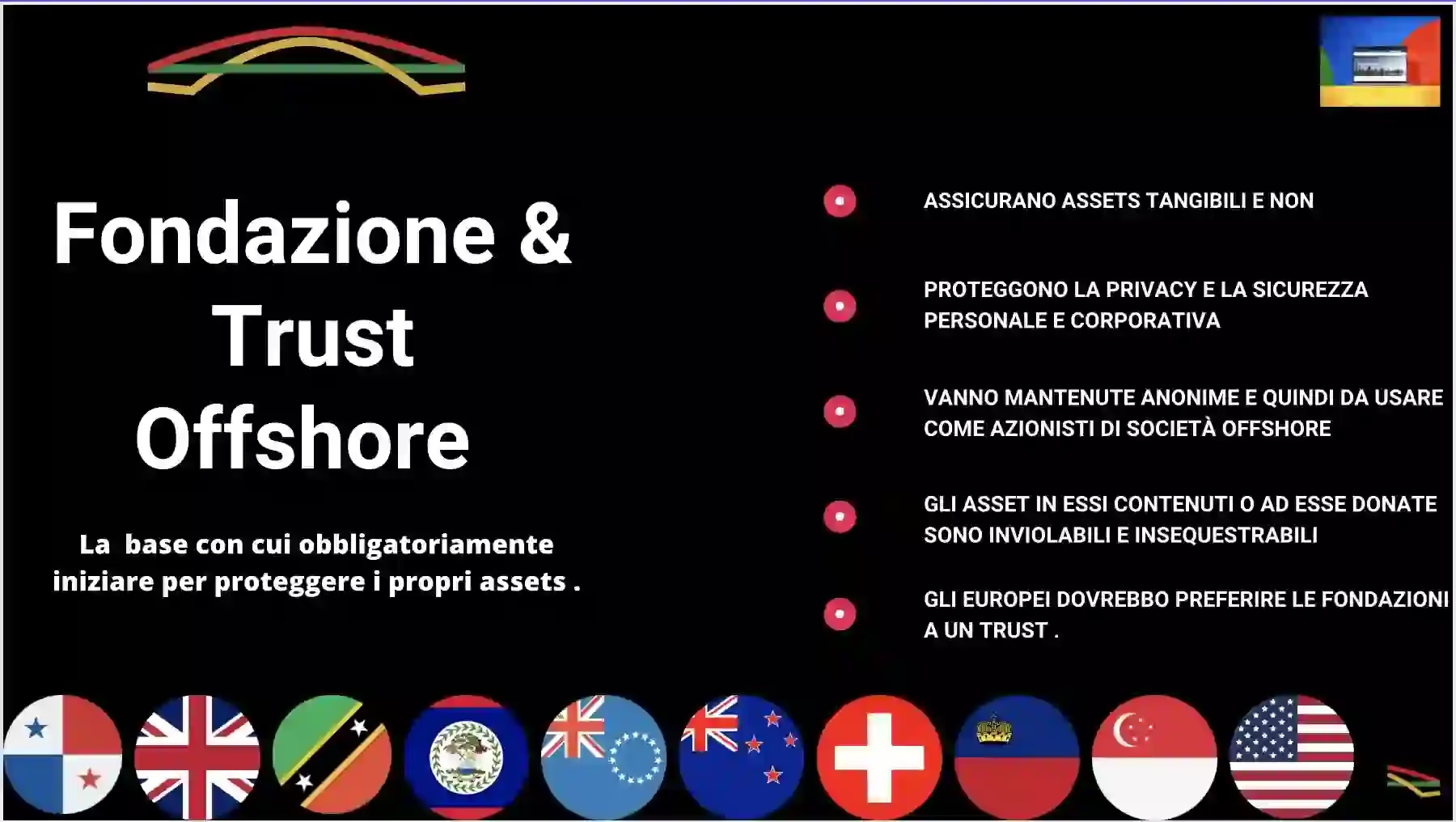
In most offshore jurisdictions, foundations and trusts do not pay local taxes on foreign-source income. However, the owner (founder/settlor) may have significant tax obligations in their country of residence.
For Italian tax residents:
- RW Table: Requirement to declare foreign foundations and trusts in the tax return (Article 4 of Legislative Decree 167/1990)
- IVAFE/IVIE: tax on financial and real estate assets held abroad through a Foundation or Trust
- Foreign Trust Regulations (Article 73 of the TUIR): Foreign Trusts with Italian beneficiaries may be subject to taxation in Italy on distributed income or, for "opaque" Trusts, on accumulated income.
- CFC Regulation: If the Foundation or Trust controls zero-tax companies, the income can be taxed on a transparency basis in Italy.
- CRS/AEOI: Foundation and Trust banking information is subject to automatic exchange if the beneficial owner is a tax resident in a CRS country
Compliant solution: Offshore foundations and trusts become fully effective if the founder/settlor has transferred tax residence to a territorial tax country not subject to CRS with the EU—such as Panama or Paraguay . In this case, the foundation/trust's income is not taxed in either the offshore jurisdiction or the country of residence, and bank secrecy applies to the accounts held by the structure.
Do you want to set up an offshore foundation or trust?
Contact us on WhatsApp for a free consultation. We'll design the optimal asset protection structure for your specific situation.
Contact us on WhatsAppFrequently Asked Questions about Offshore Foundations and Trusts (FAQ)
What is the difference between a Foundation and a Trust?
How much does it cost to set up an offshore foundation?
How much does an offshore trust cost?
Do foundations and trusts pay taxes?
Can I maintain control of the assets?
Which jurisdiction is best for asset protection?
What does the Studio Panama Italia service include?
Professional disclaimer: Studio Panama Italia provides offshore wealth structuring services. The information on this page is provided for informational purposes only and does not constitute personalized legal, tax, or financial advice. We recommend consulting a qualified accountant in your country of tax residence. The regulations cited (Panama Law 25/1995, International Trusts Act 1984 Cook Islands, Presidential Decree 917/1986, Legislative Decree 167/1990) are provided for informational purposes only and are subject to change. Updated: March 2026.
