

Residence in Costa Rica
A complete guide to residency in Costa Rica for Italian citizens. Costa Rica offers temporary residency to retirees, renters, investors, and digital nomads, with local taxation on foreign income. The process is initiated through the General Directorate of Migration and Foreign Affairs (DGME). On this page: immigration categories, requirements, documents, the 5-step process, taxes, citizenship, and FAQs.
How to obtain residency in Costa Rica
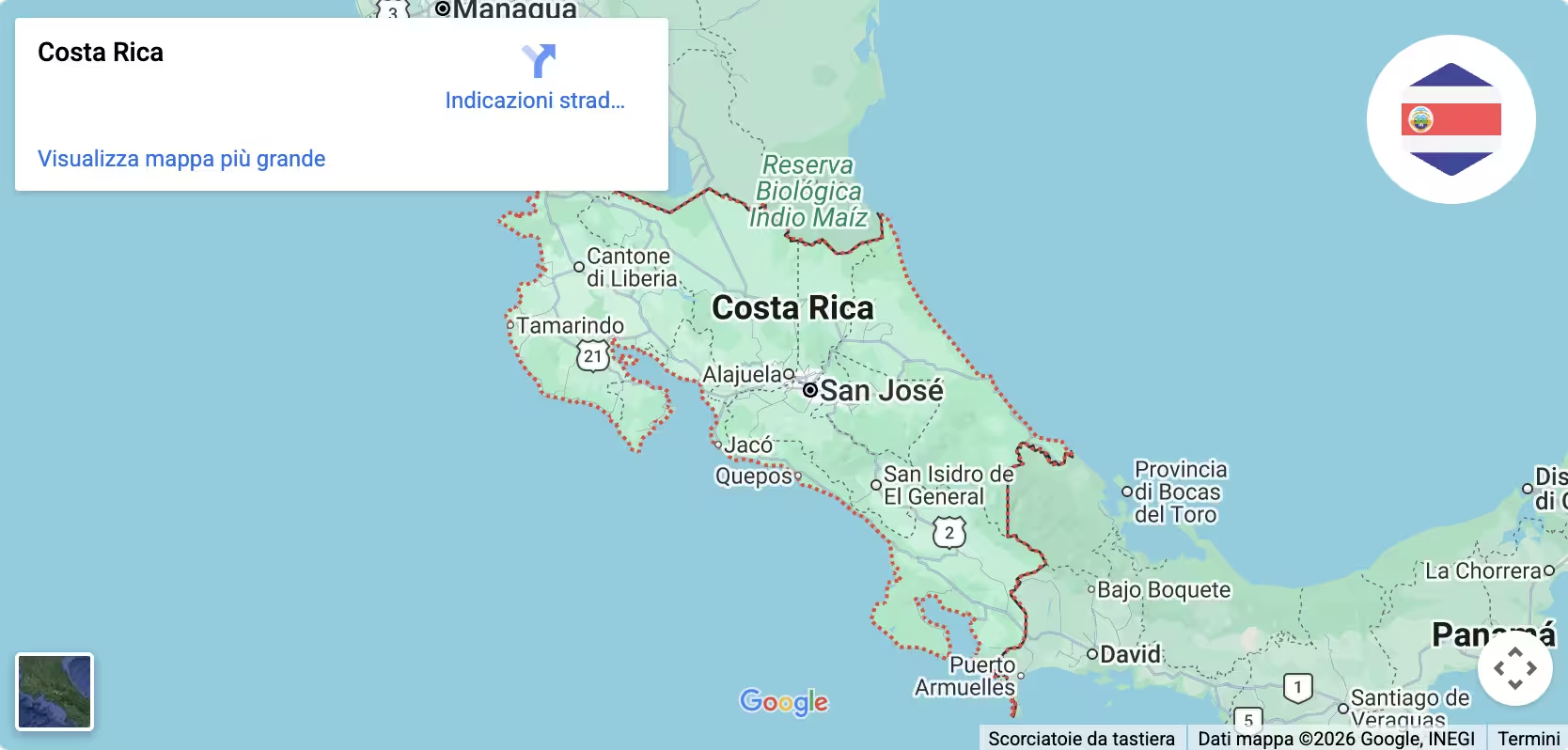
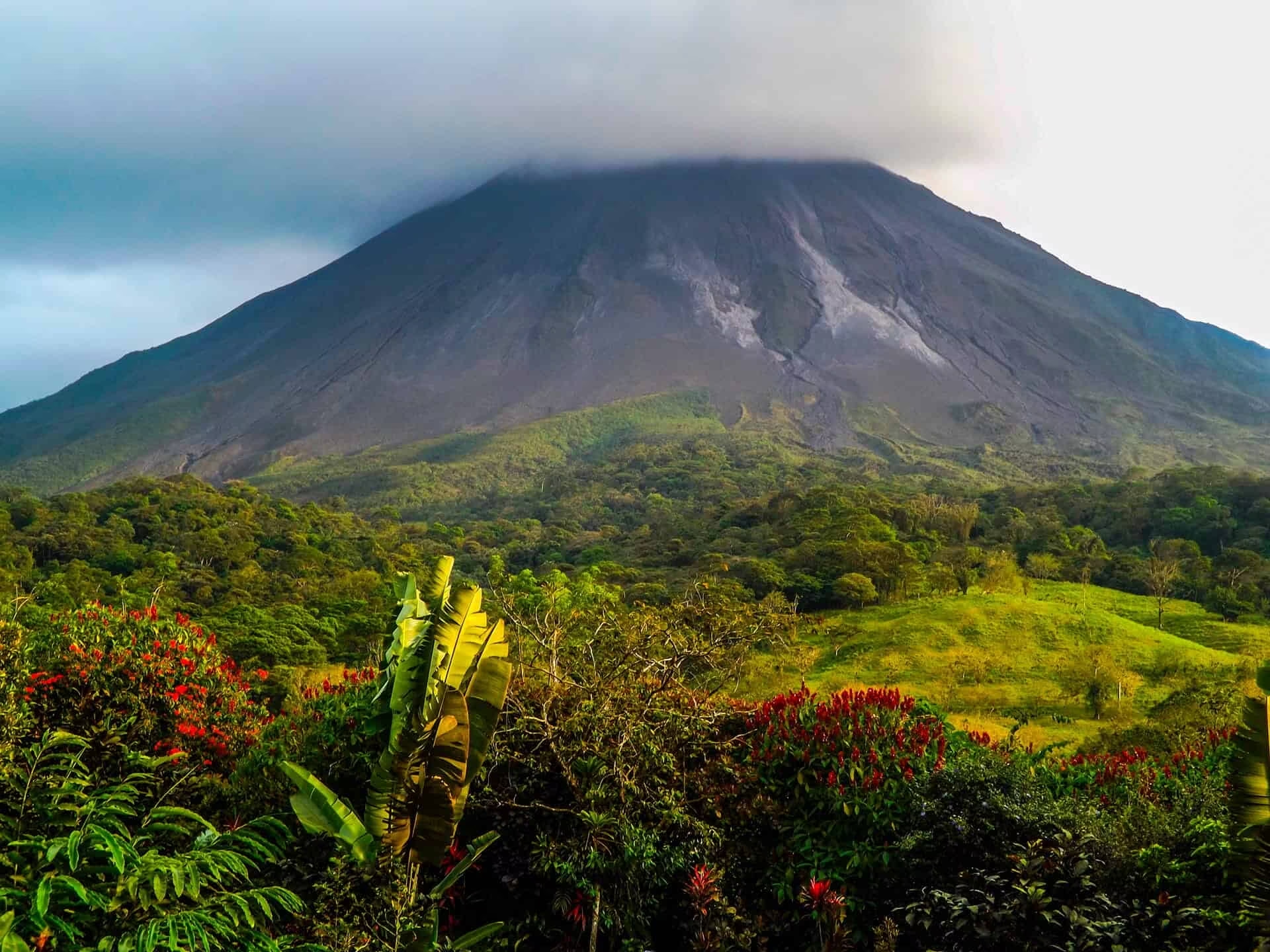
Costa Rica is often called the "Switzerland of Central America" for its pleasant lifestyle, stable democracy, lack of a military since 1948, and impressive natural beauty. With just over 51,000 km² of territory and approximately 5.2 million inhabitants, it is considered the happiest, most eco-friendly, greenest, and most sustainable country on the planet. The capital and political, cultural, and economic center is San José, and the official currency is the Costa Rican colon (CRC), although the US dollar is widely accepted everywhere.
Taking up residency in Costa Rica allows you to take advantage of territorial taxation: income earned abroad is exempt from taxation. The main economic sectors are tourism, high-tech manufacturing, agriculture, and fishing. Costa Rica is the most visited country in Central America, accounting for approximately 25% of the region's tourism market. It has traditionally been an attractive jurisdiction for incorporating companies conducting international trade, thanks to its territorial tax system and free zones.
We coordinate the entire process, from preparing documents in Italy to obtaining the DIMEX (migration identity document) and registering with the CCSS.
Why Costa Rica is a great place to live
- Territorial taxation — Foreign-source income is not taxed in Costa Rica. The maximum local rate is 25% for self-employed individuals and 15% for employees.
- Political stability and democracy — Costa Rica is the most consolidated democracy in Latin America. No army since 1948, public spending focused on education and healthcare.
- Different migration categories — Pensionado, Rentista, Inversionista, Rappresentante, Nomada Digitale: multiple ways to obtain residency.
- Exceptional quality of life — temperate tropical climate, unique biodiversity, good healthcare, and social security among the best in the region.
- Path to citizenship — after five years of legal residency for Italians and Latin Americans, naturalization requires Spanish and history exams.
- Digital Nomada Visa — Starting in 2021, Costa Rica offers a specific visa for remote workers with a minimum income of USD 3,000/month and tax exemption on foreign income.
Costa Rica's Residence Permit System
The Costa Rican immigration system is regulated by General Law on Migration and Foreigners No. 8764 and managed by the DGME ). Migration categories are divided into: Permanent Resident, Temporary Resident, Special Categories, and Non-Resident. Temporary residency is valid for two years and is renewable. After three consecutive years of temporary residency, permanent residency can be requested. The identity document issued to residents is the DIMEX (Documento de Identidad Migratoria para Extranjeros), equivalent to the cédula and required to operate in the country.
Summary table of migration categories
| Category | Type | Duration | Economic requirement | Work permitted | Permanent path |
|---|---|---|---|---|---|
| Pensioner | Temporary | 2 years (renewal) | USD 1,000/month pension | No employee. Yes company | Yes, after 3 years |
| Rentista | Temporary | 2 years (renewal) | USD 2,500/month × 24 months or USD 60,000 deposit | No employee. Yes company | Yes, after 3 years |
| Inversionist | Temporary | 2 years (renewal) | USD 150,000 investment | Yes, from the project | Yes, after 3 years |
| Representative | Temporary | 2 years (renewal) | Companies with local employees | Yes, from the company | Yes, after 3 years |
| Employee | Temporary | 2 years (renewal) | Contract + 25% above min. salary. | Yes, just for the business | Yes, after 3 years |
| Student | Temporary | 2 years (renewal) | Enrollment at an accredited university | No | No |
| Family bond | Temp. / Perm. | 2 years / unlimited | First degree relationship with Costa Rican | Yes (if permanent) | Yes, direct if related |
| Digital Nomad | Special category | 1 year (renewal 1×) | USD 3,000/month (or USD 4,000 family) | Yes, for foreign companies | No, it doesn't accumulate time |
| Permanent residence | Permanent | Unlimited | 3 years of temporary or family bond | Yes, any activity | — |
| Naturalization | Citizenship | Definitive | 5 years (ITA) or 7 years legal residence | Yes, full rights | — |
Temporary residence in Costa Rica
Temporary residency is the first step to legally settling in Costa Rica. It is valid for two years, is renewable, and, after three consecutive years, allows access to permanent residency. The application fee is USD 50 for each category. Registration with the CCSS is mandatory and must be completed within 22 business days of approval. The DIMEX is issued after biometric registration at the Banco de Costa Rica or Correos de Costa Rica and arrives in 4–6 weeks.
Pensionado Residence (Pensioner)
The Pensionado is intended for retirees with a monthly income of at least $1,000 from a permanent pension source. Proof of ability to electronically transfer funds to a local Costa Rican account is required. Employment is not permitted, but you may own a company and receive dividends. You may include your spouse and children under 18 as dependents. You must visit Costa Rica at least once a year.
Rentista Residence (Independent Income)
The Rentista requires proof of a guaranteed income of at least USD 2,500 per month for 24 months, certified by a bank, or a USD 60,000 deposit in an approved Costa Rican bank. Since 2025, the DGME has required direct deposit certification with actual transaction records. Employment is not permitted, but you can own a company and receive dividends. A single deposit covers the entire family.
Investmentist Residence (Investor)
Residency for Inversionistas requires a minimum investment of USD 150,000 in real estate, stocks, production processes, or other assets in Costa Rica. The investment must be documented with appraisals certified by authorized tax assessors. Income can be earned from the investment project. A spouse and children under 18 may be included. Visits are required at least once a year.
Residence for Company Representative
The candidate must be a director, manager, or technical staff member of a Costa Rican company that meets certain requirements, including employing a minimum number of local workers as required by labor law, and must have financial statements certified by a licensed public accountant. The company must be registered with the DGME (District Economic and Monetary Authority). The applicant may earn income from the company. The spouse and children may be included as employees.
Visa Nómada Digitale
Introduced in 2021, the Digital Nomad visa is designed for those who work remotely for foreign companies. Requirements: minimum monthly income of USD 3,000 (individual) or USD 4,000 (family), demonstrable through bank statements or CPA certification. Valid for one year, renewable once. Offers tax exemption and exemption from taxes on technology equipment. Please note: the Digital Nomad visa does not accumulate time toward permanent residency and does not lead to naturalization.
Permanent Residency in Costa Rica
Permanent residency is obtained after three consecutive years of temporary residence or directly through a first-degree family relationship with a Costa Rican citizen (parents, minor children, or minor siblings). Permanent residency does not expire, but the DIMEX must be renewed periodically. It allows you to work in any profession without restrictions. You must visit Costa Rica at least once a year. If you are absent for more than four consecutive years, your residency is cancelled.
Requirements for permanent residence
- 3 years of consecutive temporary residence under any eligible category (Pensionado, Rentista, Inversionista, Representative, Employee)
- General requirements identical to those for temporary workers (criminal history, CCSS registration, identity document)
- Application fee: USD 50 per application
- Category change fee: USD 200 for switching from temporary to permanent
- Civil Registry certification of family ties (if related to a Costa Rican)
How to obtain residency in Costa Rica
5 steps to obtain residency in Costa Rica
Contact us and choose the migration category
We evaluate your specific case and identify the most suitable immigration category: Pensionado, Rentista, Inversionista, or Rappresentante. We provide you with a complete list of documents required in Italy and the expected timeframes.
Prepare documents in Italy
Request from the registry office and court: apostilled birth certificate, apostilled criminal record (valid for up to 6 months), cumulative registry certificate, and marital status certificate. If you have any pending charges, obtain these as well. All documents must be apostilled for Costa Rica and translated into Spanish by an official translator.
Submit the application to the DGME
Submit the application online through the DGME's "Trámite en ínea" (Online Application) or in person at the San José (La Uruca) offices. Pay the USD 50 fee. Attach all documentation and proof of the specific requirements for your category (pension certificate, proof of investment, employment contract, etc.).
Wait for approval and register for CCSS
The DGME publishes updates via "Consulta de expediente." Respond promptly to any requests for additional documentation ("prevención"). Once approved, register with the CCSS (Caja Costarricense de Seguro Social) within 22 business days. Choose your local EBAIS, pay the initial fee, and obtain the membership certificate—mandatory for DIMEX.
Get your DIMEX
Complete the biometric registration (photo and fingerprints) at the Banco de Costa Rica or Correos de Costa Rica. Keep the printed receipt. The DIMEX will arrive in 4–6 weeks and is your official identification document as a Costa Rican resident. From this moment, you are a legal resident and can open bank accounts, sign contracts, and operate in the country.
Documents required for residency in Costa Rica
The basic documents required for all categories of residence in Costa Rica are:
- birth certificate for Costa Rica, translated into Spanish
- Criminal records and pending charges with apostilled status, valid for a maximum of 6 months. Required for the applicant, spouse, and children between the ages of 15 and 25.
- Original passport with adequate residual validity (minimum 180 days for Italians, Group 1)
- Cumulative registry certificate (residence, marital status, citizenship) apostilled
- Proof of payment of USD 50 to the Government for the solicitud
- Recent passport photo in digital format
In addition to these, there are specific requirements for each category:
| Category | Specific additional documents |
|---|---|
| Pensioner | Pension certificate with official certificates, translated. Proof of ability to transfer money electronically to a local account |
| Rentista | Bank certificate of income USD 2,500/month × 24 months with transaction records, or USD 60,000 deposit in a Costa Rican bank |
| Inversionist | Notarial deed, municipal receipts, certified tax assessor's avalúos. Certified documentation of the origin and value of the investment (minimum USD 150,000) |
| Representative | Company legal documentation, financial statements certified by the CPA, employment contract, proof of tax payment, and company registration at the DGME |
| Digital Nomad | Bank statements for the last 12 months or CPA certification attesting to a minimum income of USD 3,000/month |
Taxation in Costa Rica
Costa Rica applies a territorial tax system: only income generated domestically is subject to tax. Income earned abroad—including that from investments, professional activities, and corporate participation— is not taxed. This makes Costa Rica one of the most advantageous jurisdictions for those with international income. The tax year runs from January 1st to December 31st.
| Tax | Rate | Notes |
|---|---|---|
| Income from employment | Progressive: 0% → 15% | Exemption up to CRC 842,000/month. Maximum 15% above threshold |
| Income from self-employment | Progressive: 0% → 25% | Exemption up to CRC 3,742,000/year. 5 brackets up to 25% |
| Business income (company) | Progressive: 5% → 30% | 30% for incomes above CRC 122,145,000. SMEs with reduced rates |
| VAT (Impuesto al Valor Aggregado) | 13% | Standard rate on goods and services |
| Income from foreign sources | 0% | Territorial taxation: zero taxes on income earned abroad |
| CCSS Contributions (employee) | 9,34% | Withholding from wages for social security |
| CCSS Contributions (employer) | 26,33% | Paid by the employer |
| Property tax | 0,25% | Annual, on the registered value of the property |
| Corporate tax (annual) | CRC ~105,000 | Fixed annual fee for each active company. Approximately USD 190 |
What is life like in Costa Rica?
Life in Costa Rica is very good. The country consistently ranks among the world's top performers for quality of life, happiness, and environmental sustainability. With over 25% of its territory protected in national parks and reserves, it offers extraordinary biodiversity. The climate is tropical but temperate in the Central Valley (where San José is located, at about 1,200 meters above sea level). The two coasts—Pacific and Caribbean—offer spectacular beaches and a unique marine ecosystem.
The cost of living is the highest in Central America but remains competitive with Western Europe, especially in less touristy rural and coastal areas. Public healthcare is of a good standard thanks to the CCSS system, and private clinics offer excellent services at lower costs than in the US. The expat community is very active, with a strong presence of North Americans and Europeans, especially in the Guanacaste, Central Valley, and the southern Pacific coast.
San José and Valle Central
San José is the capital and the country's financial, commercial, and cultural center. It is located in the Central Valley at approximately 1,200 meters above sea level, ensuring a mild climate year-round (20–26°C). The main institutions, embassies, top-quality hospitals (Bible Clinic, CIMA Hospital), universities, and shopping centers are concentrated here. The satellite cities of Escazú, Santa Ana , and Heredia are favored by expats for their high quality of life, modern services, and international schools.
Guanacaste and the North Pacific Coast
Guanacaste is a coastal province in the North Pacific, famous for its white-sand beaches, dry tropical climate, and Daniel Oduber International Airport (LIR), which connects it directly to the US and Canada. The towns of Tamarindo, Playas del Coco , and Nosara are home to established expat communities. It's a favorite among retirees and surfers. The cost of living varies: higher in tourist areas, reasonable inland.
South Pacific Coast and Caribbean area
The southern Pacific coast (Dominican, Uvita, Ojochal) offers a quieter atmosphere and more affordable prices than Guanacaste. The Caribbean coast (Puerto Viejo, Cahuita) has a unique cultural character influenced by Afro-Caribbean culture, with a more relaxed pace and lower prices. These areas are ideal for those seeking a more authentic and less touristy experience, while still maintaining access to basic services.
Costa Rican Citizenship and Passport for Naturalization
Costa Rican naturalization is administered by the Supreme Election Tribunal (TSE) and requires continuous legal residence in Costa Rica. Article 14 of the Constitution establishes the following terms:
- 5 years of legal residency for Central American, Latin American, and Spanish citizens by birth (includes Italians)
- 7 years of legal residency for all other nationalities
- 2 years for those married to a Costa Rican citizen (marriage registered in the Civil Registry)
Requirements for naturalization
- Continuous domicile in Costa Rica for the required period
- Good conduct and no criminal convictions
- means of subsistence (profession, business or income)
- Passing exams in Spanish and Costa Rican History and Values (minimum grade 70). Those who have completed school in Costa Rica are exempt.
- birth certificate from the country of origin
- Criminal record from the country of origin apostilled (valid for a maximum of 3 months)
- Current DIMEX
- Sworn statement of two witnesses attesting to the applicant's knowledge
Naturalization costs
| Voice | Cost | Notes |
|---|---|---|
| Tax stamps | CRC 200 (other nationalities) / CRC 20 (Central Americans) | Payment by invoice to Banco de Costa Rica |
| Naturalization exams | CRC 10,000 per exam (CRC 20,000 for both) | Payment to ICER. Spanish + History and Values |
| TSE Process | Free | The process takes approximately 10 months after the documents are delivered |
| Additional documentation | Variable | Translations, apostilles, notarial certifications, current DIMEX |
Setting up a company in Costa Rica
Costa Rica has traditionally been an attractive jurisdiction for establishing companies that conduct international trade, thanks to its territorial tax system and free zones. The most common corporate forms are:
- Sociedad Anónima (SA) — equivalent to a joint stock company. Minimum two shareholders. It is the most commonly used form for real estate investments and commercial activities. Directors may be foreigners.
- Sociedad de Responsabilidad Limitada (SRL) — similar to an LLC. Liability limited to paid-up capital. From 2 to 25 members.
- Sucursal (Filiale) — Foreign companies can open a branch or representative office in Costa Rica.
Every company, active or inactive, must payannual corporate tax (approximately CRC 105,000 for active companies, approximately CRC 53,000 for inactive companies) by January 31st each year. Companies in free zones enjoy significant exemptions on taxes, customs duties, and VAT.
Apply for your residency in Costa Rica
Contact us for a personalized consultation on the best procedure for your case.
✉️ Write to us on WhatsAppTo acquire residency in Costa Rica you can contact us from the About Us / Contact Us.
You may also be interested in Panama residency, Paraguay residency or an offshore account.
Panama vs. Costa Rica: Residency Comparison for Italians
Both Panama and Costa Rica apply territorial taxation and are among the most popular destinations for Italians wishing to relocate to Latin America. However, the two jurisdictions present substantial differences in terms of costs, timeframes, bureaucracy, and lifestyle. The following table compares the main aspects.
| I wait | 🇵🇦 Panama | 🇨🇷 Costa Rica |
|---|---|---|
| Taxation | Territorial — foreign income 0%. VAT 7% | Territorial — foreign income 0%. VAT 13%. |
| Type of residence for Italians | Permanent direct (Treaty of Friendship) | Temporary 2 years → Permanent after 3 years |
| Obtaining time | 3–6 months (direct permanent) | 3–6 months (temporary only) |
| Mandatory company | Yes (by Treaty of Friendship) | No (for Representative only) |
| SPI procedure cost | From USD 1,400 + company | From USD 50 (gov. fee) + legal costs |
| Economic requirement (Pensionado) | USD 1,000/month pension | USD 1,000/month pension |
| Economic requirement (Rentista) | USD 850/month income or USD 300,000 CD | USD 2,500/month × 24 months or USD 60,000 deposit |
| Investment requirement | USD 300,000 real estate | USD 150,000 in assets/real estate |
| Digital Nomad | Not available | Yes — USD 3,000/month, 1 year |
| Mandatory health insurance | No | Yes — CCSS mandatory for DIMEX |
| Minimum stay requirement | None (no day required) | At least 1 visit/year |
| Banking system | International Offshore Financial Center | Good but domestic, not offshore |
| Main currency | USD (US Dollar) | CRC (Colón) + USD accepted |
| Cost of living | High | Alto (the highest in Central America) |
| Quality of life | High | Very high (1st Happy Planet Index) |
| Army | None (since 1990) | Nobody (since 1948) |
| Democracy | Stable | Full (unique in Latin America with Uruguay) |
| Citizenship | After 5 years of permanent | After 5 years for Italians (mandatory exams) |
| Dual citizenship | Yes | Yes |
| DTC with Italy | No | No |
| Ideal for | Entrepreneurs, investors, those who want permanent employment now and the offshore banking system | Retirees, families, nature lovers, digital nomads, and those seeking a high quality of life |
