

C-Corp USA for Italian Entrepreneurs: 2026 Guide to Wyoming, Delaware, and the Italy-USA Treaty
The C-Corp is the dominant US corporate structure for non-resident Italian entrepreneurs. It is the only US legal form that combines full access to non-residents, a flat 21% federal tax rate, the option of being a subsidiary of an Italian or European company for the L-1 visa, and a favorable 5% withholding tax on dividends distributed to the parent company under a qualified shareholding regime pursuant to the 1999 Italy-US Double Taxation Convention, in force since 2009 with Law 20/2009.
Every other US structure presents structural limitations for non-resident Italians. The S-Corporation is precluded by law for non-resident aliens (IRC §1361(b)(1)(C)). The LLC transfers income to foreign partners, exposing them to permanent US establishment with Form 5472 penalties of $25,000 for failure to do so. Proprietorship and partnership arrangements leave the partner solely liable. The C-Corp is the only structurally coherent solution, which is why in Italy over 70% of US setups for European entrepreneurs today operate through a C-Corporation.
This guide covers everything an Italian entrepreneur needs to properly decide on and launch their C-Corp: federal and state taxation, choosing the state of incorporation (Wyoming, Delaware, Florida, Nevada, or Texas), structuring as a subsidiary of a European holding company to access L-1 and E-2 visas, the effect of the Italy-US treaty on dividends, mandatory Forms 1120 and 5472, Italy's anti-tax avoidance rules on foreign tax (Art. 73, paragraph 5-bis of the Consolidated Income Tax Code), a complete numerical simulation of a $200,000 profit, a comparison with European holding companies (Estonia, Malta, the Netherlands, and Cyprus), and a roadmap for future conversion to an S-Corp after a potential green card. Data updated to April 2026, with regulatory references from the IRS, IRC, the Italy-US Convention, and the Italian Revenue Agency.
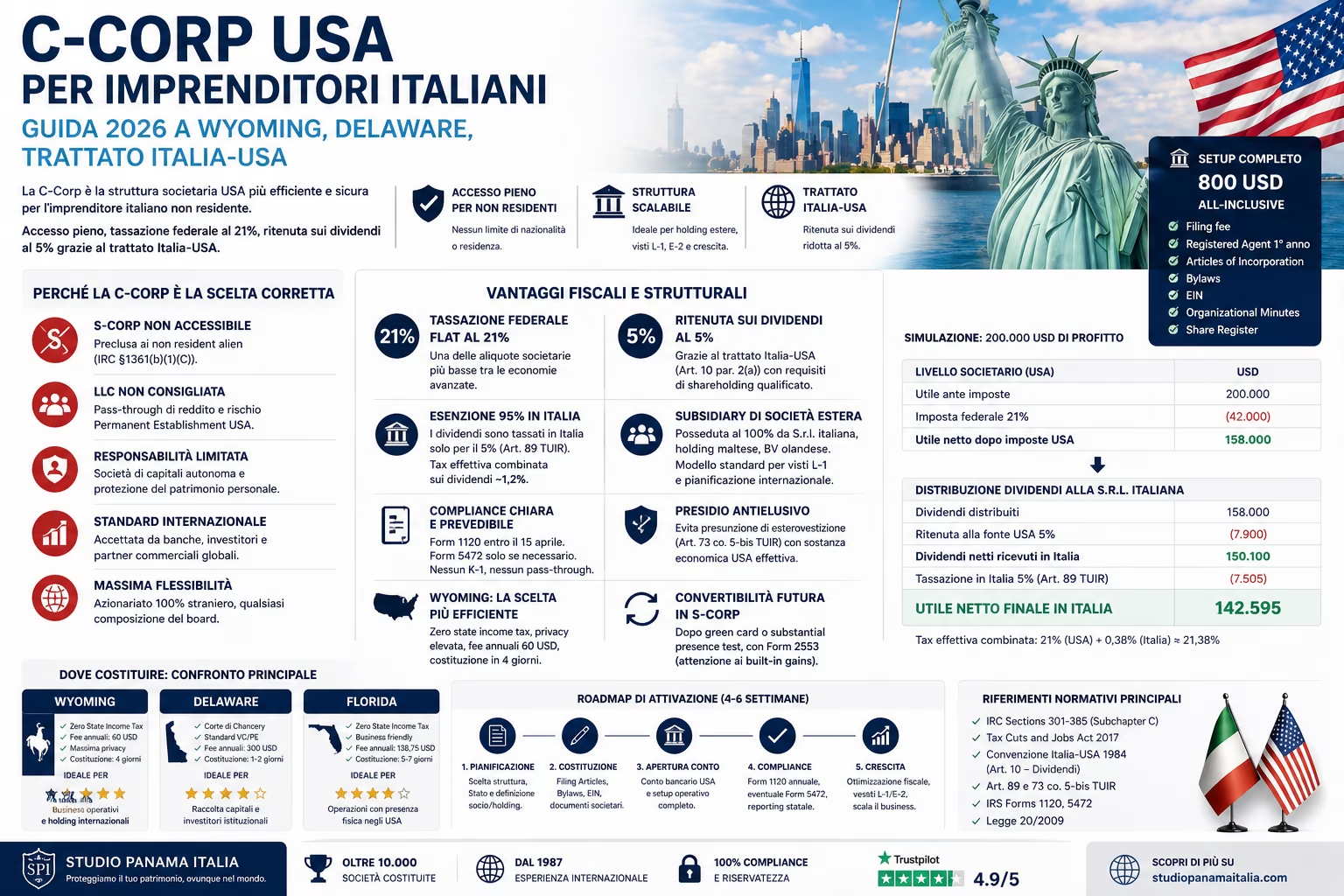
Key C-Corp Elements for Italian Entrepreneurs
- 21% flat federal tax rate: A flat rate introduced by the Tax Cuts and Jobs Act of 2017, effective 2026. One of the lowest corporate tax rates among advanced economies, applied to a C-Corporation's net income after full deductions.
- Full access for non-residents: no restrictions on nationality, residency, or board composition. An Italian entrepreneur residing in Italy, Malta, Dubai, or South America can own 100% of a C-Corp without IRS restrictions.
- Subsidiary of a foreign company: A C-Corp can be wholly owned by an Italian LLC, a Maltese holding company, a Dutch BV, or any other European legal entity. This is the standard form for obtaining an L-1 visa through intra-company transfer.
- Dividend withholding tax at 5%: the 1984 Italy-US treaty, in force since 2009, reduces the withholding tax from the standard 30% to 5% for dividends distributed to an Italian company that holds at least 25% of the C-Corporation's capital for at least 12 months (Art. 10 par. 2(a) Convention).
- 95% exemption in Italy: An Italian limited liability company (SRL) receiving dividends from its US C-Corp includes them in its business income at only 5% of their amount (Article 89 of the TUIR), with a combined effective tax rate on distributed dividends of approximately 1.2% in Italy.
- Reduced compliance compared to an LLC: Federal Form 1120 by April 15, possible Form 5472 if there are relationships with related parties, state annual report, registered agent. No K-1 for foreign partners, no income pass-through that exposes the Italian holding company to a permanent US establishment.
- Wyoming is preferred for the standard case: zero state income tax, $60 annual fees, high level of privacy, incorporation in 4 business days. Delaware is preferred only if institutional venture capital is expected to be raised due to the Court of Chancery.
- Full incorporation cost: $800 all-inclusive with Studio Panama Italia (filing fee, first-year registered agent, articles of incorporation, bylaws, EIN, organizational minutes, share register). Typical annual maintenance: $1,500–$2,500.
- Foreign investment: monitored if managed correctly: the C-Corporation avoids the presumption of Article 73 paragraph 5-bis TUIR provided that it has actual US economic substance (registered office, US board, strategic decisions taken in US territory, accounting separation from the Italian parent).
- Future convertibility into an S-Corp: Those who obtain a green card or pass the substantial presence test can convert their C-Corp into an S-Corp with Form 2553, accessing the pass-through and benefits of Subchapter S, subject to the built-in gains restriction for the 5 years following the conversion.
What is a C-Corp and why is it the dominant choice for non-residents?
A C-Corp, short for C-Corporation, is the standard form of corporation under U.S. law, governed by Subchapter C of Chapter 1 of the Internal Revenue Code (Sections 301-385). It is the functional equivalent of the Italian joint-stock company or the British public limited company: a legal entity independent of its shareholders, liability limited to the capital contributed, a shareholding structure divisible into multiple classes (common stock, preferred stock), and governance based on shareholders, a board of directors, and officers.
The adjective "C" comes directly from the taxation subchapter. The distinction between "C-Corp" and "S-Corp" is purely fiscal, not corporate: from the perspective of US state law, both are simply "corporations." The difference is the federal tax regime with the IRS. A corporation that does not elect Subchapter S is automatically a C-Corporation, subject to the 21% direct corporate tax on its net income. An S-Corp, on the other hand, is a corporation that has elected Subchapter S to be taxed transparently, with restrictive requirements that exclude nonresident aliens.
This distinction explains why the C-Corporation is the dominant choice for non-resident Italian entrepreneurs. While the S-Corp is barred by law by Section 1361(b)(1)(C) of the IRC and the LLC poses permanent establishment issues for foreign shareholders, the C-Corp is structurally designed to be owned by anyone, anywhere, without restrictions on nationality, residency, or board composition. There are no limits on the number of shareholders, the classes of shares issued, the geographic origin of the shareholders, or the nationality of the directors.
The five structural advantages for non-resident Italians
The first advantage is full access. An Italian citizen residing in Italy, Malta, Dubai, South America, or any other country can hold 100% of the capital of a C-Corporation without restrictions. No visa is required to become a shareholder, and no physical presence in the US is required for incorporation. The entire process, from filing the articles of incorporation to applying for a federal EIN, can be completed remotely through a registered agent.
The second advantage is tax separation. The C-Corp is an independent taxpayer: it pays its own federal taxes at 21% on its net income, and completely isolates the US tax perimeter from the Italian one of the parent or individual partner. There is no pass-through, no attribution of income to foreign partners, and the Italian partner is not required to file Form 1040-NR in the US. The only taxes the Italian partner pays in the US are the withholding tax on distributed dividends, which is reduced by the treaty.
The third advantage is compatibility with subsidiary structures. A C-Corporation can be wholly owned by an Italian LLC, a Maltese holding company, a Dutch BV, an Estonian OÜ, or any other European or international legal entity. This is the standard structure for the L-1 intra-company transfer visa, which requires a qualifying parent-subsidiary relationship between the foreign company and the US C-Corp. No other US legal form allows a similar structure (an S-Corp is precluded, and an entity-owned LLC loses its disregarded entity status, resulting in operational complications).
The fourth advantage is the full deductibility of costs. The C-Corp can deduct from its taxable income salary, intercompany management fees, royalties, interest on shareholder loans, consulting fees, business travel, and marketing. All costs incurred to generate US income are deductible, significantly reducing the taxable base on which to calculate the 21% federal tax. Careful planning of the L-1 manager's salary and management fees to the Italian parent can reduce the C-Corp's net taxable base by as much as 50-70%, largely neutralizing formal double taxation.
The fifth advantage is future convertibility. The C-Corporation is the only US entity that, once the member acquires resident alien status through a green card or substantial presence test, can convert to an S-Corp with a simple Form 2553 and access pass-through. This flexibility makes the C-Corp the strategically sound operational choice both today (while the member is still non-resident) and tomorrow (after a potential US relocation). Establishing an LLC or S-Corp today is impossible, precluding or radically complicating this roadmap.
C-Corp vs. LLC vs. S-Corp: The Right Choice Triangle
The choice between a C-Corp, LLC, and S-Corp for a non-resident Italian entrepreneur depends on four variables: non-resident access, US tax regime, Italian taxation on incoming flows, and compatibility with US work visas. When examining these four variables simultaneously, the picture is clear: the C-Corp dominates the non-resident scenario in over 90% of operational scenarios.
C-Corp vs. LLC: Tax Opacity vs. Transparency
An LLC owned by foreign members is by default taxed as a disregarded entity (single member) or as a partnership (multi-member). In both cases, the LLC's U.S. income is directly attributed to the Italian member, who potentially becomes engaged in trade or business in the United States (ETBUS) and subject to a Form 1040-NR USA with progressive rates up to 37%. The LLC with a foreign member is also required to file a Form 5472 annually combined with a pro forma Form 1120. Failure to do so results in an automatic IRS penalty of $25,000 for each year of omission, even in the case of a non-intentional error.
The C-Corp solves all these problems fundamentally. The C-Corporation's US income remains with the company itself, not the shareholder. The C-Corp pays its own federal Form 1120 and any state taxes, and the Italian shareholder has no US reporting obligation until it receives dividends (in which case, the withholding tax is handled directly by the C-Corp as a withholding agent). Form 5472 is only required when there are reportable transactions with related parties, not as an automatic obligation, and in any case, its filing is incorporated into the C-Corporation's ordinary compliance cycle without exposing the shareholder to direct penalties.
The only case in which an LLC can compete with a C-Corp for non-residents is an LLC that makes a C-Corporation tax election (Form 8832 Entity Classification Election). This results in an "LLC taxed as a C-Corp"—legal as an LLC but fiscally a C-Corp. This hybrid structure is sometimes used, but generally a pure C-Corp remains preferable for clarity, investor readability, and predictability in the event of an exit.
C-Corp vs. S-Corp: Which is the Only Truly Accessible One?
The S-Corp is barred by law to nonresident aliens under Section 1361(b)(1)(C) of the Internal Revenue Code. The exclusion is automatic and cannot be circumvented: no bilateral treaty, no work visa, no ordinary intermediary trust structure allows an Italian resident in Italy to hold shares in an S-Corporation. For a complete discussion of this limitation and the three avenues that may open it in the future (green card, substantial presence test, post-residency conversion), see the guide to the S-Corporation for nonresident Italians.
A C-Corp is the only US corporation effectively accessible to non-resident Italians in the short term. An S-Corp remains a long-term goal, achievable only after acquiring US tax residency. This is the technical reason why the operational choice for Italian entrepreneurs essentially boils down to a choice between a C-Corp and an LLC, with the C-Corporation dominating in almost all scenarios.
Synthetic comparative table
- C-Corp: Full access for non-residents, flat 21% federal tax rate, dividend withholding from 30% to 5% via qualified shareholding treaty, fully eligible foreign parent subsidiary, optimal compatibility with L-1, E-2, O-1, and EB-5, future conversion to an S-Corp possible. Verdict: dominant choice for non-residents.
- LLC: Access permitted but income traced back to foreign partner (risk of ETBUS and Form 1040-NR), Form 5472 mandatory with $25,000 penalty for omission, foreign parent subsidiary technically possible but fiscally complex, E-2 and O-1 compatibility but more complicated for L-1. Verdict: Niche option for specific businesses (e-commerce with US servers, rental real estate with protective clauses), no default.
- S-Corp: Nonresident Aliens Statute Prohibited (IRC §1361(b)(1)(C)). Verdict: Not Available.
C-Corp Taxation: 21% Federal Tax and the Impact of the Italy-US Treaty
A C-Corporation is subject to three levels of taxation that must be analyzed separately: federal corporate income tax (a flat 21% on net income), any state corporate income tax (ranging from 0% to 11.5% depending on the state of incorporation and operation), and a withholding tax on dividends distributed to shareholders (a standard 15% for Italian individuals, and a 5% for qualified Italian companies).
Federal tax: 21% flat from 2018
The U.S. federal corporate tax rate is set at a flat 21% by the Tax Cuts and Jobs Act of 2017, effective January 1, 2018. It applies to the C-Corp's net income after deducting all costs inherent to the business: staff salaries, including the Italian L-1 manager if active in the company, management fees paid to the foreign parent for services rendered, intercompany royalties on patents and trademarks, interest on shareholder loans, amortization, marketing costs, business travel, compliance costs, and advisory fees.
Standard tax planning for an Italian C-Corp significantly reduces the taxable base subject to the 21% tax through four main levers: the US manager's salary (also paid to himself in the case of an L-1 managing partner), management fees to the parent (within the limits of the arm's length principle and with transfer pricing documentation in the case of reportable relationships), interest expense on shareholder loans (with a Section 163(j) limit of 30% of EBITDA to avoid thin capitalization), and accelerated amortization (Section 168(k) bonus depreciation, reduced to 40% in 2026 and currently being phased out until 2027).
State taxation: variable and strategic
The state corporate income tax is the second tier and varies dramatically from state to state. Wyoming has zero state corporate income tax, as do Nevada, Texas (which has a minimal franchise tax), South Dakota, and Washington (which does, however, have a B&O tax on gross income). At the other end of the spectrum, California has a state corporate income tax of 8.84%, New York 7.25%, New Jersey 11.5%, and Massachusetts 8%.
Delaware imposes a state corporate income tax rate of 8.7%, but only on income earned in Delaware. For Delaware C-Corps operating entirely in other states, the state tax rate is effectively zero. This is the so-called "Delaware loophole," which has historically contributed to Delaware's success as a state of incorporation for companies that then operate in other states. However, the annual Delaware franchise tax must be considered, which, for companies with a large number of authorized shares, can exceed several thousand dollars annually.
Italy-USA Treaty: Reduction of Withholding Tax on Dividends
The Italy-US Double Taxation Agreement, signed on August 25, 1999, which entered into force on January 1, 2010 (ratified in Italy with Law 20/2009), governs the taxation of dividends paid by a US C-Corporation to its Italian shareholder. The standard US law rule provides for a 30% withholding tax on dividends distributed to non-US residents; the treaty significantly reduces this withholding tax.
Article 10, paragraph 2, of the Convention provides for two preferential withholding tax regimes. The ordinary regime (paragraph 2(b)) applies a 15% withholding tax on dividends distributed to an Italian beneficial owner, whether an individual or a corporation. The qualified shareholding regime (paragraph 2(a)) applies a reduced 5% withholding tax if the beneficial owner is an Italian corporation that directly holds at least 25% of the capital of the US C-Corporation for at least 12 months prior to the dividend distribution date.
Qualified shareholding at 5% is the most powerful tax lever available to Italian entrepreneurs operating in the US through a C-Corp. Structuring the C-Corporation as a subsidiary of an Italian LLC that holds at least 25% of its capital for at least 12 months allows for a reduction in withholding tax from 15% to 5%. In Italy, the LLC receiving the dividends taxes them at only 5% of their amount pursuant to Article 89 of the TUIR. The combined effective tax rate on dividends distributed by the US C-Corp to the Italian LLC is approximately 1.2% (5% US withholding + 5% of the dividend subject to Italian corporate income tax at 24% = 1.2% effective Italian tax rate), for a combined total tax rate of approximately 6.2% on the distributed dividend, compared to the combined rate of 41% (21% C-Corp + 26% withholding + final Italian tax rate) that would be achieved by distributing directly to an individual under the ordinary tax regime.
Taxation of C-Corp dividends paid to the Italian shareholder
The Italian taxation of the dividend distributed by a C-Corp depends on the nature of the beneficial owner. If the shareholder is an Italian individual, the US dividend is taxed in Italy with a 26% withholding tax (pursuant to Article 27 of Presidential Decree 600/73), calculated on the "net frontier," i.e., the dividend already net of the 15% US withholding tax. A ruling by the Court of Cassation on September 1, 2022, recognized the 15% US withholding tax credit, significantly reducing the combined effective taxation for the Italian individual.
If the shareholder is an Italian corporation (Srl or SpA), the regime is radically more favorable. Article 89, paragraph 3, of the TUIR (Italian Income Tax Code) excludes 95% of dividends distributed by foreign companies resident in white-listed countries from corporate income. The United States is on the white list (Ministerial Decree of September 4, 1996, and subsequent amendments), so an Italian LLC receiving dividends from its C-Corp includes them in corporate income for only 5% of their amount. The 5% is subject to a 24% IRES rate, resulting in an effective Italian tax rate of 1.2% of the gross dividend.
Wyoming, Delaware, Florida, Nevada, Texas: Choose your state of incorporation
Choosing the state in which to incorporate a C-Corp is a technical decision that impacts state taxation, annual fees, shareholder privacy, applicable case law in the event of corporate disputes, and attractiveness to institutional investors. For non-resident Italian entrepreneurs, the five relevant jurisdictions are Wyoming, Delaware, Florida, Nevada, and Texas. The correct choice depends on the C-Corporation's operational profile.
Wyoming: The dominant choice for the standard case
Wyoming is the recommended jurisdiction for the vast majority of Italian C-Corp operations. It offers zero state corporate income tax, zero traditional franchise tax, a $100 incorporation fee, a $60 annual reporting fee, and a typical annual registered agent fee of $100–150. Shareholder privacy is high: the list of shareholders is not publicly registered, and only the officers and directors (who may be the same shareholder or a nominee) appear in public filings.
Wyoming's commercial law is less consolidated than Delaware's, but more than adequate for privately held companies without external institutional investors. The Wyoming C-Corp is ideal for Italian-American consulting firms, engineering boutiques, IT service companies, dropshipping e-commerce businesses, small real estate holding companies, and any business that remains in the hands of the Italian founder (possibly through a subsidiary of an Italian LLC or a Maltese holding company) with no immediate prospect of raising venture capital.
Delaware: the venture capital-ready choice
Delaware is the default jurisdiction for C-Corporations raising capital from institutional venture capitalists, structured angel investors, and American family offices. The technical reason is the Court of Chancery, a dedicated corporate court founded in 1792 with consolidated case law on all US corporate law issues: mergers, acquisitions, shareholder disputes, board fiduciary duties, and fairness opinions. US institutional investors prefer investing in Delaware C-Corps because, in the event of disputes, the case law is predictable and applied by specialized judges.
Delaware's fees are higher than those of Wyoming: filing fees range from $89–$200, and the annual franchise tax is calculated based on the number of authorized shares (for companies with 1,500 shares of defaulted shares, the annual franchise tax is approximately $175–$225, but for companies authorizing 5–10 million shares, the franchise tax can exceed $5,000–$10,000). The 8.7% state corporate income tax applies only to Delaware-sourced income; for C-Corps operating entirely in other states, Delaware's state tax rate is effectively zero.
For an Italian entrepreneur, a Delaware C-Corp makes sense if: (a) they are structuring a tech startup with the prospect of a Series A/B round in the next 24 months, (b) they are receiving capital from US investors who require incorporation in Delaware, and (c) they plan to exit via M&A with a listed US buyer. For traditional consulting or engineering businesses without VCs, Wyoming remains more efficient.
Florida: Physical Presence and Business Tourism
Florida is the right choice if the C-Corporation involves a physical operational presence in the state (offices, employees, warehouse, real estate). The state corporate income tax is 5.5%, filing fees range from $70-150, and annual reporting fees range from $138.75. The Sunshine State is particularly attractive for real estate development in Miami, Orlando, and Tampa, yacht and marine businesses, and consulting firms serving Latin American clients (Florida is the hub for South America).
For pure consulting or e-commerce businesses without a physical presence in Florida, Wyoming remains more efficient due to its zero state income tax. Incorporating in Florida only makes sense if a physical presence in the state is effective and planned, otherwise, an avoidable 5.5% state tax is payable. It should also be noted that Florida has strict nexus rules that can subject even C-Corps formally incorporated elsewhere but actually operating in Florida to state taxation.
Nevada and Texas: niche choices
Nevada has historically been attractive due to its zero state income tax and high level of privacy, but recent increases in the commercial license fee (now $500 annually) and the modified business tax on salaries have made it less competitive than Wyoming. It remains valid for businesses with a physical presence in Las Vegas or Reno, but for non-resident Italians working remotely, Wyoming is preferable.
Texas has a zero traditional state income tax but a franchise tax on the gross margin of a business (0.75% of the margin), with an exemption of up to $2.47 million in annual revenue in 2026. It's an attractive jurisdiction for businesses with thin margins and high volumes (e-commerce, distribution), less so for high-margin consulting. Formation fees are moderate ($300), and the annual report is free below the exemption threshold.
The C-Corp as a subsidiary of an Italian company or European holding company
One of the most powerful C-Corporation configurations for Italian entrepreneurs is the subsidiary structure: a US C-Corp wholly owned (or at least 25% to qualify for the treaty's qualified shareholding) by an Italian Srl, a SpA, a Maltese holding company under the 5/35 tax regime, a Dutch BV, an Estonian OÜ, a UK limited company, or any other European legal entity. This configuration is structurally precluded for S-Corps (Section 1361(b)(1)(B) IRC prohibits entity shareholders) and is fiscally complex for LLCs, while it is fully permitted for C-Corps.
Qualifying relationship for the L-1 visa
The parent-subsidiary structure between an Italian company and a US C-Corp is the qualifying relationship required by USCIS to issue an L-1 intra-company transfer visa. The L-1A visa applies to executives and managers, while the L-1B visa applies to employees with specialized knowledge. Both require that the transferee have worked for the Italian company for at least one consecutive year in the three years preceding the visa application, and that the US C-Corporation be a parent, subsidiary, branch, or affiliate of the Italian company.
The most straightforward and readily understandable configuration for the USCIS is the C-Corp as a wholly owned subsidiary of the Italian parent. Required documentation: organizational chart, articles of incorporation of the C-Corporation, share register showing the Italian parent's ownership, articles of incorporation of the Italian company, financial statements for the last three years of both companies, and the US C-Corp's business plan. The Italian parent must have real operating substance (a "parent shell" without a real business is grounds for denial), and the US C-Corp must have a credible business plan and demonstrated office space.
The three structural paths to the US subsidiary
The first, more direct, option is for an existing Italian LLC to open a US C-Corporation as a subsidiary. This works when the LLC already has established Italian operations and the Italian founder is willing to maintain his Italian tax residency and be taxed on the LLC's Italian income in Italy. The US C-Corp operates independently, pays its own 21% federal tax, and distributes dividends to the parent LLC at a 5% withholding rate via qualified shareholding.
The second option is to establish an intermediate holding company. This involves creating a Maltese holding company under the 5/35 regime, a Dutch BV, an Estonian OÜ, or a UK limited company, which in turn owns the US C-Corp. The intermediate holding company maximizes tax efficiency because it benefits from broader participation exemption regimes (Malta exempts qualified dividends with a refund of 6/7 of the tax paid, the Netherlands exempts dividends via a 95% participation exemption, and Estonia does not tax profits until distributed). The disadvantage is the complexity of management and additional annual costs (€3,000–8,000 for the holding company).
The third option is a C-Corp owned directly by an Italian individual, without a proxy. It's simpler and less expensive, but it forgoes the benefit of the 5% qualified shareholding (the individual pays the 15% withholding, not the 5%) and the 95% exemption regime in Italy. It's only suitable for early-stage founders with limited income and no significant dividend distributions.
Dividend withholding tax: from 30% to 5% via qualified shareholding
US withholding tax on dividends distributed to nonresidents is one of the most significant tax items in C-Corporation planning. The standard rule in Chapter 3 of Subtitle A of the Internal Revenue Code (Sections 1441-1464) imposes a 30% gross withholding tax on the distributed dividend, which the C-Corp is required to withhold and remit to the IRS upon distribution.
The 1999 Italy-US treaty radically changes this rule, reducing the withholding tax into two brackets. The ordinary regime applies a 15% withholding tax (Article 10, paragraph 2(b) of the Convention) for Italian beneficial owners, whether natural persons or companies without qualified shareholdings. The privileged regime applies a 5% withholding tax (Article 10, paragraph 2(a)) for Italian beneficiaries that hold at least 25% of the capital of the US C-Corporation for at least 12 months prior to the distribution.
Treaty Activation: Form W-8BEN-E and LOB Clause
To apply the treaty's preferential withholding tax, the Italian beneficiary must submit a completed and signed Form W-8BEN-E (for Italian companies) or W-8BEN (for individuals) to the US C-Corporation, declaring Italian tax residence, effective beneficial ownership of the dividend, and applicability of the Italy-US treaty. Without a properly completed W-8BEN-E, the C-Corp is required to apply the standard 30% withholding tax.
The Italy-USA Convention also contains a Limitation on Benefits clause (Art. 2 of the Amending Protocol) that may limit the application of withholding tax reductions in the case of an Italian company that is a tax-avoidance vehicle without economic substance. To avoid LOB challenges, the Italian parent LLC must have genuine economic substance: operating office, employees, its own commercial activity, and strategic decisions made in Italy. The LLC that exists solely to hold the US C-Corp can be reclassified and lose the 5%, dropping to 15%.
C-Corp Compliance: Form 1120, Form 5472, deadlines, sanctions
The Italian C-Corporation must fulfill a set of US compliance obligations which, while less onerous than those of an LLC with a foreign partner, require annual attention and discipline. The main compliance requirements revolve around four federal forms and a package of state requirements.
Form 1120: Federal Annual Return
Form 1120 is the annual income tax return for C-Corporations, due to be filed with the IRS by the 15th day of the fourth month following the end of the fiscal year (April 15 for corporations with a fiscal year from January 1 to December 31). It can be extended by six months (to October 15) by filing Form 7004 by the original deadline. The return includes the income statement, balance sheet, book-to-tax reconciliation (Schedules M-1 and M-3), Schedule G of beneficial owners, and Schedule J of tax calculations.
Quarterly advance payments (estimated taxes) are due on April 15, June 15, September 15, and December 15 for calendar-year corporations. Each advance payment must cover 25% of the estimated annual tax to avoid penalties. First-time C-Corps expecting to pay less than $500 in tax in their first year are exempt from advance payments.
Form 5472: relations with related parties
Form 5472 is required for every C-Corporation that (a) has at least 25% of its capital held by a foreign person (the Italian entrepreneur or the parent LLC), and (b) has carried out reportable transactions with the related party during the tax period. Reportable transactions include: purchase/sale of goods or services, payment of management fees or royalties, shareholder loans, capital contributions, and distributions. Form 5472 must be filed in conjunction with Form 1120 by the same deadline.
Failure to file Form 5472 or filing it late results in an automatic penalty of $25,000 for each year of failure, even if the error was not intentional. The penalty is doubled if the failure continues after IRS notification. Form 5472 compliance is mandatory and must be integrated into the annual routine of a US C-Corp with a specialized C-Corp tax preparer.
Form 1099 and withholding taxes
A C-Corporation that pays compensation to non-employee U.S. contractors in amounts exceeding $600 annually must issue Form 1099-NEC by January 31 of the following year. For payments to foreign entities (royalties, interest, dividends), the C-Corp acts as a withholding agent and applies the withholding tax (standard 30%, reduced by treaty), paying it on Form 1042 by March 15 of the following year and providing Form 1042-S to the foreign beneficiary by the same date.
Annual report and state franchise tax
Each state requires an annual report and sometimes an annual franchise tax. Wyoming: Annual report of $60 by the first day of the anniversary month of incorporation. Delaware: Annual report of $50 plus a minimum franchise tax of $175 by March 1st. Florida: Annual report of $138.75 by May 1st. Nevada: Annual list of $200 plus a state business license of $500. Texas: Annual franchise tax report (free below the revenue threshold of $2.47 million).
Failure to file an annual report typically results in a $50–$200 state late fee and, after 12–24 months of failure, administrative dissolution of the C-Corp with loss of good standing. Restoring an administratively dissolved C-Corp typically costs $200–$500 in state fees plus arrears.
Outsourcing: How to Properly Structure a C-Corp from Italy
The most significant Italian tax risk for Italian entrepreneurs operating through US C-Corporations is foreign tax residency. Article 73, paragraph 5-bis of the TUIR (Italian Consolidated Law on Income Tax) introduces a presumption of Italian tax residency for foreign companies that are controlled by Italian residents and (a) are predominantly managed by Italian residents, or (b) have their effective management office in Italy. If activated, the presumption results in the C-Corp's tax reclassification as an Italian company, subject to a 24% IRES tax rate in Italy on all worldwide income, penalties of 90-180% of unpaid taxes, and criminal tax proceedings in the most serious cases.
Foreign-investiture occurs when the Italian founder effectively manages the US C-Corp from Italy: he or she makes strategic decisions from his or her computer in Italy, signs contracts in Italy, manages financial flows from Italian bank transfers, and has no effective US operating entity. The Court of Cassation (Court Section, ruling 33234/2018) and the Revenue Agency Circular 25/E of July 30, 2025, have clarified that the "place of effective management" prevails over the formal registered office: a Wyoming C-Corp registered but effectively managed from Italy is an Italian company in foreign-investiture.
The six operational garrisons against foreign investiture
To protect a C-Corp from the presumption of foreign ownership, six operational safeguards are recommended. First, a real U.S. registered office—not just a virtual mailbox, but a physical address with an active registered agent service. Second, documented U.S. board meetings, at least quarterly, with formal minutes signed in the U.S. by directors physically present in the U.S. Third, a U.S. officer with a real operational role, at least one transferred L-1 manager or a U.S. person elected as CEO with documented compensation.
Fourth: The C-Corp's US bank account has significant transactions (receipts from US customers, payments to US suppliers), not a safe deposit account funded solely by wire transfers from the Italian parent. Fifth: Strict accounting separation between the Italian parent and the US C-Corp, with transfer pricing documentation for every reportable transaction (management fees, royalties, interest, intercompany sales). Sixth: The absence of "shell" indicators, such as the complete absence of US employees, US customers, US marketing, or signed US contracts.
A C-Corporation properly structured with these six safeguards resists challenges of foreign tax treatment even in the event of a thorough investigation by the Revenue Agency. A C-Corp that omits them is exposed to reclassification, and no hypothetical tax efficiency of the treaty offsets the cost of a challenge, which can easily exceed 100% of the theoretical tax benefit.
Costs and times of incorporation
Studio Panama Italia incorporates a C-Corporation in Wyoming for an all-inclusive fee of $800, with a turnaround time of four business days from receipt of the client's documents to delivery of the operationally ready C-Corp. The package includes everything you need to get started: Wyoming state filing fee, first-year registered agent, articles of incorporation with an "any lawful purpose" clause that avoids corporate purpose restrictions, adaptable standard bylaws, obtaining a federal EIN from the IRS, organizational minutes, and initial share register with issuance of shares to the partner or parent.
Typical annual maintenance for a Wyoming C-Corp established with this configuration is $1,500–$2,500 total, including: annual registered agent fee ($100–$150), Wyoming annual report fee ($60), federal Form 1120 prepared by a U.S. CPA ($800–$1,500 depending on complexity), basic bookkeeping ($300–$600), and any Form 5472 for related party transactions (included or +$200–$400 depending on the CPA). For C-Corps with U.S. employees, payroll, real estate, or multi-state operations, costs rise to $3,000–$6,000 annually.
For a Delaware C-Corp with a simple cap table (1,500 authorized shares by default), the costs are comparable to Wyoming, with an additional state franchise tax of $175–$225. For a Delaware C-Corp with a venture capital cap table (10 million authorized shares, multiple classes), the annual franchise tax can rise to $5,000–$10,000, and the initial setup requires dedicated U.S. legal counsel for custom document drafting, with additional fees of $3,000–$8,000.
Numerical Case Study: $200,000 Profit at Wyoming C-Corp
To quantify the true advantage of a C-Corp with qualified shareholding, we simulate the full $200,000 net profit stream generated by a Wyoming C-Corporation 100% owned by an Italian limited liability company. This scenario is typical for consulting firms, engineering boutiques, and medium-sized IT service companies.
Step 1: Wyoming C-Corp generates $200,000 in net income after all costs (including the Italian L-1 manager's salary, any management fees to the parent, and operating costs). Federal tax rate of 21%: $42,000 in federal tax. Wyoming state tax: zero. Net income after U.S. taxes: $158,000.
Step 2: The C-Corp distributes its entire net profit as a dividend to the Italian parent LLC that has held 100% of the capital for over 12 months (qualified shareholding pursuant to Article 10, paragraph 2(a) of the Convention). 5% U.S. withholding tax: $7,900 withheld by the C-Corp and paid to the IRS on Form 1042. Net dividend received by the Italian LLC: $150,100.
Step 3: The Italian LLC includes the dividend received in its business income at only 5% of its gross income (Art. 89 TUIR), or approximately $7,500. IRES tax at 24% on the 5%: approximately $1,800 in Italian tax. Adding IRAP on the 5% (3.9%, applicable at a reduced rate), the total Italian tax is approximately $2,100.
Full Flow Summary: C-Corp Profit $200,000 → US Federal Taxes $42,000 → US State Taxes $0 → Dividend Withholding $7,900 → Italian Taxes on Parent LLC $2,100 → Total Taxes $52,000 → Net Disposable Income on Parent LLC $148,000. **Combined Effective Tax Rate: 26%.**
The same income generated directly by an Italian LLC operating in Italy would be subject to IRES 24% + IRAP 3.9% = 27.9% on the company, and in the event of a dividend distribution to the individual shareholder, an additional 26% withholding tax, for a combined effective amount of approximately 47%. The Wyoming C-Corp with qualified shareholding halves the overall tax burden compared to the scenario of a pure Italian LLC distributed to the shareholder.
The simulation assumes full distribution of the dividend from the C-Corp to its Italian parent. If the C-Corporation reinvests the after-US tax net income ($158,000) rather than distributing it, the tax rate remains at 21% federal, and the Italian LLC has no additional taxable income until the eventual future distribution. This "tax deferral" via reinvestment is another structural advantage of the C-Corp over the pass-through LLC.
C-Corps vs. European Holdings: Estonia, Malta, the Netherlands, Cyprus
For the Italian entrepreneur considering where to establish an international corporate structure, the US C-Corp should be compared with the main European alternatives. The updated 2026 scenario is as follows.
Estonia OÜ: Estonia does not tax corporate profits until distribution. The distribution rate is 22% (transitioning from the previous 20%). E-Residency enables fully digital management. Establishment costs €250–400, maintenance €500–1,500/year. Key advantage: tax deferral on reinvested profits. Limit: "Pass-through to distribution" regime similar to an S-Corp, meaning you pay the full 22% upon distribution. Better than a C-Corp only if you reinvest everything and never distribute.
Malta Ltd: Malta applies the "5/35" regime for non-resident shareholders: a nominal 35% tax on profits, but a 6/7 (28.57%) refund to the shareholder upon distribution, for an effective tax rate of 5%. Establishment costs €1,200-2,000, maintenance €3,000-6,000/year. Advantage: very low taxation and access to the EU market. Limitations: administrative complexity and the need for real economic substance in Malta to avoid LOB and GAAR challenges.
Netherlands BV: The Dutch BV has a corporate tax rate of 25.8% (19% below €200,000 of profit), a 100% participation exemption on qualified dividends, and a very extensive treaty network. Establishment costs €1,500–3,000, maintenance costs €5,000–10,000/year. Advantage: pure, efficient holding company, finance company, or royalty company. Limit: high statutory rate on operating profits not classified as passive.
Cyprus Ltd: 12.5% corporate tax rate, participation exemption on qualified dividends, 2.5% effective IP box for patent income. Establishment costs: €1,500-2,500, annual maintenance: €2,500-4,000. Advantages: Excellent for holding companies and IPs. Limitations: Tax reputation partially tarnished by historical scandals, high EU banking scrutiny.
Comparing C-Corps vs. European holding companies, the strategic conclusion is simple: for those who want to effectively operate in the US with US clients and US work visas, a C-Corp is the natural choice, and no European holding company replaces it. For those who simply want a cross-border holding company without actual US operations, European structures remain competitive. For the complex case of the Italian entrepreneur who wants to both operate in the US and optimize cross-border operations, the optimal combination is often an Italian LLC → Maltese holding company 5/35 → Wyoming C-Corp, with a triple-tier regime that combines the advantages of all three.
Future C-Corp to S-Corp Conversion After Green Card
One of the strategic reasons why a C-Corp is the right choice for an Italian entrepreneur transitioning to the US is its future convertibility into an S-Corporation. A C-Corp currently operating with a nonresident alien Italian partner can, on the day the partner acquires a green card or passes the substantial presence test, make the Subchapter S election with Form 2553 and access the pass-through typical of an S-Corp.
The technical conversion is relatively simple: Form 2553 is filed by the 15th day of the third month of the desired first-time tax year (March 15 for calendar years). All shareholders must be eligible shareholders at the time of the election (US citizens, resident aliens, certain trusts). The C-Corp becomes an S-Corp starting from the following tax period and ceases to pay 21% federal tax: the income is reverted to the shareholders via Schedule K-1.
The three technical aspects of conversion are: built-in gains tax (Section 1374) on unrealized capital gains realized in the five years following conversion, taxed at 21% if realized; passive investment income tax (Section 1375) on dividends and interest if they exceed 25% of revenues and there are accumulated earnings and profits as a C-Corp; and LIFO recapture on inventories valued at LIFO. For early-stage companies without significant built-in gains, passive income, or LIFO inventory, the conversion is clean and produces an immediate pass-through benefit.
For a complete discussion of S-Corp entry requirements, IRC §1361 restrictions, and the three U.S. tax residency paths that open the conversion, see the S-Corporation Guide for Non-Resident Italians.
Mistakes to Avoid When Choosing and Managing a C-Corp
Five common mistakes we receive from Italian entrepreneurs interested in C-Corps. Knowing them beforehand can help avoid significant wasted time and money.
- Incorporating a C-Corp via online services without a CPA: Some online providers incorporate C-Corps at low prices ($200-$400) but omit the EIN, fail to open the company in the correct fiscal year, and fail to recommend the appropriate share class. The C-Corp formally exists, but the first Form 1120 compliance process exposes structural errors that are costly to correct. Incorporating a C-Corp with a provider that includes a CPA is essential.
- Confusing a registered office with an operational headquarters: a registered agent provides a US address for receiving official documents, but does not represent economic substance. A C-Corp with only a registered agent and no actual US operations is exposed to foreign investiture challenges from Italy and sham transaction challenges from the US. The operational substance must be built in parallel.
- Underestimating Form 5472: Many entrepreneurs think that Form 5472 is optional or limited to rare cases. However, it is required by almost all C-Corps with a foreign partner that conduct any reportable transaction with the parent. The $25,000 penalty for failure to file is automatic and severe. It must be filed annually with Form 1120, even if the transaction was modest.
- Failure to file a W-8BEN-E on time: Without a signed W-8BEN-E from the Italian parent, the C-Corp is required to apply a 30% withholding tax on dividends even though the treaty allows a 5% withholding tax. The W-8BEN-E must be filed with the C-Corp before each distribution, not afterward. The W-8BEN-E is valid for three years from the date of signature and must be renewed.
- Distributing dividends without qualifying shareholding 25%/12 months: To obtain the 5% withholding, the parent LLC must hold at least 25% of the C-Corp's capital for at least 12 months prior to the distribution. Distributions made before the 12-month period are subject to a 15% rate, not a 5%. Plan the first distribution at least 13 months after the qualifying relationship is established.
Conclusion: the C-Corp as a strategic choice for the Italian entrepreneur
The C-Corp is the most powerful, flexible, and accessible US corporate structure for non-resident Italian entrepreneurs looking to operate in the United States today. It combines full access for non-residents, a flat 21% federal tax rate, a favorable 5% withholding tax on dividends through shareholdings qualified under the Italy-US treaty, the option of a subsidiary of a European holding company to qualify for L-1 visas, complete separation of the US and Italian tax regimes, and future convertibility into an S-Corp after obtaining a green card.
Properly structured as a 100% subsidiary of an Italian limited liability company, or as a triple-tier entity with an intermediate Maltese holding company, a C-Corporation achieves a combined effective tax rate on the entire flow (US profit → dividend → Italian income of the parent) of approximately 26%, halving the tax rate the same income would be subject to if generated directly in Italy. The structural tax advantage is material and replicable, provided the C-Corp has genuine US economic substance and complies with the six anti-foreignization safeguards.
Studio Panama Italia incorporates an all-inclusive Wyoming C-Corporation for $800 in four business days, with optional coordination with a legal counsel partner for L-1, E-2, O-1, or EB-5 visas, and ongoing support for Form 1120 and Form 5472 compliance, W-8BEN-E withholding, and annual maintenance. For cases requiring a Delaware C-Corp ready for venture capital, a Maltese or Dutch holding company, or complex cross-border planning, the firm activates its network of international advisors specializing in US structures for Italian entrepreneurs. For a complete overview of US corporate services, see the US Corporate hub page.
Frequently Asked Questions about C-Corps for Italian Entrepreneurs
Can I open a C-Corp if I'm an Italian citizen residing in Italy?
Yes. A C-Corporation has no nationality or residency restrictions for shareholders or directors. An Italian citizen residing in Italy can own 100% of a US C-Corp and hold all corporate positions without a physical presence in the US or a work visa. Incorporation is done remotely via a registered agent, a federal EIN is obtained via Form SS-4, and a US bank account is typically opened through Mercury, Wise Business, or Brex without traveling to the United States.
Wyoming or Delaware for an Italian entrepreneur's C-Corp?
Wyoming is the standard case: zero state income tax, low annual fees (a $60 annual report), high privacy, and minimal total maintenance costs. Delaware is preferred only if capital is raised from institutional venture capitalists or structured US angel investors, based on Court of Chancery case law and investors' familiarity with Delaware General Corporation Law. For consulting, engineering, IT services, e-commerce, and small real estate holdings, the Wyoming C-Corp is the preferred choice.
How does the 21% federal C-Corp tax work?
The US corporate federal tax rate is 21% flat since the Tax Cuts and Jobs Act of 2017, applied to a C-Corporation's net income after deducting all related costs (salary, management fees, royalties, interest, depreciation, marketing, business travel, and advisory services). The C-Corp files its federal Form 1120 by April 15 of the following year (extendable to October 15 with Form 7004). Quarterly advance payments are due on April 15, June 15, September 15, and December 15. Standard salary and management fee schedules can reduce the taxable income by 50–70% compared to gross income.
How much is the withholding tax on dividends distributed by a C-Corp to an Italian shareholder?
It depends on the beneficiary. For Italian individuals: 15% U.S. withholding pursuant to the Italy-US Treaty, Article 10, paragraph 2(b), instead of the standard 30%. For Italian companies that hold at least 25% of the C-Corp's capital for at least 12 months (qualified shareholding): 5% U.S. withholding pursuant to Article 10, paragraph 2(a). To activate the preferential regime, the beneficiary must submit a signed Form W-8BEN (individual) or W-8BEN-E (corporation) with a declaration of Italian tax residence and beneficial ownership.
Can my Italian LLC own 100% of a US C-Corp?
Yes, absolutely. A C-Corporation has no restrictions on the nationality or type of shareholders: an Italian LLC, a SpA, a Maltese holding company, a Dutch BV, an Estonian OÜ, or a Cypriot Ltd. can own 100% of a US C-Corp. This is the standard configuration for accessing the L-1 visa (requiring a qualifying parent-subsidiary relationship between the Italian company and the US C-Corp) and for benefiting from the Italy-US treaty's qualified shareholding (a 5% withholding on dividends if the parent company holds at least 25% for at least 12 months).
Do I have to open a C-Corp to get an L-1 visa?
The L-1 intracompany transfer visa requires the US subsidiary to have a qualifying relationship with the Italian parent (parent, subsidiary, branch, or affiliate). The standard US form for accommodating the L-1 is a C-Corporation as a 100% subsidiary of the Italian company. An S-Corp is precluded (Section 1361(b)(1)(B) of the IRC prohibits entity shareholders), while an LLC is technically possible but more complex from a fiscal perspective. The L-1A (executive) or L-1B (specialized knowledge) manager must have worked for the Italian company for at least one consecutive year in the previous three years, and the US C-Corp must have a credible business plan and demonstrable office space.
How much does it cost to start and maintain a C-Corp?
Wyoming C-Corp incorporation with Studio Panama Italia: $800 all-inclusive, 4 business days. Package includes state filing fee, first-year registered agent, articles of incorporation, bylaws, federal EIN, organizational minutes, and initial share register. Typical annual maintenance is $1,500–$2,500, including registered agent fees, Wyoming annual report, federal Form 1120 prepared by a U.S. CPA, possible Form 5472 for related party transactions, and basic bookkeeping. For Delaware C-Corps with 1,500 authorized shares, the costs are comparable plus a franchise tax of $175–$225 per year. For Delaware C-Corps with a VC-ready cap table (10 million+ authorized shares, multiple classes), the franchise tax increases to $5,000–$10,000 per year.
Does a C-Corp expose you to double taxation?
Formally, yes (21% federal withholding tax on the company + withholding tax on distributed dividends), but for the Italian shareholder, double taxation is largely neutralized. With qualified shareholding, the withholding rate drops from 30% to 5%. In Italy, the Italian parent LLC exempts 95% of the dividend received (Art. 89 TUIR), taxing only 5% in IRES (corporate income tax) at 24%. The combined effective tax rate on the distributed dividend is approximately 6.2% for the Italian parent. Adding the 21% federal C-Corp tax and the 6.2% effective withholding tax on distributions, the overall tax rate is approximately 26%, comparable to or lower than the same income generated directly in Italy.
What is Form 5472 and when should it be filed?
Form 5472 is the IRS information return required by every C-Corp with at least 25% of its capital held by a foreign person that conducts reportable transactions with a related party (purchase/sale of goods or services, management fees, royalties, shareholder loans, capital contributions, distributions). It must be submitted in conjunction with Form 1120 by April 15 (extendable to October 15). Failure to file results in an automatic IRS penalty of $25,000 for each year missed, even for non-intentional errors. The penalty is doubled for continued failure after IRS notification. Form 5472 compliance must be integrated into the C-Corporation's annual reporting routine with a specialized U.S. CPA.
Can the Italian Revenue Agency consider a C-Corp to be considered a "foreign-owned" company?
Yes, if it has no actual US economic substance. Article 73, paragraph 5-bis of the TUIR (Income Tax Code) introduces the presumption of Italian tax residency for foreign companies controlled by Italian residents and managed primarily by Italian residents. This presumption results in the C-Corp being reclassified as an Italian company with Italian corporate income tax (IRES) on worldwide income and penalties of 90-180% of the evaded taxes. To protect a C-Corporation, six safeguards are required: an actual US registered office, documented US board meetings, a US officer with a genuine operational role, an operational US bank account, rigorous accounting separation with transfer pricing documentation, and evidence of genuine US customers, employees, or contracts.
Can I convert my C-Corp to an S-Corp after getting my green card?
Yes. The conversion from a C-Corporation to an S-Corporation is completed using Form 2553 by March 15 of the desired first-time tax year. All shareholders must be eligible shareholders at the time of the election (US citizens, resident aliens with a green card or substantial presence test, certain trusts). Frequent planning: the Italian entrepreneur currently establishes a Wyoming C-Corp, operates for 2-3 years during the green card or E-2/L-1 process, and upon issuance of the Permanent Resident Card, converts to an S-Corp. Pre-conversion checks: latent built-in gains are taxed at 21% if realized within the following 5 years (Section 1374), passive investment income tax (Section 1375), and LIFO recapture on inventory. For early-stage companies without significant built-in gains, the conversion is clean.
Is a US C-Corp or a Maltese holding company better?
It depends on the business. For those who want to effectively operate in the US with US clients and a US work visa, a C-Corporation is natural and irreplaceable: no Maltese holding company allows operations in the US or the obtaining of L-1, E-2, or O-1 visas. For those who only want to operate a cross-border holding company without actual US activities, Malta's 5/35 tax regime with an effective tax rate of 5% is competitive. For the optimal case of an Italian entrepreneur operating in the US and optimizing cross-border operations, the ideal structure is a triple-tier one: an operating Italian LLC → an intermediate Maltese 5/35 holding company → a Wyoming C-Corp subsidiary, combining the advantages of all three regimes.
What is the combined effective tax rate on a C-Corp with qualified shareholding?
Approximately 26% of the full flow of US profits → dividends → Italian income of the parent. Calculation: 21% US federal income tax on the C-Corporation (zero status in Wyoming), 5% US withholding tax on dividends distributed to the qualified Italian parent, 1.2% Italian corporate income tax (IRES) on 5% of the dividend received under the 95% exemption regime. Total 26-27% comparable to or lower than the pure Italian LLC distributed to the individual shareholder (47% combined corporate income tax (IRES) + regional production tax (IRAP) + 26% dividend withholding tax). The structural advantage of a C-Corp with qualified shareholding is material and replicable.
Do I also have to file C-Corp tax returns in Italy?
Yes, by the Italian shareholder. Individuals residing in Italy with a stake in the C-Corp must complete Form RW (tax monitoring of foreign investments) and Form RL or RM to declare dividends received. IVAFE (VAT) is applied at 0.2% on the value of the shareholding as of December 31st. The Italian limited liability company (SRL) that holds the C-Corp declares dividends in its business income at a rate of 5% (Article 89 of the TUIR) and includes the C-Corp among its holdings in foreign companies. The C-Corp itself does not file Italian returns: it is the individual or Italian company that is the shareholder that is responsible.
Incorporation of a US C-Corp with Studio Panama Italia
Wyoming C-Corp all-inclusive for $800 in 4 business days. Filing fee, registered agent, articles of incorporation, bylaws, federal EIN, organizational minutes, share register. Coordination with legal counsel partner for L-1, E-2, O-1, or EB-5 visas, ongoing support for Form 1120, Form 5472, withholding W-8BEN-E, and annual maintenance.
