

Tax Havens: What They Are, Where They Are, and Why They Don't Work Anymore
A tax haven is a country or territory that offers zero or very low taxes, banking secrecy, and opaque corporate structures to attract capital from abroad. This guide, written by Studio Panama Italia (international consultancy since 2010, license no. 14465 Panama), analyzes for Italian entrepreneurs and investors what tax havens are, how they emerged, where they are located in the world, which lists exist (EU, OECD, Revenue Agency), the difference between common law and civil law structures, and, above all, why in 2026 it is impossible to operate with offshore structures without first having resolved your registered residence, domicile, and tax residency.
The key point is this: tax havens in the traditional sense (bank secrecy, bearer shares, zero exchange of information) no longer exist. The CRS automatic exchange of securities, the Italian CFC regulation, beneficial ownership registers, the DAC6, and the Global Minimum Tax have closed every door. Those who choose to operate through international structures today do so using a legal basis based on the convenience and legality of operating from Panama as a Panamanian resident, through offshore structures around the world. Not by selling companies for €999, but by building a real path that begins with the transfer of residence.
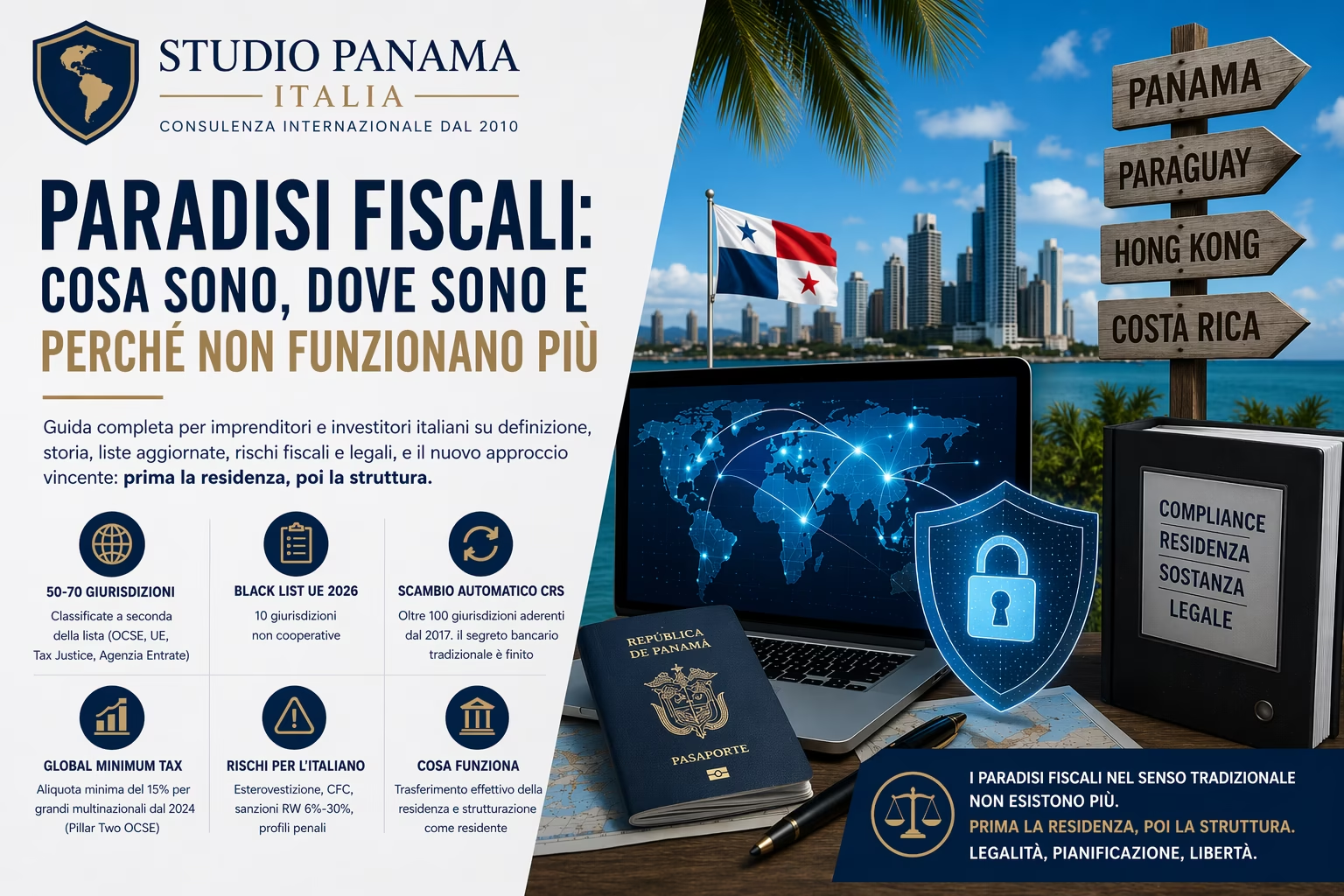
Key points on tax havens
- Definition: Jurisdiction with zero or very low taxation, banking secrecy, and opaque corporate structures for non-residents. Between 50 and 70 jurisdictions classified according to the list (OECD, EU, Tax Justice Network, Italian Revenue Agency).
- Updated EU blacklist: 10 uncooperative jurisdictions (Panama, Russia, Vietnam, Anguilla, Guam, Palau, Vanuatu, American Samoa, Turks and Caicos Islands, U.S. Virgin Islands)
- CRS Automatic Exchange: Over 100 jurisdictions have joined since 2017, including Switzerland, Panama, Singapore, Hong Kong, and the Cayman Islands. Traditional banking secrecy is over.
- Global Minimum Tax: 15% minimum rate for large multinationals from 2024 (OECD Pillar Two)
- Risks for Italians operating in tax havens without actual transfer: foreign investiture (Article 73 of the TUIR), CFC taxation for transparency (Article 167 of the TUIR), RW framework penalties from 6% to 30%, presumption of residence (Article 2, paragraph 2-bis of the TUIR), criminal profiles (Legislative Decree 74/2000)
- What works: Effective transfer of residency to a jurisdiction with territorial taxation (Panama, Paraguay, Costa Rica, Hong Kong) and international structuring as a resident of the new country. Residency first, then the structure.
What are tax havens: definition and characteristics
A tax haven (literally "tax shelter," often mistranslated as "tax heaven") is a state or autonomous territory that offers significantly more favorable tax conditions than the international average, with the aim of attracting capital, companies, and investments from abroad. The definition of a tax haven is not unambiguous: different organizations (OECD, European Union, individual states) use different criteria to identify these jurisdictions.
The OECD, in its seminal 1998 report "Harmful Tax Competition: An Emerging Global Issue," identified four criteria for qualifying as a tax haven: zero or nominal corporate income tax, no requirement for companies to carry out actual economic activity in the territory, poor transparency in the legislative and administrative system, and the absence of mechanisms for exchanging tax information with other countries.
Italian law has historically defined tax havens as those countries where the tax rate is at least 50% lower than that applied in Italy, combined with the absence of information exchange. Italian law distinguishes between different lists depending on the purpose: the list for natural persons (Ministerial Decree of May 4, 1999), the list for CFCs (Article 167 of the Consolidated Law on Income Tax, with the effective tax rate criterion lower than 50% of the Italian rate), and the EU list of non-cooperative jurisdictions.
How tax havens arose: history and evolution
The origins: from antiquity to the 20th century
The concept of tax havens is not a modern invention. In ancient Greece, the island of Delos served as a free port where merchants could trade duty-free. In the Middle Ages, Italian city-states (Genoa, Venice, Florence) competed to attract capital by offering favorable tax conditions to foreign merchants. Flanders in the 16th century and Switzerland from the 17th century onward built their prosperity partly on offering advantageous banking and tax conditions to capital fleeing European wars and revolutions.
Swiss banking secrecy, codified in the Federal Banking Act of 1934, was the cornerstone of the modern concept of tax havens for nearly a century. The law was officially passed to protect the deposits of citizens of neighboring countries from Nazi confiscation, but it quickly became the preferred tool of tax evaders, dictators, and criminal organizations around the world.
The post-war boom: 1945-1980
After World War II, modern tax havens emerged in three main geographic areas. In the Caribbean, the Bahamas (independent since 1973) and the Cayman Islands (a British Overseas Territory) built offshore financial systems, taking advantage of their proximity to the United States, the common law inherited from the United Kingdom, and the absence of direct taxes. Bermuda, another British territory, attracted global insurance and reinsurance companies with its zero-tax regime.
In Europe, Luxembourg developed a system of holding companies (SOPARFI) that allowed dividends and capital gains to be channeled with minimal taxation. Liechtenstein perfected the Anstalt (foundation) as a means of concealing assets. The Channel Islands (Jersey and Guernsey), British Crown dependencies but not part of the United Kingdom, created an ecosystem of offshore trusts and companies based on English common law but with autonomous taxation close to zero.
In Asia, Hong Kong (then a British colony) and Singapore combined strategic geographic location, common law, low taxation, and the absence of capital controls to become the leading offshore financial centers of the Asia-Pacific.
The explosion of the 80s and 90s
The 1980s and 1990s saw an explosion of new tax havens, especially in the Caribbean and the Pacific. The British Virgin Islands (BVI) introduced the International Business Companies Act in 1984, which created the most copied offshore company model in the world: 24-hour incorporation, no taxation, no reporting requirements, bearer shares, and complete anonymity. Nevis followed suit with the Nevis Business Corporation Ordinance of 1984 and the Nevis International Exempt Trust Ordinance of 1994, creating some of the most aggressive asset protection structures in the world. Panama strengthened its system of joint-stock companies and private interest foundations.
During this period, the number of offshore companies registered in tax havens exploded: the BVI alone had over 800,000 active companies, more than the number of people residing in the archipelago. The International Monetary Fund estimated in 2000 that capital in tax havens amounted to approximately $1.7 trillion, a figure later revised by the Tax Justice Network to over $11.5 trillion in 2005.
The international counteroffensive: 2008-2026
The 2008 financial crisis marked a turning point. OECD governments, faced with massive deficits and the need to increase tax revenues, launched a coordinated offensive against tax havens. Key milestones: In 2009, the G20 summit in London declared "the end of the era of banking secrecy" and forced Switzerland and other tax havens to sign information exchange agreements. In 2010, the United States passed FATCA (Foreign Account Tax Compliance Act), requiring all banks worldwide to report US account holder data to the US tax authorities. In 2014, the OECD developed the CRS (Common Reporting Standard) for multilateral automatic exchange of information. In 2016, the Panama Papers exposed 11.5 million documents from the law firm Mossack Fonseca, revealing the offshore structures of heads of state, celebrities, and criminals. In 2017, the CRS became operational in over 100 jurisdictions. In 2024, the OECD Pillar Two framework introduced a global minimum tax rate of 15%.
Each step has reduced the room for maneuver for traditional tax havens. In 2026, the old model, where simply opening a company in a tax haven was enough to escape taxation in your own country, is definitively over.

Where are the tax havens: a map by geographical area
Tax havens aren't limited to tropical islands. The map of offshore financial centers spans every continent and includes both independent microstates and territories dependent on European powers. According to the Tax Justice Network's Financial Secrecy Index, the top ten tax havens by volume of capital managed include unsuspecting jurisdictions such as the United States (Delaware, South Dakota, Nevada), the United Kingdom, the Netherlands, and Switzerland.
Caribbean and Central America
The Caribbean region is home to the highest concentration of tax havens in the world. The Cayman Islands are the fifth-largest global financial center, with over 100,000 registered companies and trillions of dollars in investment funds. The British Virgin Islands (BVI) holds the record for offshore companies (over 400,000 active). The Bahamas combine zero taxation with a sophisticated banking system. Nevis and Saint Kitts offer the most aggressive asset protection structures (asset protection trusts and LLCs with foreign anti-judgment clauses). Belize, Antigua and Barbuda , and the U.S. Virgin Islands complete the Caribbean landscape. All these jurisdictions operate under common law derived from English law, with the exception of Panama (civil law, a legal system derived from the Napoleonic Civil Code with Colombian and Spanish influences).
Panama occupies a unique position: it is the only offshore center in the region to operate under a civil law system, making its structures (joint-stock companies, private interest foundations) more familiar and understandable to Italians, whose legal system shares the same Roman roots. Panama is not a tax haven in the traditional sense: it applies territorial taxation, taxes local income, and cooperates (albeit with limitations) with international authorities.
Europe
Europe is, paradoxically, the continent with the highest concentration of tax havens by value of assets under management. Switzerland, despite having joined the CRS and dismantled traditional banking secrecy, remains the world's leading wealth management hub, with over $2.4 trillion in foreign assets under management. Luxembourg is home to over 3,000 investment funds and offers favorable tax regimes for holding companies and intellectual property companies. Ireland,with a 12.5% corporate tax rate, has attracted the European headquarters of Google, Apple, Facebook, and Microsoft. The Netherlands serves as a transit hub for dividends and royalties thanks to the world's most extensive tax treaty network.
The Channel Islands (Jersey, Guernsey), theIsle of Man , and Gibraltar operate as British Crown dependencies with fiscal autonomy and common law systems. Liechtenstein, Monaco , and Andorra complete the European tax haven map. Cyprus and Malta, despite being EU members, offer favorable tax regimes for holding companies (non-domiciled regime in Malta, IP box in Cyprus).
Asia-Pacific
Hong Kong and Singapore are Asia's two major offshore centers, both based on British common law, with either territorial taxation (Hong Kong) or low and competitive taxation (Singapore, 17% corporate tax but with significant exemptions), and world-class banking systems. Labuan (Malaysia) offers a separate offshore regime with a 3% tax rate. The Marshall Islands and Samoa in the Pacific Ocean host offshore shipping and corporate registries. Brunei is a de facto tax haven with zero personal income tax.
Middle East
The United Arab Emirates (Dubai, Abu Dhabi, Ras Al Khaimah) has become one of the most sought-after offshore destinations over the past 15 years, with zero-tax free zones, no personal taxes, and a modern financial ecosystem. However, the introduction of a 9% corporate tax in 2023 has weakened its competitive advantage over jurisdictions such as Panama. Bahrain offers similar conditions with a regulated financial market. Qatar has special economic zones with reduced taxes.
Indian Ocean and Africa
The Seychelles and Mauritius are the region's major offshore hubs, both with fast and cost-effective offshore company systems. Mauritius also serves as a hub for investment in India thanks to the India-Mauritius tax treaty. In Africa, South Africa has a sophisticated financial center but is not a tax haven, while Djibouti and Liberia host offshore shipping registries.
Common law vs. civil law: why the distinction is crucial for offshore structures
The majority of tax havens operate under common law , derived from English law and based on case law. The Cayman Islands, the British Virgin Islands, Nevis, the Bahamas, Jersey, Hong Kong, and Singapore are all common law. This legal system has produced instruments such as the trust (unknown to civil law), the LLC (Limited Liability Company), the IBC (International Business Company), and fiduciary structures with a level of flexibility and protection that civil law traditionally does not offer.
Civil law countries (continental European law, derived from Roman law and the Code Napoleon) use different instruments: joint-stock companies, limited liability companies, and foundations. Trusts do not exist in traditional civil law, although some civil law jurisdictions have introduced them through legislation (such as San Marino with the 2005 Trust Act, or Panama with the 1984 Trust Act, which was incorporated into the civil law system).
For an Italian operating under a civil law system, this distinction has significant practical consequences. Common law instruments (trusts, LLCs) may not be recognized or may be classified differently under Italian law. A US LLC, for example, may be considered transparent or opaque for Italian tax purposes depending on its structure. A common law trust is subject to specific tax monitoring rules (RW framework) and may be classified as "interposed" if it does not meet the effectiveness requirements set forth by Italian case law.
Tax haven lists: who compiles them and what they mean
There is no single, universal list of tax havens. Different organizations compile different lists, with different criteria and different consequences for taxpayers. The overlap between the lists is partial: a country may be on the EU blacklist but not on the Italian one, or be considered a tax haven by the Tax Justice Network but not by the OECD.
European Union Blacklist (Ecofin)
The EU list of non-cooperative jurisdictions for tax purposes is updated twice a year by the Economic and Financial Affairs Council (Ecofin). It is based on three criteria: tax transparency, fair taxation, and compliance with the OECD's Base Erosion and Profit Shifting (BEPS) standards. As of the February 2026 update, the EU blacklist (Annex I) includes ten jurisdictions: American Samoa, Anguilla, Guam, Palau, Panama, the Russian Federation, the Turks and Caicos Islands, the US Virgin Islands, Vanuatu, and Vietnam. Annex II (grey list, jurisdictions under monitoring) includes over 40 countries, including the Seychelles, the British Virgin Islands, Belize, Turkey, and Antigua and Barbuda. The consequences of inclusion in the EU blacklist are primarily political and reputational: they do not automatically result in penalties for Member State taxpayers, but may trigger defensive measures at the national level.
Italian blacklist (Revenue Agency)
Italy maintains its own system of lists, with direct and concrete tax consequences for Italian taxpayers. The main list is that of the Ministerial Decree of May 4, 1999, used to trigger the legal presumption of residency (Article 2, paragraph 2-bis of the Consolidated Law on Income Tax): if an Italian citizen removes himself from the registry and moves to a country on this list, the burden of proof is reversed and it is up to the taxpayer to demonstrate that he has actually moved. The list historically includes countries such as Monaco, Liechtenstein, the Channel Islands, the British Virgin Islands, the Cayman Islands, the Bahamas, Bermuda, the Seychelles, and dozens of other jurisdictions. Panama is included in the Ministerial Decree of May 4, 1999, meaning that the reinforced presumption applies to Italians moving to Panama. However, the burden of proof can be overcome with adequate documentation (lease agreement, utilities, cedula, operational bank account, business activity, AIRE registration).
The CFC regulation (Article 167 of the Consolidated Income Tax Act) uses a different, dynamic criterion: a jurisdiction is considered to have a preferential tax regime if the effective tax rate applied to the subsidiary is less than 50% of the effective tax rate that would have been applied in Italy. This criterion is not based on a fixed list but on a case-by-case calculation.
OECD and FATF
The OECD maintains a peer review system through the Global Forum on Transparency and Exchange of Information for Tax Purposes, which assesses jurisdictions' compliance with information exchange standards. Panama has been promoted to "Largely Compliant" by the Global Forum, meaning it substantially meets OECD standards, although it remains on the EU blacklist for reasons related to the European assessment (different from the OECD). The FATF (Financial Action Task Force), or FATF in English, assesses countries' compliance with anti-money laundering standards. The FATF's greylist has direct consequences for banking operations: correspondent banks apply enhanced due diligence procedures to transfers to and from greylisted countries, causing delays and operational friction.
Financial Secrecy Index (Tax Justice Network)
The Tax Justice Network, an independent organization, publishes the Financial Secrecy Index, a ranking that measures the degree of financial opacity of each jurisdiction weighted by the volume of financial services offered. The 2022 ranking (latest available) places the United States (1st), Switzerland (2nd), Singapore (3rd), Hong Kong (4th), and Luxembourg (5th) at the top. Traditional tax havens such as the Cayman Islands (7th) and the British Virgin Islands (15th) rank lower than large economies that offer opacity on a much larger scale. This index dispels the myth that tax havens are merely small tropical islands: the greatest facilitators of financial opacity are industrialized countries.
What does it mean in practice to be included in a blacklist?
Inclusion on a blacklist has different consequences depending on the list and the taxpayer's country. For an Italian tax resident, the main consequences are: reversal of the burden of proof for transfer of residence (Ministerial Decree of May 4, 1999), increased penalties for failure to file a tax return in the RW section (from 6% to 30% instead of 3% to 15%), application of the CFC rules with the presumption of preferential tax status, and increased likelihood of inspections and audits by the Revenue Agency. Inclusion does not mean that operating in that jurisdiction is illegal: it simply means that the transaction is subject to a significantly heightened level of scrutiny and reporting requirements.
Why the old tax haven model no longer works
The traditional tax haven model was based on four pillars: banking secrecy, corporate anonymity, the lack of information exchange between states, and the inability of the tax authorities in the country of origin to access the taxpayer's assets and income data. Within a decade, all four pillars have been demolished.
CRS: the automatic exchange that killed banking secrecy
The Common Reporting Standard (CRS), developed by the OECD and operational since 2017, requires over 100 jurisdictions (including Switzerland, Panama, Singapore, Hong Kong, the Cayman Islands, BVI, Liechtenstein, Luxembourg, and virtually all relevant tax havens) to automatically and annually exchange information on financial accounts held by non-residents. Every bank, insurance company, fund, and broker is required to identify the beneficial owners of the accounts, determine their tax residency, and automatically transmit the data (balances, interest, dividends, capital gains, gross income) to the local tax authority, which in turn transmits it to the tax authority of the account holder's country of residence. If an Italian opens an account in a CRS-compliant tax haven, the Italian Revenue Agency receives the data automatically, without having to request it. Bank secrecy in the traditional sense is over.
End of corporate anonymity
Bearer shares have been abolished or immobilized in almost all tax havens: Panama (Law 47 of 2013, mandatory custody with an authorized agent), the British Virgin Islands (eliminated since 2006), the Seychelles (abolished), and Switzerland (abolished since 2015). Beneficial ownership registers, required by European anti-money laundering directives (IV and V AML Directives) and the FATF recommendations, require disclosure of the identity of the owners behind each corporate structure. Trusts must declare their beneficiaries. Foundations must declare their founders and beneficiaries. The corporate anonymity that characterized the old offshore system is no longer available.
DAC6: Reporting Obligations for Intermediaries and Consultants
The European Directive DAC6 (2018/822), effective since 2020, requires tax intermediaries, lawyers, accountants, and advisors to report to the tax authorities any cross-border arrangements with hallmarks of aggressive tax planning. This means that any offshore structure set up by a European intermediary for a European client is automatically reported to the tax authorities before it even takes effect.
Global Minimum Tax (OECD Pillar Two)
Starting in 2024, the Pillar Two mandates a minimum effective tax rate of 15% for multinational groups with consolidated revenues exceeding €750 million. If a group subsidiary pays a rate lower than 15% in a tax haven, the difference is recovered by the parent company's country through a top-up tax. This is a historic principle: for the first time, the international community has established that all profits must be taxed at a minimum of 15%, regardless of the jurisdiction in which they are accounted for.
The concrete risks for Italian taxpayers operating in tax havens
The consequences for Italian tax residents who operate with structures in tax havens without first resolving their residency status are not hypothetical. The Revenue Agency has intensified its controls, the Supreme Court's case law has consolidated, and the penalties are severe.
Foreign tax residency (Article 73, paragraph 3, TUIR). If the Revenue Agency determines that a foreign company is effectively managed and administered from Italy (because the owner resides in Italy, strategic decisions are made in Italy, and the main customers are Italian), the company is considered tax resident in Italy. Consequences: IRES (corporate income tax) at 24% on all worldwide income, IRAP (regional business tax), penalties ranging from 120% to 240% of the evaded tax, late payment interest, and criminal penalties for incorrect or omitted tax returns (Articles 4 and 5 of Legislative Decree 74/2000).
CFC taxation by transparency (Article 167 of the Consolidated Income Tax Act). Income generated by subsidiaries resident in jurisdictions with privileged tax regimes (effective tax rate less than 50% of the Italian rate) is taxed by transparency in the hands of the Italian shareholder, unless proof of actual economic activity is provided. This proof is impossible for those who do not actually reside abroad.
Tax monitoring and RW form (Legislative Decree 167/1990). Any financial or patrimonial assets held abroad must be declared in the RW form. Failure to declare carries penalties ranging from 3% to 15% of the value (from 6% to 30% if in blacklisted countries), with the presumption that the undeclared amounts are untaxed income.
Presumption of residence (Article 2, paragraph 2-bis, TUIR). For those moving to a country on the Italian blacklist (Ministerial Decree of May 4, 1999), the burden of proof is reversed: it is up to the taxpayer to demonstrate that they have actually moved. Case law evaluates the center of vital interests comprehensively: family, property, economic, and social ties.
What works today: residence first and foremost
Everything described so far leads to an unequivocal conclusion: today, the ability to operate with structures in tax havens without first establishing registered residence, domicile, and tax residency has disappeared from anyone's reach. Anyone who decides to utilize offshore services in 2026 will opt to do so using a legal basis based on the convenience and legality of operating from a jurisdiction with territorial taxation as an actual resident, through offshore structures around the world.
The course is divided into four phases, each preparatory to the next:
Phase 1: Termination of residency status. The first step is to actually transfer your residence to a jurisdiction with territorial taxation. "Actually" means: moving your center of vital interests, continuous and demonstrable physical presence, AIRE registration, cancellation from the Italian registry, and severing ties that could give rise to a dispute (utilities, contracts, assignments, bank domiciles, professional registrations in Italy). The transfer must be substantial and documentable in every respect.
Phase 2: Consolidation of civil domicile. Domicile (Article 43 of the Civil Code) is the place where a person has established the principal place of business and interests. The reform of Legislative Decree 209/2023 has strengthened the role of "physical presence" and domicile as determining criteria for tax residency. For those relocating: a lease or property ownership agreement in the new country, a local operating bank account, and professional and personal relationships in the area.
Phase 3: International structuring from the new country of residence. Only after establishing effective resident status can the structuring proceed: operating companies in the country of residence, offshore vehicles in third jurisdictions (Nevis for asset protection, Delaware for US operations, UK LLPs for specific business models, Panamanian foundations for estate planning), and multi-jurisdictional bank accounts. Each structure serves a genuine economic purpose, not a concealment strategy.
Phase 4: ongoing compliance. Renewal of resident agents, accounting, compliance with reporting requirements in the jurisdiction of residence, documentation of flows. Maintenance is not an additional cost: it ensures that the structure remains sustainable over time.
Panama: Not a tax haven, but the most complete operating platform
Panama appears on the EU blacklist and the Italian list of the Ministerial Decree of May 4, 1999. This appears contradictory to those who choose it as a base for operations. The explanation lies in a fundamental distinction: the EU list evaluates cooperation in the exchange of information, not the legality of the tax system. The 1999 Italian list is a historical, outdated list, which does not reflect Panama's current position (OECD White List since 2023, "Largely Compliant" at the Global Forum).
Panama's tax system is territorially based: it taxes only income generated within Panamanian territory. Foreign-source income is exempt from taxation. This principle is codified in the Fiscal Code; it is not a special regime, a concession, or a loophole: it is the standard structure of the tax system. Paraguay, Costa Rica, Guatemala, and Hong Kong adopt the same principle.
Panama's advantage over other territorial tax jurisdictions is its unique combination of: full dollarization (no currency risk), an international banking system with over 70 banks, civil law (family legal structures for Italians: SA, SRL, private interest foundations), permanent residency accessible to Italians through the Italy-Panama Friendship Treaty (Law 13 of 1963), a path to citizenship and a second passport after 5 years, a strategic geographic location (hub of the Americas, Panama Canal, UTC-5 time zone), and a double taxation agreement with Italy (Law 208/2016).
For a Panamanian resident operating internationally, Panama isn't a tax haven: it's a platform from which to legally and transparently manage an international corporate and wealth structure. The difference between these two concepts is the difference between the old (finished) offshore and modern (legal, structured, defensible) international tax planning.
Studio Panama Italia's approach
Since 2010, Studio Panama Italia has been assisting Italian citizens choosing Panama as their base for international planning. Our work doesn't begin with the sale of an offshore company, but with a comprehensive analysis of the client's status: registered residence, assets, sources of income, family composition, life and professional goals. Only after this analysis can we determine whether a move to Panama is appropriate for the specific case and what structures are needed.
Services include: advice on permanent residency in Panama through the Italy-Panama Treaty, incorporation and management of Panamanian companies (SA and SRL), private interest foundations for asset protection and succession planning, structuring of offshore vehicles in third-party jurisdictions with integrated compliance, opening of bank accounts in Panama, and ongoing assistance with the maintenance of the structures.
Want to know if Panama is the right choice for you?
Contact us for an initial assessment. We'll analyze your current situation and suggest the best course of action for you.
Write to us on WhatsAppFrequently Asked Questions about Tax Havens
Are tax havens illegal?
No. Operating in low-tax jurisdictions is not prohibited. It is illegal to do so in violation of the reporting requirements of your country of tax residence. An Italian tax resident who owns structures in tax havens without declaring them is committing tax crimes. A Panamanian resident who operates international structures in compliance with Panamanian regulations is not violating any law.
Can I open an offshore company while remaining a resident in Italy?
Yes, but the tax consequences almost always render the transaction unprofitable. A foreign company controlled by an Italian resident is subject to CFC rules (Article 167 of the TUIR) if the effective tax rate is less than 50% of the Italian rate. Income is taxed transparently in Italy. The company must be declared in the RW section. Starting a company in a tax haven without transferring residency does not generate any tax savings and creates additional obligations and risks.
Is Panama a tax haven?
Panama is on the EU blacklist and in the Italian Ministerial Decree of May 4, 1999, but its territorial tax system is not a favorable regime: it is the standard Panamanian tax structure. Panama has been on the OECD White List since 2023, has a double taxation agreement with Italy (Law 208/2016), and the Global Forum rates it as "Largely Compliant." Its inclusion on the EU blacklist concerns aspects of information cooperation, not the legitimacy of the tax regime.
What does territorial taxation mean?
A territorial tax system taxes only income generated domestically. Foreign-source income is not subject to taxation. Panama, Paraguay, Costa Rica, Guatemala, and Hong Kong adopt this principle. For a Panamanian resident earning income from international activities, the local tax burden is limited to Panamanian-source income only.
What is the difference between common law and civil law for offshore structures?
Most tax havens operate under common law (Anglo-Saxon law), which has produced instruments such as trusts, LLCs, and IBCs. Italy operates under civil law (Roman-Germanic law), which can create problems in qualifying foreign structures. Panama, the only major offshore center based on civil law, offers structures (SAs, SRLs, foundations) that are recognized and comprehensible under Italian law.
Does banking secrecy still exist in tax havens?
Not in the traditional form. With the CRS (operational since 2017), over 100 jurisdictions, including nearly all tax havens, automatically exchange financial account information. Switzerland joined in 2018, Panama in 2018, and the Cayman Islands in 2017. The Italian Revenue Agency automatically receives data on accounts held by Italian residents in participating countries.
What happens if I move to a tax haven and Italy objects?
If the tax haven is listed in the Ministerial Decree of May 4, 1999, the relative legal presumption of residence applies (Article 2, paragraph 2-bis of the Consolidated Income Tax Code): the burden of proof is reversed and the taxpayer must demonstrate the actual transfer. Therefore, the transfer process must be rigorously managed, documenting the center of vital interests, physical presence, local contracts, AIRE registration, and deregistration from the Italian registry.
What is the difference between someone selling offshore packages and a serious consultant?
Those who sell standardized offshore packages (a BVI company for €999) ignore the client's personal status: they sell the structure without addressing the underlying requirement (residency). A reputable consultant begins with an analysis of the residency status, builds a comprehensive process (transfer, structuring, ongoing compliance), and doesn't promise "zero taxes" without the actual transfer of residency.
How much money is in tax havens in 2026?
According to the most recent estimates (Oxfam, Tax Justice Network), over $3.55 trillion is held in undeclared offshore accounts. The richest 0.1% of the world's wealth is held in tax havens more than the entire poorest half of humanity. Italy loses approximately €10 billion in tax revenue each year due to tax evasion through offshore financial centers, according to the CGIA (Italian Trade Union Association) of Mestre.
Will tax havens disappear?
The traditional model (bank secrecy, anonymity, zero information exchange) is already over. Low-tax jurisdictions will continue to exist because they meet a legitimate demand for international tax competition, but they will operate in an environment of increasing transparency. The future is not the end of tax havens, but the end of opacity: those who wish to benefit from them will have to do so transparently, with real residence and compliant structures.
Learn how to obtain residency in Panama , register with AIRE , obtain a tax residency certificate , avoid foreign investment , manage the exit tax , and complete the RW Form . For asset protection structures and Private Interest Foundations , consult the dedicated guides.
