

Defending Tax Residency Abroad: Verification, Evidence, and Defense for Those Living in Panama
Transferring tax residency to Panama or another country doesn't end the matter with the Italian tax authorities: it opens it. An Italian citizen removed from the registry can receive a tax assessment even years after the move, and at that point, only one thing matters: whether they can prove that their foreign residency is genuine. This guide explains, in a practical manner and without unrealistic promises, how to defend tax residency abroad: the rules introduced by the 2024 reform, why AIRE registration alone doesn't protect, what evidence holds up before the Revenue Agency, and what causes the entire case to collapse. Defending tax residency involves two fronts that must be considered together: the Italian one and that of the destination country.
One point must be made immediately: defending tax residency doesn't mean hiding or faking a transfer, but being able to demonstrate a transfer that has actually occurred. Tax residency is a de facto status, not a stamp: it is acquired when real life, economic interests, and personal ties have actually moved. For this reason, the page devotes equal space to rules and evidence, and includes a section on the mistakes that undermine even the best-intentioned transfer.
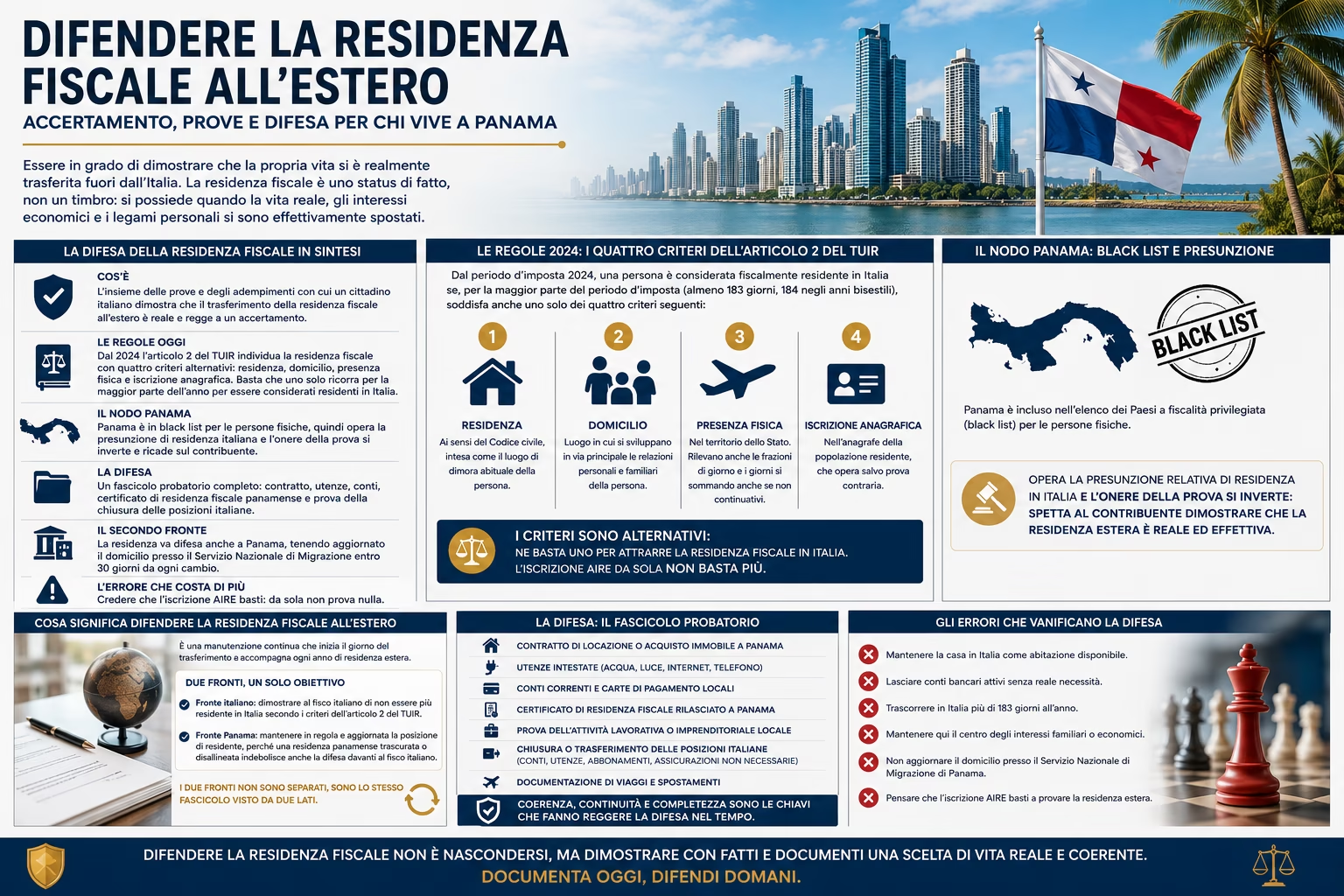
The defense of tax residency in brief
- What it is: The set of evidence and procedures with which an Italian citizen demonstrates that the transfer of tax residence abroad is genuine and can withstand an audit.
- The rules today: starting in 2024, Article 2 of the TUIR (Consolidated Income Tax Code) defines tax residency using four alternative criteria: residence, domicile, physical presence, and registration in the registry office; only one of these criteria is required for most of the year to be considered resident in Italy.
- The Panama issue: Panama is blacklisted for individuals, so the presumption of Italian tax residency applies and the burden of proof is reversed and falls on the taxpayer.
- The defense: a complete supporting file, including the contract, utilities, accounts, Panamanian tax residency certificate, and proof of closure of the Italian accounts.
- Second, residency must be protected in Panama as well, by updating the address with the National Migration Service within 30 days of each change.
- The most costly mistake: believing that AIRE registration is enough; by itself, it proves nothing.
What does it mean to protect tax residency abroad?
Defending your tax residency means being able, at any time, to prove with documents that your life has actually moved outside of Italy. This isn't something that happens only when an assessment arrives: it's an ongoing process that begins on the day of the transfer and continues throughout each year of foreign residency. The Revenue Agency can challenge your tax residency for a tax period within the standard time limits, and when it does so, the taxpayer must have the necessary documentation to prove the transfer.
The defense is based on two distinct fronts, which many overlook. The first is the Italian front: demonstrating to the Italian tax authorities that you are no longer resident in Italy according to the criteria of Article 2 of the TUIR. The second is the front of the destination country, Panama in our case: maintaining your residency status in order and up to date, because a neglected or misaligned Panamanian residency also weakens your defense before the Italian tax authorities. The two fronts are not separate; they are the same file seen from two sides.
The 2024 rules: the four criteria of Article 2 of the TUIR
To protect tax residency, you must first understand the rules used by the Italian tax authorities to define it. This has recently changed. Legislative Decree No. 209 of December 27, 2023, implementing the international tax reform, rewrote Article 2, paragraph 2, of the TUIR, effective January 1, 2024. The Revenue Agency then provided operating instructions with Circular No. 20/E of November 4, 2024.
Residence, domicile, physical presence and registration in the registry office
Starting from the 2024 tax period, a person is considered tax resident in Italy if, for the majority of the tax period, i.e. for at least 183 days per year or 184 in leap years, he or she satisfies even just one of the following four criteria:
- Residence pursuant to the Civil Code, understood as the person's habitual place of residence.
- The domicile, which the reform defines in a new way as the place where a person's personal and family relationships primarily develop.
- Physical presence in the territory of the State, a criterion introduced by the reform; fractions of a day are also relevant, and days are added together even if they are not continuous.
- Registration in the resident population registry, which however now applies unless proven otherwise.
The criteria are alternative: one is enough to secure tax residency in Italy. This is the first thing to understand for those who want to defend their tax residency, because a transfer that meets one criterion but leaves another unfulfilled is unsustainable.
Why AIRE registration alone is no longer enough
The 2024 reform has changed the weight of registry data. In the previous version, registration in the registry of the resident population was the predominant formal criterion; today, it is valid unless proven otherwise. The practical consequence is clear and must be stated clearly: deregistration from the registry and registration in AIRE, the Registry of Italians Resident Abroad, is a necessary but entirely insufficient requirement to prove foreign tax residency. The Supreme Court of Cassation's case law has affirmed this for years, and the reform has made it even more evident. A taxpayer registered in AIRE who maintains his or her domicile in Italy, understood as the center of his or her relations, or who is physically present there for the majority of the year, remains tax resident in Italy. The defense of tax residency begins where the registry process ends, not ends there. For detailed operational details, it is helpful to read the guide onAIRE registration.
Presumption of tax residency for those moving to Panama
Those who move their tax residency to Panama face a further challenge compared to those who move to a regular country. This challenge needs to be addressed before leaving, not afterward.
Panama blacklisted and burden of proof reversed
Panama is included in the list of states with preferential tax regimes for individuals, identified by the Ministerial Decree of May 4, 1999. This list is the basis for paragraph 2-bis of Article 2 of the TUIR, a provision that the 2023 reform did not affect and remains fully in force: Italian citizens removed from the registry and transferred to a state with preferential tax regimes are considered resident in Italy, unless proven otherwise.
The consequence is a reversal of the burden of proof. In a standard transfer, the Revenue Agency must demonstrate that tax residency has remained in Italy. For those moving to Panama, the situation is reversed: Italian tax residency is presumed, and the taxpayer must prove otherwise. Defending tax residency, in this context, means building evidence from day one that the tax authorities are not required to seek and which is your responsibility to provide. Those who undertake a transfer without considering this reversal establish a fragile position, which collapses at the first inspection. On the corporate side, the same mechanism applies to thetransfer of foreign companies effectively managed from Italy.
The evidentiary file: the evidence that stands up to the investigation
The most effective tool for defending tax residency is the evidentiary file: an organized and coherent collection of documents that, when read together, demonstrate that the person's life has moved. The file isn't improvised upon the tax assessment; it's built from the move onward and updated annually.
Documentary evidence of the transfer
Case law requires positive and concrete proof of the transfer, not a series of declarations. The elements that constitute a solid evidentiary record for those who have moved their tax residence to Panama are:
- A lease or title deed for a home in Panama, with a term and rent consistent with permanent residence.
- Active and registered utilities, i.e. electricity, water, internet and telephone, with real consumption that demonstrates an effective presence.
- Local bank transactions, i.e. a Panamanian account funded and used for daily expenses.
- Panamanian Tax Residency Certificate, issued by the Panamanian Tax Authority.
- Documentation of local life, such as membership cards, memberships, season tickets, any school enrollment of children and service contracts.
- Proof of closure of Italian positions, i.e. cancellation of the registry, AIRE registration, closure of the VAT number and correct resetting of the RW table.
- Travel documentation, i.e. travel documents and stamps that reconstruct where the person spent the year.
A file is strong when the documents corroborate each other and tell the same story. It is weak when one element contradicts the other, such as a Panamanian lease accompanied by active Italian utilities. The internal consistency of the file is as important as the individual documents.
The center of vital interests according to the Court of Cassation
The crux of almost every tax residency assessment is the center of a person's vital interests. The Court of Cassation has clarified that this is the place where economic and patrimonial interests are concentrated, and that this place must be recognizable to third parties, not merely declared. With ruling no. 19843 of 2024, concerning a taxpayer formally resident in the Principality of Monaco, the Court reiterated that, for periods prior to 2024, the decisive criterion is the center of vital interests, and that economic interests can even prevail over family ties.
For those moving to a low-tax country like Panama, the guidance is even more stringent. To rebut the presumption of paragraph 2-bis, the taxpayer must prove that the center of their vital interests is effectively abroad; and in this specific context, the presence of emotional and family relationships in Italy has been deemed by case law to be non-determining in favor of the taxpayer. Defending tax residency therefore means clearly documenting that business, income, and economic life are habitually conducted in Panama.
Defending residency in Panama: Migration maintenance
The second defense is often overlooked because it seems like a simple local formality. In reality, proper maintenance of a Panamanian residence provides part of the evidence needed to defend tax residency before the Italian tax authorities. A legal and traceable resident in Panama has a stronger case; a resident with a neglected immigration record has a weaker case.
The obligation to update the domicile at Migración
Anyone who holds a residence in Panama, whether temporary or permanent, has a specific legal obligation: to notify the National Migration Service of any changes in their registered information, particularly any change of address. This obligation is established by Articles 37 and 87 of Legislative Decree No. 3 of February 22, 2008, and is regulated by Executive Decree No. 320 of August 8, 2008. The deadline for notification is 30 calendar days from the change of address.
The National Migration Service has enabled the process of changing and updating residency online, through the portal enif.migracion.gob.pa. The process no longer requires a visit to the office and consists of four steps:
- User registration. Access the Migración en Línea area and create an account by entering your information; the account is activated via the link received via email.
- File selection. In the solicitudes area, select the "change of residence" option and start a new register, indicating whether the file is being handled for you or on behalf of a third party.
- Filling out the form and submitting the required documents. Complete the form and attach the required documentation, including the current rental agreement, a copy of the owner's ID, a recent utility bill, and the immigration card. Some documents must be notarized.
- Submission and verification. Once the form is submitted, it is verified by the National Migration Service.
The update can be completed directly by the resident or through a lawyer representing them. Since this is a requirement subject to procedural updates, the procedures and requirements must be verified at the time of application.
The consequences of non-compliance are progressive and serious. The first offense carries a fine of 100 balboas, equivalent to $100. Repeated violations may result in the cancellation of immigration status. A third violation may result in deportation. The National Migration Service announced the strict enforcement of these sanctions in a statement dated July 25, 2025. For a complete overview of Panamanian residency, please refer to the six-step residency procedure in Panama.
Why an updated Panamanian domicile is also tax proof
There is a fiscal reason, in addition to immigration, for keeping your Panamanian address up-to-date. Your address registered with Migración is your legal address for official notifications, and above all, it is one of the elements that prove a real and continuous presence in Panama. An up-to-date Panamanian address, consistent with the rental agreement, utilities, and tax residency certificate, makes your evidentiary file solid and credible. An outdated address, or one registered as empty because no contract was filed at the time of the application, introduces a flaw: the official Panamanian registry data doesn't match the rest of the documentation, and this inconsistency is precisely what an investigation seeks. Keeping your address up-to-date isn't a matter of local bureaucracy; it's maintaining the evidence needed to establish your tax residency.
Tie-breaker and Double Taxation Convention
When two countries claim tax residency for the same individual, double taxation treaties based on the OECD Model resolve the conflict with tie-breaker rules, scaled criteria that identify a single country of tax residency. The permanent residence, the center of vital interests, habitual residence, and finally nationality are all considered, in order. Tie-breaker rules are an important defense tool, but they have two limitations. First, they do not prevent the initiation of an assessment; they intervene to resolve it. Second, if the Italian tax authorities demonstrate that the center of vital interests has remained in Italy, the convention criterion confirms Italian residency rather than disproving it. The Convention protects those with a genuine and documented transfer; it does not replace evidence, but rather orders it. The basic rule also applies here: the defense of tax residency is built on facts, and the law interprets them.
Defending Your Tax Residency in Panama: Let's Talk
We have been operating from Panama City since 2010, license no. 14465. If you have transferred or are about to transfer your tax residency to Panama, we can analyze your position, clearly inform you of its solidity in the event of a potential audit, and build the supporting documentation with you, from Panamanian documentation to coordination of Italian compliance requirements. If your position has any weaknesses, we will inform you immediately and explain how to strengthen it.
✉️ Write to us on WhatsAppFrequently Asked Questions about Tax Residency Protection
Is AIRE registration sufficient to prove foreign tax residency?
No. Registration with AIRE is a necessary but not sufficient condition. Following the 2024 reform, personal data is valid unless proven otherwise, and the Court of Cassation has long held that anyone registered with AIRE but maintaining their domicile or primary physical presence in Italy remains a tax resident in Italy. Defending tax residency requires a complete supporting documentation, not just the registry office.
Why does moving to Panama involve a higher burden of proof?
Because Panama is included in the list of states with preferential tax regimes for individuals, established by the Ministerial Decree of May 4, 1999. Pursuant to Article 2, paragraph 2-bis of the TUIR, anyone moving to a state on that list is presumed to be resident in Italy unless proven otherwise. The burden of proof is reversed: it is not the tax authorities that must demonstrate Italian tax residency; it is the taxpayer who must prove foreign tax residency.
What documents make up a solid evidentiary record?
Rental agreement or property title in Panama, active and registered utilities, Panamanian bank account transactions, Panamanian tax residency certificate, local residence documents, proof of closure of Italian accounts, and travel documentation. The strength of the file depends on internal consistency: the documents must all tell the same story, without contradictory elements.
What does center of vital interests mean and why is it crucial?
It is the place where a person's economic and financial interests are concentrated, and according to the Supreme Court, it must be recognizable to third parties, not just declared. It is the cornerstone of almost every tax residency assessment: if the tax authorities demonstrate that the business and principal income remain in Italy, foreign tax residency is disavowed. For those moving to Panama, overcoming the presumption requires proving that the center of vital interests is actually in the foreign country.
Do I need to update my address at Migración in Panama, and how do I do it?
Yes. Every resident, whether temporary or permanent, must notify the National Migration Service of any change of address within 30 days, pursuant to Articles 37 and 87 of Legislative Decree No. 3 of 2008. The National Migration Service has enabled online change of residence procedures. These can be completed through the enif.migracion.gob.pa portal by registering an account, selecting the change of residence application, and attaching the required documents. Failure to do so can result in a $100 fine for the first offense, possible cancellation of status for the second offense, and possible deportation for the third offense.
Do double taxation agreements protect me from an audit?
The Conventions resolve dual residency conflicts through tie-breaker rules, but they do not prevent the initiation of an assessment. They intervene to resolve it, not to avoid it. Furthermore, if the tax authorities demonstrate that the center of vital interests remains in Italy, the conventional criterion ultimately confirms Italian tax residency. The Convention mandates the evidence, not replaces it.
Can I maintain tax residency if I still have a home in Italy?
Owning a property in Italy alone does not in itself establish Italian tax residency, but a property held for rent with active utilities registered in the tax authorities' name is evidence the tax authorities can use against the taxpayer. The position is stronger if the property is rented to third parties or otherwise unused, and if the rest of the documentation clearly demonstrates that the taxpayer's real life takes place in Panama. This is a point to be evaluated on a case-by-case basis.
When is it best to start building tax residency defense?
From the first day of the move, not when the tax assessment arrives. The evidentiary file is built and updated year by year, gathering documents as life abroad unfolds. Reconstructing evidence retrospectively is difficult and results in a weak file. Defending tax residency is an ongoing process, not an emergency intervention.
Learn more about how to transfer residency to Panama in six steps, register with AIRE, avoid theforeign investment of a foreign company, correctly complete the RW Form , and manage theexit tax on qualified holdings. Creators and digital freelancers can also find a useful guide on residency in Panama and LLCs for creators and influencers.
