

Panama vs. Dubai: A Complete Comparison for Italians Looking to Transfer Their Tax Residency
Is it better to move to Panama or Dubai to pay lower taxes? This is the question every Italian pondering a zero-tax residence abroad asks. The similarity between the two jurisdictions ends with the zero personal income tax rate. Entry costs, corporate tax, residency requirements, the path to a second passport, the cost of living, and, in 2026, geopolitical risk are variables that differ markedly and that ultimately determine the choice between Panama and Dubai.
This guide compares Panama and Dubai based on every relevant variable for an Italian planning a relocation: entrepreneur, freelancer, crypto holder, retiree, HNWI. Data updated to April 2026, Italian regulatory references (TUIR reformed by Legislative Decree 209/2023, Revenue Agency Circular No. 20/E of November 4, 2024, Ministerial Decree of May 4, 1999), and a numerical case study. It assumes that the reader is seriously considering the options and wants a technical answer, not a brochure.
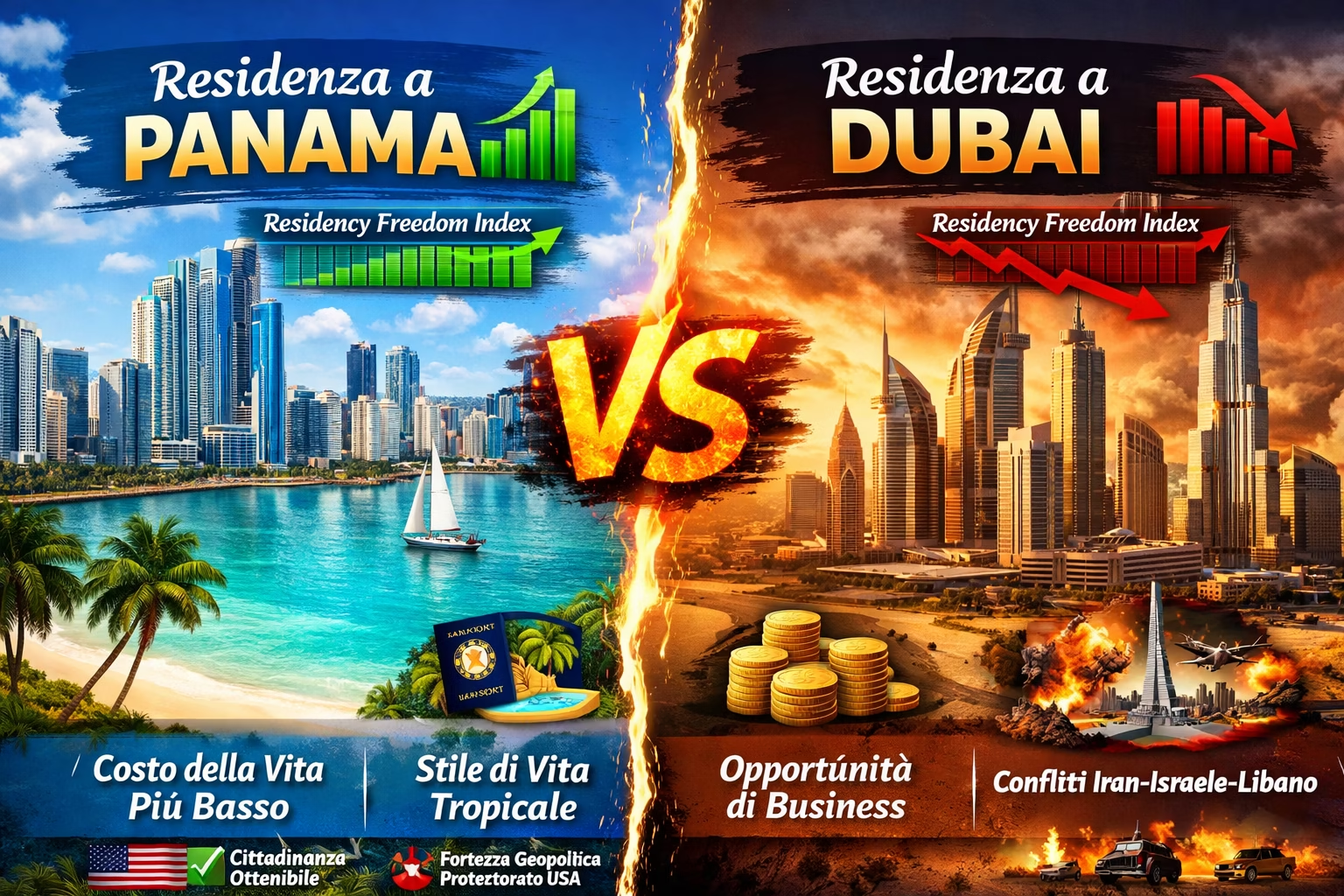
Quick comparison Panama vs Dubai
- Personal taxation: Panama 0% on foreign income (territorial taxation). Dubai 0% on all personal income.
- Corporate tax: Panama 0% on foreign-source income. Dubai 9% above AED 375,000 (~€102,000), 0% in Free Zones only on qualifying income.
- Cost of obtaining residency: Panama ~5,000-8,000 USD via Italy-Panama Treaty 1963. Dubai 15,000-25,000 USD (Free Zone company + visa) or real estate investment of AED 2 million for the Golden Visa.
- Required physical residence: Panama, no requirement to maintain status. Dubai, 183 days/year for the international TRC recognized by Italy.
- Italian Black List Status Ministerial Decree of May 4, 1999: both countries are included. In the event of an assessment, the burden of proof is reversed to the taxpayer (Article 2, paragraph 2-bis of the Consolidated Income Tax Code). The reform of Legislative Decree 209/2023 has not changed this presumption.
- Cost of living (single, including rent): Panama City ~1,500-2,500 USD/month. Dubai ~3,500-6,000 USD/month.
- Citizenship path: Panama yes, after 5 years (passport with visa-free access to 140+ countries, dual citizenship permitted). Dubai no, except in exceptional cases.
- Geopolitical context 2026: Panama no conflict, no armed forces since 1990. UAE under missile and drone attacks from Iran from February 28, 2026, with disruption to flights, insurance and business continuity.
In short: the choice for your profile
Before going into detail, here's a brief, profile-by-profile answer on where to move. Each entry links to the detailed section below.
- Freelancer/digital nomad, income €50,000-150,000: Panama. Lower entry costs, no physical residency requirement for Panamanian residency, zero corporate tax on offshore companies. Residency in Dubai requires Free Zone companies with costs 3-4 times higher and 183 physical days.
- Entrepreneur, turnover €300,000-€1,000,000: Panama if the business targets international clients (zero corporate tax). Dubai only if the target market is the Gulf or Middle East and the brand requires a local presence.
- Retired, pension €2,000-5,000/month: Panama. The cost of living in Dubai makes an Italian pension insufficient for a decent lifestyle; Panama offers a Pensioner's Visa with government discounts.
- Crypto holders with a portfolio > €500,000: Panama for its more liberal tax regime and lower operating costs. Dubai if a mature regulatory ecosystem is needed (VARA, locally licensed exchange).
- HNWI/family office: multi-jurisdictional architecture. Panama serves as the tax base and for asset protection, with Dubai (or another jurisdiction) as the operational presence. The profile will change in 2026 with the geopolitical context of the Gulf.
Taxation Comparison: Individuals and Corporations
Personal income tax
Both jurisdictions do not tax foreign-source personal income, but the mechanism is different.
Panama applies the principle of territorial taxation: only income generated within Panama is subject to the Income Tax (ISR), with progressive rates up to 25%. Foreign-source income (salaries from international clients, dividends from foreign companies, capital gains on international assets, income from real estate outside Panama, capital gains on cryptocurrencies) is exempt. There is no wealth tax on worldwide assets, nor is there an inheritance or gift tax for assets located outside Panama.
Dubai has no personal income tax, either on local or foreign income. There are no taxes on capital gains, dividends, interest, rent, or personal capital gains. The only related tax is a one-time registration fee of 4% of the property's value at the time of purchase.
For an Italian who structures the transfer correctly ( AIRE, local tax residency certificate, supporting documentation), the practical result is the same: zero personal income tax. The real difference emerges at the corporate level.
Corporate tax: the difference that matters
For those who want to open a company abroad, corporate tax is the variable that clearly separates Panama from Dubai.
Panama, company with foreign operations: 0%. A Panamanian company (SA or SRL) that operates exclusively outside Panama (international clients, foreign turnover) does not pay income tax in Panama. A tax return is not required, and no ISR or ITBMS (VAT) is applied on extraterritorial operations. The only obligations are the maintenance of a resident agent and the payment of the annual government tax (franchise tax). Annual compliance costs: approximately USD 1,500–2,500.
Dubai, 9% Corporate Tax from June 1, 2023. Federal Decree-Law No. 47/2022 introduced a corporate tax in the Emirates: 9% on profits exceeding AED 375,000 (approximately €102,000). Companies in the Free Zone benefit from the exemption only on "qualifying income" (income that meets the Free Zone's economic substance requirements). Non-qualifying income is taxed at 9%. Compliance requires certified accounting, annual tax returns, and transfer pricing documentation for intragroup transactions. Annual compliance costs: USD 5,000–15,000.
Obtaining residency: requirements, times and costs
Residency in Panama for Italians
Italians wishing to move to Panama enjoy a privileged channel: the Italy-Panama Treaty of Friendship, Commerce, and Navigation (Law 13 of 1963), which allows for permanent residency with accessible requirements. The procedure:
Incorporation of a Panamanian company (SA or SRL), demonstrating the economic reason for the move. Opening of a bank account with a minimum deposit of $5,000–$10,000. Submission of documentation (passport, apostilled criminal record, birth certificate, bank references). Issuance of a temporary residence permit (Cédula E) in Panama City within 5–8 business days. Automatic conversion to permanent residency after 2 years. Total cost: $5,000–$8,000, including legal fees, government costs, company, and bank account.
Physical residence requirement in Panama: none to maintain residency status. The permit remains valid indefinitely. To obtain Panamanian tax residency for the purposes of the DGI certificate, 183 days of presence or proof of a center of vital interests in Panama is required.
Residence in Dubai for Italians
Those wishing to move to Dubai can choose from several paths to obtaining residency, all tied to economic investment or entrepreneurial activity. Unlike Panama, where the 1963 Treaty simplifies everything, residency in Dubai requires an operational architecture from day one.
Free Zone company + residence visa. The most common route: company incorporation in DMCC, IFZA, RAKEZ, Meydan, or another Free Zone, business license, and associated visa. First-year cost: USD 15,000–25,000 (license, visa, Emirates ID, medical, deposit). Annual renewal: USD 5,000–10,000. Requires real assets (office, including virtual office, operations, accounting).
Golden Visa: 5 or 10 years. Reserved for real estate investors (properties worth at least AED 2 million, approximately €545,000), entrepreneurs with startups earning AED 500,000, and professionals earning at least AED 30,000 per month. The visa itself costs approximately €1,500 (AED 5,000-6,000); the underlying investment is significant.
Freelance Visa: New Applications Suspended. Effective July 5, 2025, the issuance of new Freelance Visas in Dubai has been suspended indefinitely. Existing holders can renew; new applicants should consider applying for Free Zone companies or Green Visas. Some other emirates continue to issue them, but Dubai is blocked.
Italian Blacklist Status and Reversal of the Burden of Proof
This is the point where inaccurate information most often circulates. The technical answer, verified in Revenue Agency Circular No. 20/E of November 4, 2024, and the current version of the Ministerial Decree of May 4, 1999, is this: Panama and the United Arab Emirates are both included in the Italian Black List for natural persons pursuant to the Ministerial Decree of May 4, 1999.Legislative Decree 209/2023 (International Tax Reform) amended Article 2, paragraph 2, of the TUIR but did not affect paragraph 2-bis, which governs the presumption of Italian residency for those moving to countries with privileged tax regimes. The only country recently removed from this list for natural persons is Switzerland (Ministerial Decree of July 20, 2023, effective from the 2024 tax year).
For an Italian who transfers his residence to Panama or Dubai, the mechanism is as follows:
Reversal of the burden of proof. Pursuant to Article 2, paragraph 2-bis of the TUIR, an Italian citizen removed from the registry and transferred to a Black List country is presumed resident in Italy, unless proven otherwise. The burden of proof falls on the taxpayer: they must demonstrate that the transfer is effective, that the center of their vital interests is no longer in Italy, and that they have not had a civil residence, domicile (now defined as the center of personal and family relations), or physical presence in Italy for 183+ days.
Doubled assessment deadlines for tax monitoring violations. Increased RW Framework penalties (from 6% to 30% of assets held in Black List countries, compared to 3% to 15% for non-Black List countries).
So the correct question isn't "Is Panama or Dubai safer for Italian purposes?" but "How do you overcome the presumption?" The answer is the supporting documentation: rental agreement or property abroad, active utilities in your name, local bank transactions, certificate of tax residency in the foreign country, AIRE registration, documentation of the family unit's transfer if applicable, proof of termination of Italian utilities, resignation of Italian corporate positions. Without a supporting documentation, any transfer is vulnerable.
Panama outperforms Dubai in terms of documentation: the 1963 Italy-Panama Treaty provides a mutual recognition framework that facilitates the compilation of the evidentiary file (Panamanian cédula, DGI certificate, Panamanian corporate documentation, all available in Italian or with a simplified apostille). The Italy-Panama Convention (ratified by Law 208/2016) also provides explicit tie-breaker rules to resolve dual residency disputes. In Dubai, the TRC certificate is the key element and requires 183 physical days, with no shortcuts acceptable to the Italian tax authorities.
Dubai and Panama are equivalent: both trigger the reinforced presumption, both double the time limits, and both require a robust evidentiary record. There is no "safe" jurisdiction in terms of presumption; there is a jurisdiction where counter-evidence is stronger and quicker to assemble. From this perspective, the 1963 Treaty represents a tangible operational advantage for Panama. Studio Panama Italia assists clients in preparing the dossier from the outset of the trial, precisely to neutralize the presumption at the first inspection.
Double Taxation Agreement with Italy
Both jurisdictions have a double taxation agreement with Italy, which is an advantage over countries without an agreement.
Panama: Italy-Panama Convention signed on December 30, 2010, ratified by Law No. 208 of November 3, 2016. It provides tie-breaker rules for conflicts of dual residence and specific rules for dividends, interest, royalties, and capital gains. It includes a split-year clause for the year of transfer.
Dubai: Italy-UAE Convention signed in 1995, ratified by Law 10 August 1998, no. 309. It covers the same matters with specific provisions for Free Zones and dependent work.
The Convention does not neutralize the presumption referred to in paragraph 2-bis, but offers tools to resolve conflicts of dual residence downstream and to avoid double economic taxation on dividends, interest, and royalties.
Cost of living: real numbers compared
The cost of living gap between Panama and Dubai is the most underestimated variable by those planning a move.
Cost of living in Panama City
Studio apartment rent in the central area (Obarrio, San Francisco, El Cangrejo): $800-$1,200; one-bedroom apartment: $1,000-$1,800. Grocery: $300-$500. Transportation (metro + taxi/Uber): $100-$200. Utilities (electricity, water, internet): $100-$150. Private health insurance: $150-$400. Total cost for a single person: $1,500-$2,500/month. Family with two children in international school: $4,000-$7,000/month.
Cost of living in Dubai
Studio/studio apartment in accessible area (JVC, Sports City): $1,500-$2,500; central area (Downtown, Marina): $2,500-$4,500. Food expenses: $500-$800. Transportation (metro + taxi/Uber): $200-$400. Utilities (DEWA + cooling + internet): $200-$400. Health insurance: $200-$500 (required for visa). Single total: $3,500-$6,000/month. Family with two children in international school: $8,000-$15,000/month.
Asset protection and available structures
Asset protection in Panama
Panama is a well-established center for asset protection. The main instruments are: Private Interest Foundations (Law 25 of 1995), asset protection vehicles exempt from foreign-source income, with confidentiality of founders and beneficiaries; joint stock companies (SA) and registered LLCs; Panamanian trusts (Law 1 of 1984); bank accounts with strict AML procedures and access to the USD interbank system; and offshore safe deposit boxes. The legal framework dates back to 1927 (the first law on joint stock companies) and has over 90 years of established case law and practice.
Asset Protection in Dubai
Dubai offers newer but growing instruments: DIFC Trust (Dubai International Financial Centre), a common law trust with independent jurisdiction and court; ADGM (Abu Dhabi Global Market) Foundation, a structure similar to the Panamanian Foundation; and Free Zone companies with asset protection. This is a modern and well-regulated system, but with less established case law and a shorter track record in international litigation.
Path to citizenship and a second passport
On this point the two jurisdictions are at opposite ends of the spectrum.
Panamanian citizenship
After five years of permanent residency, you can apply for naturalization. The process requires an exam in Spanish and Panamanian history/geography, as well as proof of ties to the country (property, business, family relations). Panama accepts dual citizenship with Italy: renunciation of your original citizenship is not required. The Panamanian passport allows visa-free entry to over 140 countries, including the entire Schengen Area, the United Kingdom, and much of Latin America and Asia.
Emirati citizenship
Emirati naturalization is exceptional and discretionary. There is no predictable path. Since 2021, investors, scientists, artists, and outstanding professionals have been eligible for naturalization, but this is granted on a case-by-case basis and cannot be claimed. The vast majority of expats in Dubai will never obtain citizenship. Neither the standard visa nor the 10-year Golden Visa lead to citizenship.
Banking system comparison
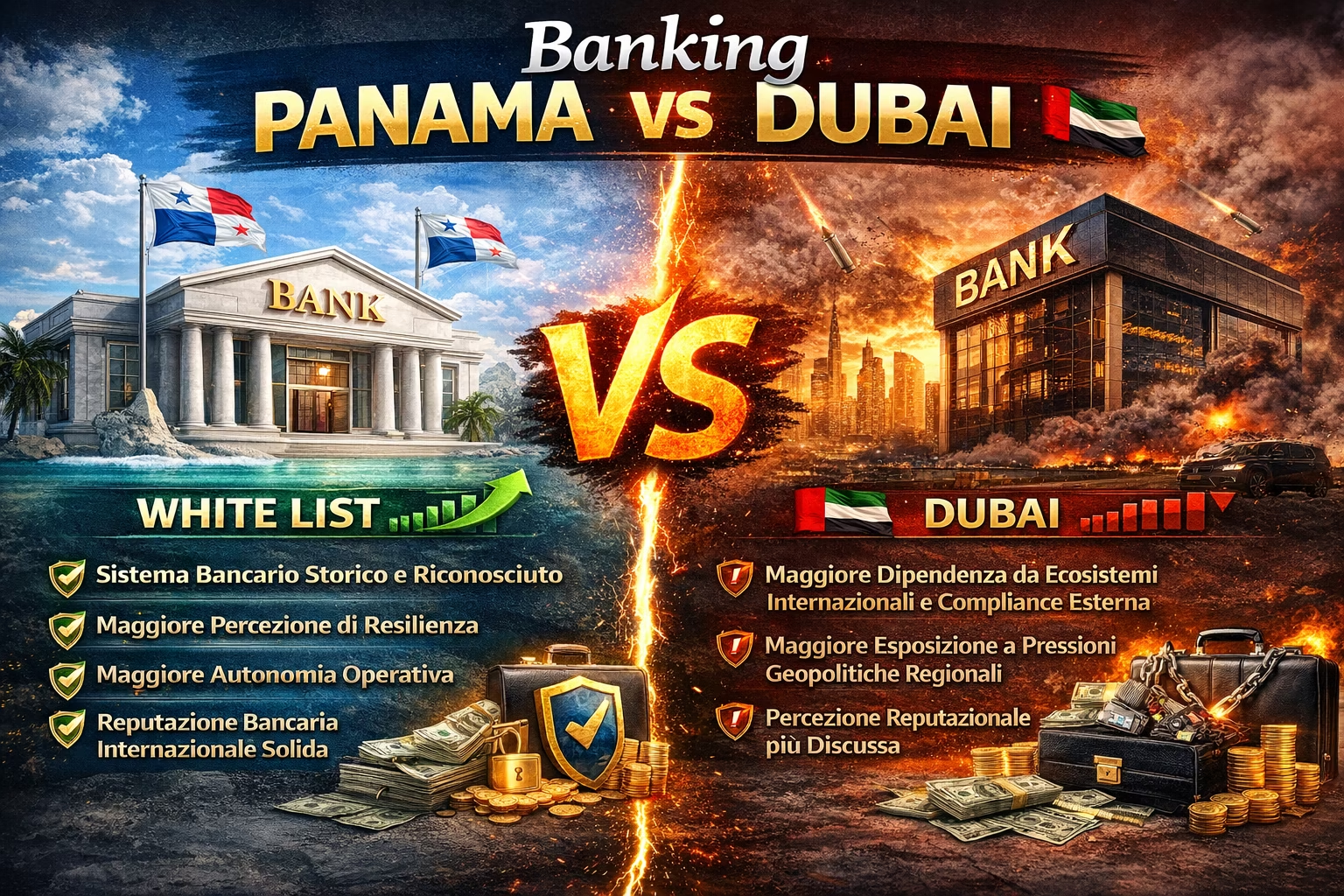
Banks in Panama
The Panamanian banking system comprises over 70 institutions, including international branches (HSBC, Citibank, Scotiabank). Accounts in USD (Panama's de facto currency), online banking, international debit cards, and investment products are available. Strict KYC/AML procedures are under FATF supervision, but opening an account is possible with proper documentation. Personal accounts: minimum deposit $1,000–$5,000. Corporate accounts: typical minimum deposit $5,000–$10,000.
Banks in Dubai
Banking system among the most advanced in the Middle East (Emirates NBD, FAB, Mashreq, ADCB). Accounts in AED, USD, and EUR. Very selective KYC: significant rejection rate, especially for Free Zone companies without consolidated revenue. Personal account: variable minimum deposit of AED 3,000-25,000. Corporate account: often requires demonstrable minimum revenue and international bank references.
International reputation and correspondent banking
Many European and North American banks apply enhanced due diligence (EDD) on incoming and outgoing wire transfers from UAE accounts, partly due to the volume of historically sanctioned flows and partly due to FATF pressure. In practice, wire transfers to or from Dubai may be subject to delays, temporary holds, or requests for additional documentation from correspondent banks. For a business owner collecting from European or US clients, this means operational friction. Panama, despite having faced scrutiny (Panama Papers, FATF lists in the past), has a banking system with stable correspondent relationships with the US and Europe, without the reputational friction that currently characterizes UAE flows. The difference is noticeable in clearing times and the amount of documentation required on a case-by-case basis.
Cryptocurrencies: Which jurisdiction is best?
With the Italian tax rate on cryptocurrency capital gains set to rise to 33% in 2026 and the elimination of tax exemptions, more and more holders are looking for alternatives. Both Panama and Dubai offer zero personal tax on cryptocurrency capital gains, with significant operational differences.
Crypto in Panama
Crypto assets from foreign sources (held on non-Panamanian international exchanges) are not subject to taxation in Panama. There is no specific tax on cryptocurrencies, nor is there a local reporting requirement for cryptocurrencies. Operational freedom is maximum, but opening bank accounts with deposits from cryptocurrency sales requires rigorous AML documentation (proof of origin of funds).
Crypto in Dubai
Capital gains are not taxed at the personal level. Dubai has built a crypto-friendly ecosystem with the VARA (Virtual Assets Regulatory Authority) and specialized zones like the DMCC Crypto Centre. Regulated exchanges operate locally (Binance and OKX have UAE licenses). Access to banking services for cryptocurrency traders is more structured than in Panama, but the 9% corporate tax applies to corporate crypto profits outside of qualifying income regimes.
For the pure holder who holds and sells periodically, Panama offers the simplest and least regulated regime. For those operating professionally in the sector (exchange, services, systematic trading), Dubai offers a more mature regulatory ecosystem, except for the corporate tax on the business side.
Climate, lifestyle and Italian community
Living in Panama
Tropical climate year-round (25-33°C), dry season December-April, rainy season May-November. Panama is outside the hurricane belt. Relaxed, Americanized lifestyle with a strong Latin influence. International cuisine, a well-established expat community (over 30,000 Americans, several thousand Europeans), and a small but active Italian community. UTC-5 time zone (6 hours behind Italy in winter, 7 hours behind Italy in summer). Direct flights to the USA and Europe via Copa Airlines hub.
Living in Dubai
Desert climate with extreme summers (40-50°C from June to September) and mild winters (18-25°C from November to March). Outdoor living possible 6-7 months a year. Cosmopolitan, modern, luxury-oriented lifestyle. A rapidly growing Italian community of over 21,000 residents. High-end international cuisine. UTC+4 (3 hours ahead of Italy in winter, 2 hours ahead of Italy in summer). Global air connections via Emirates.
Geopolitical Context 2026: What Has Changed for the UAE
Until 2025, the geopolitical risk of the Persian Gulf was a theoretical variable that rarely factored into relocation plans. As of February 28, 2026, the picture has changed significantly for those considering a relocation to the UAE.
Following a coordinated US-Israeli attack on Iran, Iran launched a campaign of ballistic missile, cruise missile, and drone strikes against the UAE and other Gulf countries hosting US bases. As of April 9, 2026, the UAE Ministry of Defense claims to have intercepted 537 ballistic missiles, 26 cruise missiles, and 2,256 drones. The official casualties are 13 killed (two military personnel, one contractor, and ten civilians of various nationalities) and over 220 injured.
Practical implications for those planning the transfer of residence, assets and family:
- Flights continue. A drone strike on a fuel tank at Dubai International Airport caused a fire, temporarily suspending flights, and redirecting them to Al Maktoum. Similar incidents have occurred since February 28. Airlines are operating with selective reductions and suspensions.
- Damage to civil and commercial infrastructure. Debris from interceptions has hit residential buildings, hotels, data centers (including an Oracle building in Dubai), power plants (Habshan, Ajban), and industrial zones (KEZAD). The risk of impact is low but not zero, resulting in sharply increased property and business interruption insurance premiums.
- Economic impact. UAE oil production has fallen by between 500,000 and 800,000 barrels per day. Dubai hotels have applied steep discounts in response to cancellations. Iran has threatened to close the Strait of Hormuz, through which approximately 20% of the world's oil passes.
- Information restrictions. UAE authorities have imposed bans on the dissemination of images and videos of the attacks, arresting residents, tourists, and journalists for publishing "unofficial" material. Penalties include up to two years in prison and a fine of AED 200,000 (~$55,000).
This doesn't mean that living in Dubai is impossible or that millions of residents are evacuating; it simply means that the operational risk profile for a multi-year relocation plan is very different today than it was in 2024. Those deciding on Dubai in 2025 were starting from one dataset; those deciding today are starting from another. Panama hasn't had an armed force since 1990, is not part of any active military alliance, and is geographically outside any major conflict theater. The "country risk" variable enters the calculation symmetrically with fiscal efficiency: two aspects of the same planning.
Profiles: Extended analysis for your case
There's no single answer to the question of choosing between Panama and Dubai: it depends on your income, business type, family, and time horizon. Below is a detailed analysis of the five most common profiles among Italians who contact us.
Freelancer / digital nomad (income €50,000-150,000/year)
Recommended choice: Panama. Entry fee: $5,000–$8,000, cost of living compatible with income, zero corporate tax on offshore companies, no requirement to remain in residence for immigration purposes. With the suspension of the Dubai Freelance Visa starting July 2025, the Dubai alternative costs $15,000–$25,000 per year, including free zone companies and compliance; over five years, the difference is $70,000–$110,000 in favor of Panama, even before considering the cost of living.
Entrepreneur with a turnover of €300,000-1,000,000/year
It depends on the market. Businesses targeting international clients (USA, Europe, Latin America): Panama, for its zero corporate tax, low compliance costs, and consolidated offshore ecosystem. Businesses targeting the Gulf or Middle East Asia with the need for a "Dubai brand" for positioning: Dubai, accepting the 9% corporate tax and higher costs. The hybrid scenario (Panama holding company + Dubai operating subsidiary) is common in higher revenue brackets.
Retired with a pension of €2,000-5,000/month
Recommended choice: Panama. The Pensioner's Visa program offers government discounts on transportation, restaurants, cinemas, domestic flights, and medical services. The cost of living is comparable to an average Italian pension. In Dubai, a pension of €3,000/month barely covers the rent for a studio apartment in the suburbs.
Crypto holder with a wallet > €500,000
Both are valid, but with different perspectives. Pure tax optimization and minimal costs: Panama. Regulated ecosystem, local exchanges, structured crypto-friendly banking: Dubai. Zero personal capital gains tax in both. Those holding assets above €4 million should consider theexit tax before transferring.
HNWI / family office
Multi-jurisdictional architecture. Panama serves as a tax base and asset protection (Private Interest Foundations, joint-stock companies, offshore accounts, 1963 Treaty for Document Simplification), while Dubai or another jurisdiction provides an operational presence and networking. The Dubai component of the mix has been reduced in 2026 based on the geopolitical risk profile. Studio Panama Italia structures these integrated architectures.
The most common mistakes when choosing Panama vs. Dubai
In the Dubai vs. Panama debate, certain mistakes recur regularly and cost those who commit them tens of thousands of euros. Here are the six most common ones in our experience assisting Italians.
1. Confusing gross tax savings and net savings. The five-year cost-of-living difference between Panama and Dubai (USD 120,000–500,000 for each profile) often exceeds the tax savings attributable to the move. Planning is evaluated in terms of consolidated net savings, not income tax rate.
2. Believing that the UAE allows a valid Italian tax residency for 90 days. The UAE "domestic" TRC (90 days) is not accepted by the Revenue Agency. An Italian must have 183 days of actual presence in Dubai for the international TRC. In Panama, there is no presence requirement for immigration residency, but Italian tax residency still requires 183+ days outside of Italy, not necessarily all in Panama.
3. Underestimating Dubai's Corporate Tax from 2023. Before 2023, Dubai had zero taxes, even for companies. Today, the 9% tax rate changes the calculation for non-qualified income or transactions outside the Free Zone. It must be calculated precisely based on the business profile.
4. Ignore the citizenship path. Those aiming for a second passport as a strategic asset in the next 5-10 years should choose Panama. Dubai doesn't predictably offer this path.
5. Forget the Italian Blacklist. Both Panama and the UAE are on the Blacklist pursuant to Ministerial Decree of May 4, 1999. The presumption of Italian residency applies pursuant to art. 2, paragraph 2-bis of the TUIR. A solid supporting document is required, regardless of the jurisdiction chosen. A transfer without proper documentation is vulnerable to tax audits.
6. Do not update the country risk profile to 2026. The geopolitical situation in the Persian Gulf has changed since February 28, 2026. A family and wealth transfer plan is assessed using current data, not 2024 assumptions.
Studio Panama Italia assists Italian entrepreneurs, investors, freelancers, and retirees in transferring their tax residency to Panama. From preliminary analysis (Panama vs. Dubai vs. Paraguay vs. other jurisdictions) to complete structuring: treaty residency, company incorporation, bank account opening, AIRE registration, DGI tax residency certificate, preparation of supporting documents, and Italian compliance (exit tax, RW form, risk of foreign investiture).
Moving to Panama or Dubai: Personalized Consulting
We have been operating from Panama City since 2010, license no. 14465. If you're considering whether Panama or Dubai is better for paying less taxes and transferring your tax residency, we can provide a comprehensive comparative analysis based on your specific profile.
✉️ Write to us on WhatsAppFrequently Asked Questions about Panama vs. Dubai
Where do you pay less taxes, in Panama or Dubai?
For an Italian looking to relocate to Panama or Dubai to pay lower taxes, both jurisdictions offer zero taxes on foreign-source income. For businesses, Panama offers a more advantageous rate: 0% corporate tax for companies with foreign operations, compared to Dubai's 9% on profits over €102,000, with the possibility of exemption in the Free Zone only on qualifying income. The choice depends on the type of business and the target market.
Is it cheaper to live in Panama or Dubai?
Panama costs 40-60% less. A single person can live comfortably on $1,500-$2,500/month in Panama City, compared to $3,500-$6,000/month in Dubai. For a family with children in international school, the gap is even wider and can exceed $6,000/month.
Are Panama and Dubai on the Italian Blacklist?
Yes, both are included in the Italian Black List for natural persons pursuant to Ministerial Decree of May 4, 1999. Legislative Decree 209/2023 amended Article 2 of the TUIR but did not amend paragraph 2-bis, as confirmed by Revenue Agency Circular No. 20/E of November 4, 2024. In the event of an assessment, the burden of proof is reversed: the taxpayer must demonstrate the actual transfer. The defense is the evidentiary file. The 1963 Italy-Panama Treaty facilitates the documentation of the file compared to the UAE case.
Can I get citizenship in Dubai?
In practice, no. Emirati naturalization is discretionary and reserved for exceptional cases. The 10-year Golden Visa does not lead to citizenship. In Panama, however, after five years of permanent residency, you can apply for naturalization and obtain a second passport with visa-free access to over 140 countries. Panama accepts dual citizenship with Italy.
How many days do I have to stay in Dubai for tax residency?
It takes 183 days to obtain the international TRC, the only one valid for the Italian Revenue Agency under the Italy-UAE Convention. The 90-day "domestic" TRC is for internal use in the UAE and does not protect against Italian tax audits. There is no minimum stay requirement for immigration residency in Panama, but leaving Italian tax residency still requires 183+ days outside Italy, not all of which are necessarily in Panama.
Are cryptocurrencies taxed in Panama or Dubai?
In both jurisdictions, capital gains on cryptocurrencies are not taxed at the personal level. In Panama, there is no specific regulation and the regime is liberal. Dubai has a more structured regulatory framework (VARA), with regulated exchanges and crypto-friendly banking services, but a 9% corporate tax applies to corporate crypto profits outside of qualifying income regimes.
Can I have residency in both Panama and Dubai?
Yes, many HNWIs structure a multi-jurisdictional architecture. Panama serves as a base for asset protection, a second passport, and tax residency; Dubai serves as an operational presence and access to the Gulf. Effective tax residency will be in the country where they spend the most time and have their center of vital interests. Planning must be coordinated to avoid dual residency conflicts and to build the evidence base against the Italian presumption.
Is the Freelance Visa in Dubai still available in 2026?
No, not for new applicants. Effective July 5, 2025, the issuance of new Freelance Visas in Dubai has been suspended indefinitely. Existing holders may renew. For those arriving now, the alternatives are a Free Zone company (USD 15,000-25,000 for the first year) or a Green Visa. In Panama, the residency path for freelancers remains open and accessible through the 1963 Italy-Panama Treaty.
How does the situation in the Persian Gulf impact Dubai's choice?
Since February 28, 2026, the UAE has been subjected to missile and drone attacks from Iran following US-Israeli military operations. The practical consequences for a relocation plan include flight reductions and suspensions, increased insurance premiums, information restrictions on the dissemination of images of the attacks, a decline in UAE oil production, and the risk of escalation. This does not make Dubai uninhabitable, but it does alter the risk profile of a five- to ten-year plan. This must be considered in the overall assessment, along with tax and cost-of-living factors.
Find out how to obtain residency in Panama in 6 steps , register with AIRE , obtain a tax residency certificate , avoid foreign investiture , manage the exit tax , calculate IVAFE and IVIE , and complete the RW form . For asset protection structures and Private Interest Foundations , consult the dedicated guides.
