

Residency in Panama for Italian Retirees: A Guide to the 2026 Pension Visa
To move to Panama as an Italian retiree, you need a minimum monthly lifetime pension of $1,000, or $750 per month plus the purchase of a property in Panama worth at least $100,000. The Pensionado Visa grants permanent residency on the first application, with a typical processing time of 3-5 months and a typical cost of $3,500-5,500. Processing times vary depending on the workload of the National Migration Service and the completeness of the initial documentation.
Private Italian pensions are fully tax-free thanks to Article 18 of the Italy-Panama Convention (Law 208/2016), and pensions in Panama are not subject to local taxation due to the principle of territorial taxation. The cost of living in Boquete or Coronado leaves a real margin even with pensions starting at €2,000 per month.
This guide covers who can apply for the Pensioner's Visa, private and public pension taxation, change of residence and AIRE registration, private healthcare, the cost of living in five zones, four real-world numerical profiles, and Panamanian citizenship after five years. Data updated as of April 2026.
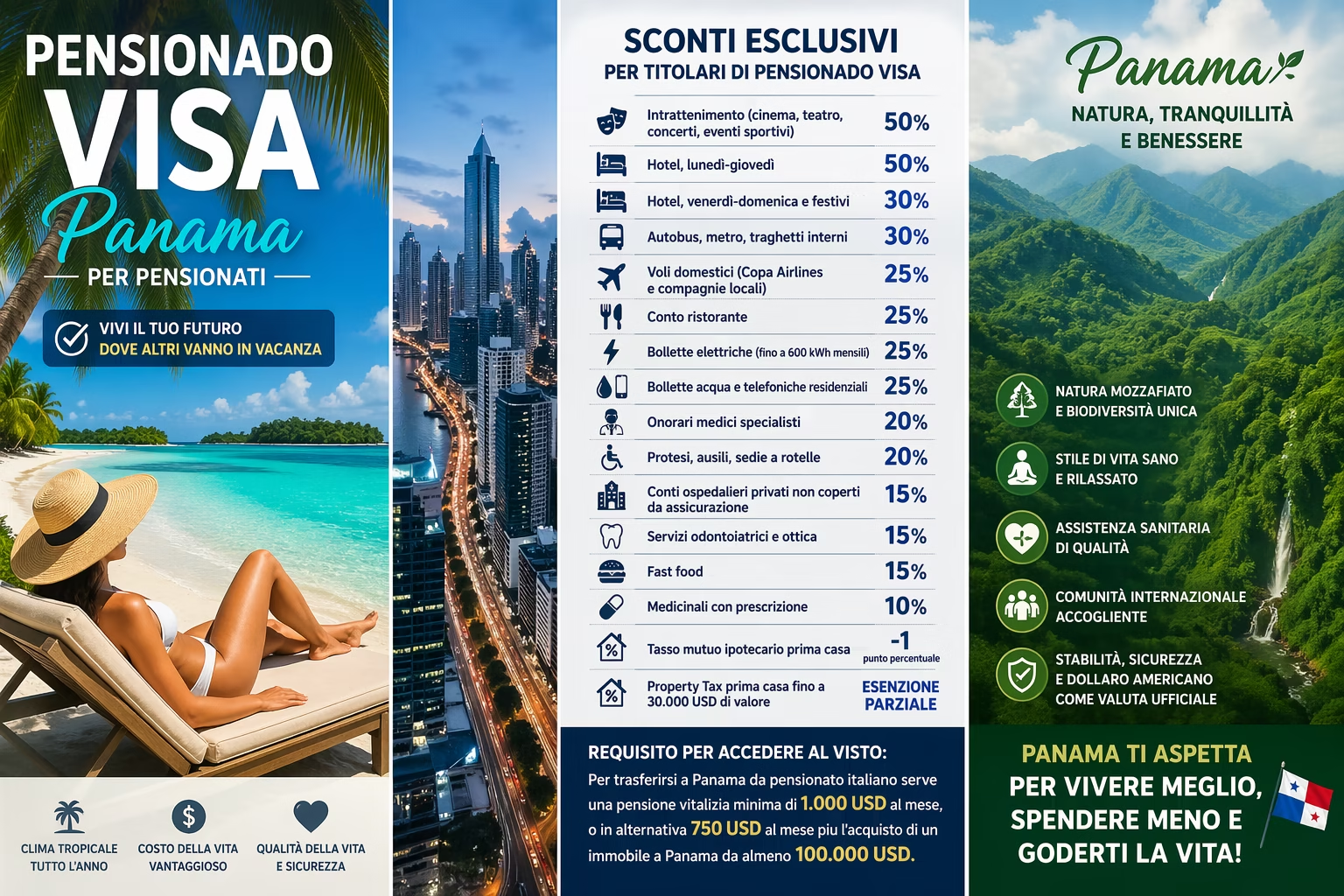
Key elements of residency in Panama for Italian retirees
- Pensioner's Visa (financial requirement): Minimum pension of $1,000/month for life, or $750/month plus property in Panama worth $100,000. Legal basis: Executive Decree 320/2008.
- Italian private pension: effective taxation is zero in the typical case. Article 18 of the Italy-Panama Convention (Law 208/2016): taxable only in Panama. Panama does not tax foreign-source income. The result presupposes an effective transfer of tax residence.
- Italian public pension: remains taxed in Italy pursuant to Article 19, unless the pensioner obtains Panamanian citizenship (accessible after 5 years of permanent residency).
- Cost of living: Single $1,990–$3,280/month in Boquete, $2,750–$4,530 in Panama City. Couple $3,400–$5,570/month in Coronado.
- Italian Blacklist: Panama is on the Ministerial Decree of May 4, 1999. The presumption of Italian residency applies pursuant to art. 2, paragraph 2-bis of the TUIR, confirmed by Revenue Agency Circular 20/E of November 4, 2024. Mandatory supporting documentation.
- AIRE registration: mandatory within 90 days (Law 470/1988). This entails cancellation of your registration with the Italian National Health Service.
- Private healthcare: US-level hospital network (Hospital Punta Pacifica, affiliated with Johns Hopkins International Medicine). Insurance: $120-$500/month for those aged 60-70.
- Government Discounts for Pensioners: Law 6/1987, 15-50% on healthcare, medicines, transportation, utilities, restaurants, hotels, domestic flights.
- Panamanian citizenship: available after five years of permanent residency. Dual citizenship with Italy permitted. Panamanian passport is visa-free in over 140 countries (as of 2026, to be verified upon issuance based on current bilateral agreements).
Retirees in Panama: Six Profiles Compared
For retirees in Panama, this option works well when their private pension exceeds €1,500/month. It's a marginal option for pensions under €1,200, and requires careful consideration for former public employees, those with chronic illnesses, or children who are financially dependent on Italy. Each profile below links to the detailed section below.
- Single retiree, private pension €1,500-2,500/month: Panama operates on a comfortable schedule. The tax exemption pursuant to Article 18 of the Convention provides €300-600/month. The cost of living in Boquete or Coronado is compatible with income. Private healthcare is accessible for those between the ages of 55 and 70, with manageable premiums.
- Couple, total income €3,000-€5,000/month: excellent choice. Higher financial margin, possibility of purchasing a home in the province for $150,000-$300,000, well-established Italian social network in Panama City and Boquete.
- A private pension under €1,200/month is a marginal option. The tax savings are modest, and private healthcare significantly impacts the budget. The move is only justified if your priority is a lifestyle change, not financial optimization.
- Retirees with an Italian public pension: be careful. Article 19 of the Convention keeps them taxed in Italy until they acquire Panamanian citizenship. The full tax benefit only comes after five years of permanent residence.
- Major chronic conditions: to be evaluated. AIRE removes them from the National Health Service. Diabetes, compensated heart disease, hypertension, and orthopedics are easily treatable in Panama. Active oncology or dialysis requires dedicated planning and an increased healthcare budget.
- Financially dependent adult children in Italy: verification of the center of vital interests. Regular contributions to Italian children and frequent returns may expose them to assessment, even with formal residence in Panama.
Pension Visa: Requirements, Costs, and Deadlines
Financial Requirements for the Pension Visa
The Pension Visa is governed by Executive Decree No. 320 of 2008 and grants permanent residency to foreigners with a minimum monthly lifetime pension of USD 1,000, or USD 750 with the purchase of a residential property in Panama worth at least USD 100,000. The pension must be certified by INPS (National Institute of Social Security) or an Italian pension fund (ENPAM, INPGI, ENPAPI, the Professionals' Funds, and sector pension funds) and must be for life: fixed-term annuities, financial annuities, and fixed-term benefits are excluded. Disability pensions are accepted only if certified as lifetime.
For a family unit, the spouse included in the application increases the required pension threshold by $250 per month (bringing the couple's threshold to $1,250). Each minor child or student up to age 25 adds an additional $250 per month to the minimum threshold. There is no minimum age requirement: the Pensioner's Visa is also available to Italian retirees under 60 with early retirement through Quota 100/102/103, women's option, or certified disability.
Required documents: eleven apostilled and translated documents
The procedure requires eleven documents apostilled according to the Hague Convention and translated into Spanish by a sworn translator. The pension certificate is the most delicate: it must explicitly certify the amount, currency, and life-long nature of the pension.
- Italian passport with at least 12 months of residual validity.
- Apostilled multilingual birth certificate.
- Certificate of criminal record and pending charges, apostilled, issued within the last 6 months.
- Pension certificate complete with amount, currency, and lifetime nature, apostilled and translated.
- Panamanian medical certificate of absence of infectious diseases, issueable on the same day during the trip to Panama.
- Eight passport-sized photographs.
- Certified copy of all passport pages.
- Notarized power of attorney for the Panamanian lawyer.
- Affidavit of source of funds.
- Apostilled marriage certificate (if the spouse is included in the request).
- Birth certificate of children (if children are included).
The Hague apostille is issued by the Prefecture for administrative certificates or by the Court for judicial certificates. The Spanish translation can be done by a sworn Panamanian translator or an Italian translator, whose signature is subsequently legalized at the Panamanian Embassy in Rome.
Procedure times and costs
The all-in-one cost of the Pensioner's Visa is typically $3,500–$5,500, including government fees ($250 plus $800), legal fees, a Panamanian medical certificate, apostille, translations, and courier. The process typically takes 3–5 months from submission to the issuance of the final carnet, with a single trip to Panama lasting 5–8 business days upon initial entry. There is no requirement to remain in person to maintain immigration status, but any returns to Italy must be coordinated with tax planning.
Including a spouse typically adds $800–$1,200 in fees; including each child adds $500–$900. Actual costs may vary depending on the complexity of the case, the source of the documents, and the dollar-euro exchange rate at the time of the procedure.
Government discounts for Visa de Pensionado holders
Panama grants holders of a Pensionado Visa, women over 55 and men over 60, state discounts of between 15% and 50% on healthcare, medicines, transportation, restaurants, hotels, utilities, and domestic flights, pursuant to Law 6 of 1987. The discounts are applied by presenting the residence card at participating points of sale and services.
- Entertainment (cinema, theater, concerts, sporting events): 50% discount.
- Hotel: 50% from Monday to Thursday, 30% on weekends and holidays.
- Public transport (buses, metro, domestic ferries): 30% discount.
- Domestic flights (Copa Airlines and local airlines): 25%.
- Restaurants: 25% off your bill for dine-in or takeout. Fast food: 15%.
- Electricity bills up to 600 kWh/month: 25%. IDAAN water and residential telephone services: 25%.
- Private hospitals not covered by insurance: 15%. Specialist medical fees: 20%. Dentistry and optics: 15%.
- Prescription medicines: 10%. Prosthetics and aids: 20%.
- Property Tax on first home: partial exemption up to USD 30,000 of cadastral value.
- First home mortgage: 1 percentage point reduction on the interest rate.
The economic impact is tangible: a retired couple in Boquete with an average spending plan and one domestic flight per month typically saves $180–320 per month thanks to Pensionado discounts. Over a 10-year horizon, the cumulative savings are $22,000–38,000 in additional purchasing power.
Italian retirees with mixed income (pension plus consulting, rent, or dividends) or who prefer to manage investments through Panamanian companies can consider the alternative route governed by the Italy-Panama bilateral agreement. Complete details, costs, procedures, and operational differences can be found in the complete guide to Panamanian residence visas.
Taxation of Italian pensions in Panama
The Italian private pension of a Panamanian tax resident is taxed at zero: Italy does not apply a withholding tax pursuant to Article 18 of the Italy-Panama Convention, and the Panamanian pension is not subject to local taxation under the principle of territorial taxation. The Italian public pension, however, remains taxed in Italy pursuant to Article 19 of the same Convention until the pensioner also obtains Panamanian citizenship.
The regulatory reference is the Convention between Italy and Panama for the avoidance of double taxation, signed in Rome on 30 December 2010, ratified with Law no. 208 of 3 November 2016, in force since 1 June 2017. The text follows the OECD Model.
Article 18: Taxation of private pensions
Article 18 establishes that private pensions paid to a Panamanian resident are taxable only in Panama. Panama, due to territorial taxation, does not tax foreign-source income. The result is zero effective taxation on the Italian private pension, in the typical case of an Italian pensioner who has effectively transferred his tax residency.
Article 18 states: Pensions and other similar remuneration paid to a resident of a Contracting State in connection with past employment shall be taxable only in that State
. The categories of Italian pensions covered by the article are INPS for private sector employees, supplementary pension funds for individual sectors, pension funds for self-employed professionals (ENPAM, INPGI, ENPAPI, CNPADC, Inarcassa), private survivor's pensions, and certified lifelong disability pensions.
The Italian withholding tax, normally applied by INPS as a substitute tax on Panamanian pensions and other pensions paid abroad, can be waived ex ante by presenting documentation of Panamanian residency, or applied and subsequently reimbursed within 48 months by submitting a request to the Operations Center in Pescara.
Article 19: public pension
The Italian pension paid for services rendered to the Italian state, i.e., the public pension, remains taxed in Italy pursuant to Article 19 of the Convention, unless the pensioner is also a Panamanian citizen. The categories covered include former state school teachers, former military and law enforcement personnel, former magistrates, former National Health Service doctors, former employees of ministries, regions, provinces, and municipalities, and former employees of non-profit public entities.
The tax advantage on the public pension requires Panamanian citizenship. Article 19 transfers taxation authority to Panama only if the pensioner is a resident of that other state and holds its nationality
. Panamanian citizenship is obtained after five years of permanent residency. Until then, the public pension continues to pay the standard Italian income tax.
A former public employee with a private pension fund accumulated during his or her career obtains immediate tax relief on the private component and awaits citizenship for tax relief on the public component.
INPS exemption pursuant to Article 18: a six-step procedure
To apply the exemption directly through INPS, the pensioner submits the Convention application form accompanied by the Panamanian tax residency certificate issued by the DGI, translated into Italian and apostilled. INPS typically applies the exemption within 2-4 months of receiving the completed application.
- Actual transfer to Panama and registration withAIRE within 90 days.
- Acquisition of the Panamanian residence card (cédula).
- Physical presence in Panama for at least 183 days in the calendar year, documented by passport stamps and airline tickets.
- Request a tax residency certificate from the Panamanian Directorate General of Revenue.
- Completion of the Convention application form in duplicate (Italian and Spanish).
- Send to the INPS Central Pensions Directorate with a translated and apostilled DGI certificate.
Taxes already withheld prior to the request can be refunded within 48 months by submitting a request to the Pescara Operations Center, attaching documentation of Panamanian residency for the period requested.
Italian Blacklist and Presumption of Residence
Panama is still included in the Black List for natural persons pursuant to Ministerial Decree of May 4, 1999. Legislative Decree 209/2023 amended Article 2 of the TUIR (Italian Consolidated Law on Income Tax) regarding tax residency criteria, but did not affect paragraph 2-bis regarding the Black List, as confirmed by Revenue Agency Circular No. 20/E of November 4, 2024. In practice, an Italian pensioner who moves to Panama is presumed to be a tax resident in Italy unless proven otherwise: the burden of proof falls on the taxpayer.
AIRE registration, Panamanian residency certificate, and a pension credited to a Panamanian account are not sufficient to rebut the presumption. A documentary evidence file demonstrating the actual transfer of the pensioner's center of vital interests to Panama is required, compiled for each tax year of foreign residence.
Evidence file: nine documentary elements
As a general rule, the file is constructed by assembling nine categories of documents simultaneously: residence, utilities, bank account, DGI certificate, physical presence, local registrations, local health care, termination of Italian ties, Italian compliance. The relative weight of each element and the expected evidence vary from case to case and must be tailored to the pensioner's specific profile.
- Panamanian housing: rental agreement registered with the Ministerio de Vivienda or deed of purchase registered in the Registro Público.
- Utilities in your name: ENSA, Edemet, or Naturgy for electricity, IDAAN for water, Cable & Wireless, Tigo, or Digicel for connectivity and telephony, with regular payments.
- Active Panamanian account: regular transactions, pension credits, utility payments, debit cards with continuous local use.
- DGI Tax Residency Certificate: Annual request to the General Directorate of Revenue.
- Documented physical presence: passport stamps, preserved airline tickets, hotel registrations for short-term returns to Italy.
- Local memberships: Dante Alighieri in Panama City, Boquete associations, clubs, parishes, and expat communities.
- Medical transfer: Panamanian general practitioner, local health insurance, Panamanian medical records and prescriptions.
- Termination of non-essential Italian ties: closure or suspension of Italian utilities, transfer of season tickets, termination of unjustified memberships.
- Italian compliance: Correct RW form, IVAFE and IVIE paid, consistent residual tax returns.
The optimal distribution of days for an Italian pensioner residing in Panama is typically 220-280 days in Panama and 85-145 days in Italy. At 200 days in Panama and 165 in Italy, the position is formally valid but can be challenged by the Revenue Agency during an assessment, especially if other indications indicate that the center of interests remains in Italy.
AIRE, National Health Service (NHS) abolished and private healthcare in Panama
AIRE: legal requirement within 90 days
Registration in the Registry of Italians Resident Abroad (AIRE) is mandatory by law (Law 470/1988) for anyone transferring their residence abroad for a period exceeding 12 months. The pensioner must register with the Italian Embassy in Panama City within 90 days of the actual move. AIRE registration automatically removes the pensioner from the Italian National Health Service. Only emergency care is guaranteed during returns to Italy; general practitioner, free specialist care, hospitalization, and medications are the pensioner's responsibility.
Some Italian regions (Emilia-Romagna, Tuscany, Veneto) offer temporary reinstatement programs to the National Health Service (SSN) for Italians registered with AIRE during extended stays, subject to assessment on a case-by-case basis. In the event of a permanent return to Italy, re-registration automatically reinstates entitlement to the National Health Service (SSN).
Private hospital network in Panama
Panama's private hospital network is of a quality comparable to U.S. standards. The primary provider is Hospital Punta Pacifica in Panama City, affiliated with Johns Hopkins International Medicine. For Boquete and the western mountainous areas, the primary provider is Hospital Chiriquí in David.
- Punta Pacifica Hospital (Panama City): Affiliated with Johns Hopkins. Cardiology, oncology, orthopedics, neurology, advanced surgery. US standards.
- Hospital Nacional (Panama City): Historic private referral hospital. Extensive network, lower costs than Punta Pacifica for the same service.
- Hospital Paitilla (Panama City): consolidated specialties in cardiology and oncology.
- Clínica Hospital San Fernando (Panama City): extensive network, 24/7 emergency room, good value for money.
- Chiriquí Hospital (David): referral center for Boquete, Cerro Punta, and Volcán. Emergency, orthopedics, cardiology. Complex surgeries referred to Panama City.
- Mae Lewis Medical Center (David): alternative to Hospital Chiriquí, well equipped.
- Hospital Metropolitano (Panama City): Specializes in oncology and complex procedures.
Cost of healthcare in Panama
A general practitioner visit typically costs $30–60, a specialist visit $60–150, and a major cardiovascular procedure $25,000–60,000. Prices are 40%–60% lower than in the United States for the same clinical standard. A private semi-intensive care room costs $400–800/night; MRI without contrast $350–600; CT scan with contrast $400–700; a single course of chemotherapy $1,000–4,000 per session; a minor surgery (hernia, gallbladder, cataract) $3,000–7,000; and gastroscopy or colonoscopy $500–900.
Private health insurance by age
For a retiree without significant health conditions, Panamanian private health insurance typically costs $120-250 per month between the ages of 55 and 60, $300-500 per month between the ages of 65 and 70, and $400-700 per month between the ages of 70 and 75. After age 75, it is often difficult to activate new policies: the correct strategy is to sign up before age 70 and maintain continuity of contributions.
The main providers on the Panamanian market are BUPA, Pan-American Life Insurance, Mapfre, ASSA, and Internacional de Seguros. Pre-existing conditions are subject to exclusions, 12-month waiting periods, or premium increases. Alternatively, there are international insurance companies such as Cigna Global, Allianz Worldwide Care, and April International, which offer higher premiums but global portability and coverage in Italy. These are often preferred by retirees with pre-existing conditions.
Healthcare planning should be done at least six months before arriving in Panama to avoid coverage gaps and defensive decisions made in an emergency. Signing up for insurance before moving allows you to calmly evaluate exclusions, deficiencies, and the network of approved facilities.
Cost of Living for Retirees in Panama
A single retiree typically spends $1,990–$3,280 per month in Boquete, and $2,750–$4,530 per month in Panama City. A couple in Coronado or Gorgona spends $3,400–$5,570 per month. The cost of living is 35–50% lower than in a comparable-sized Italian city, with additional purchasing power resulting from the USD conversion and pension tax exemption.
Singles in Boquete: USD 1,990-3,280/month
A single retiree in Boquete typically spends between $1,990 and $3,280 per month, living in a detached house with a garden, with private health insurance, local transportation, and eating out two to three times a week. The main expense is rent for a one- or two-bedroom house with a garden, which costs between $800 and $1,300 per month. Food costs range from $350 to $500, restaurants $200 to $350, utilities $90 to $130, transportation $100 to $200, and health insurance for those between the ages of 60 and 65 $200 to $300. Entertainment, hobbies, unexpected expenses, and savings account for the remaining $250 to $500.
Singles in Panama City: USD 2,750-4,530/month
A single retiree in Panama City typically spends between $2,750 and $4,530 per month living in a centrally located apartment in Obarrio, San Francisco, or El Cangrejo, with a doorman, air conditioning, a daily Uber, and frequent restaurants. Renting a one-bedroom apartment in a building with a doorman and a pool costs $1,200-$1,800 per month. Groceries cost $400-$600, restaurants $250-$450, utilities including air conditioning $150-$230, Uber and taxi transportation $150-$300, and health insurance $200-$350. Urban entertainment, unexpected expenses, and savings account for the remaining $400-$800.
Couple in Coronado: $3,400-$5,570/month
A retired couple in Coronado or Gorgona typically spends between $3,400 and $5,570 per month living in a villa or townhouse in a gated community, with health insurance for both, a company car, and golf and club activities. Renting a two- or three-bedroom villa in a gated community costs $1,200-$2,000 per month. Food expenses for two people are $600-$900, restaurants visited three or four times a week are $350-$500, utilities with moderate air conditioning and a community pool are $150-$220, transportation with a car is $200-$400, health insurance for two people between the ages of 60 and 68 is $400-$650, and social activities including golf and clubs are $200-$400. Unexpected expenses and savings account for the remaining $300-$500.
Delta Italy vs. Panama: How Much You Save
An Italian pensioner earning €2,200 net per month who successfully moves to Panama typically improves their standard of living by the equivalent of €500–€1,100 per month, thanks to three cumulative effects. The first is the tax exemption pursuant to Article 18 of the Convention, which recoups €250–€600 per month on their Italian private pension. The second is the cost of living, which is 35–50% lower than in a comparable-sized Italian city. The third is the purchasing power of the USD exchange rate, with Panama having been dollarized since 1904 and local prices for basic goods typically lower.
The cumulative difference over 20 years of remaining life expectancy is typically €120,000–265,000 in additional purchasing power. For a couple with a combined income of €3,800 per month, the difference favoring Panama is typically €8,000–14,000 per year, or €160,000–280,000 over 20 years.
Where to Live: Six Areas for Italian Retirees
The top five areas chosen by Italian retirees are Boquete (mountains, spring-like climate, large expat community), Coronado (Pacific coast, gated community), El Valle de Antón (volcanic crater, rural), Panama City (capital, top-notch healthcare), and Pedasí (authentic Azuero coast). Added to these are David (Chiriquí's economic capital), Bocas del Toro (Caribbean), and Santa Fe de Veraguas (mountainous interior).
Boquete: A 1,200-meter mountain with a vibrant expat community
Boquete, in the province of Chiriquí, at an altitude of 1,200 meters, is the place with the highest concentration of foreign retirees in Panama in proportion to the population. The climate is spring-like year-round (18-24°C), with a rainy season from May to November. The expat community numbers over 3,000 permanent residents, including Americans, Canadians, and Europeans. The primary hospital is Hospital Chiriquí in David, a 40-50 minute drive away. David's Enrique Malek Airport offers direct flights to Panama City in about an hour. Renting a detached house typically costs $700-1,300 per month; purchasing a house with land costs $180,000-450,000. It is a production area for Geisha coffee, offering trekking to Volcán Barú, hot springs, and a vibrant social life around the Tuesday Market and the library.
Coronado: Pacific Coast and gated community
Coronado is Panama's largest gated community on the Pacific coast, with 20,000 residents, including retired expats and Panamanian families. It is a 1-hour and 15-minute drive from Panama City, which provides quick access to the capital's specialized healthcare. The climate is warm (25-32°C) and breezy, with a dry season from December to April. It offers the Coronado Golf & Beach Resort, Tucán Golf Club, yacht clubs, Riba Smith and Super 99 XL supermarkets, private clinics, and international schools. Rent typically costs $1,000-$2,200 per month, while purchase costs $200,000-$700,000. The community includes the Gorgona and San Carlos districts.
Antón Valley: a volcanic crater at 600 meters
El Valle is a village of 8,000 inhabitants located inside the crater of an extinct volcano, at 600 meters above sea level. Its mild climate (20-28°C), rural atmosphere, and expat community of a few hundred residents make it ideal for those seeking tranquility. The nearest hospital is in Penonomé, a 45-minute drive; Panama City is two hours away. Rent typically costs $600-1,100 per month, and purchases range from $150,000-350,000. It is famous for its weekly Saturday market, hot springs, and endemic orchids.
Pedasí and the Azuero Peninsula: authentic coast
Pedasí is the center of the Azuero Peninsula, a traditional agricultural region facing the southwest Pacific. Semi-deserted beaches, a dry, warm climate (27-33°C), a small but growing expat community, and knowledge of Spanish are essential for daily integration. The nearest hospital is in Chitré, 35 minutes away; Panama City is a four-hour drive or a 30-minute plane ride from Chitré. Rent typically costs $500-900 per month, and purchase costs $120,000-400,000. The area is renowned for surfing, fishing, and seasonal whale watching.
Panama City: Urban living and top-notch healthcare
The capital offers international urban living, immediate access to first-class healthcare (Punta Pacifica is 10 minutes away), cultural life, and a Tocumen international airport with over 80 direct flights. Expats' favorite areas are Obarrio, San Francisco, El Cangrejo (central, walkable, and full of amenities), Costa del Este (modern residential), and Punta Pacifica (luxury beachfront). El Cangrejo is historically the Italian part of the capital, with well-established restaurants and businesses. Rent typically costs $1,200–$3,500 per month, while purchasing costs $250,000–$1,500,000, depending on the area and size.
David, Bocas del Toro, and Santa Fe: niche choices
David, the capital of Chiriquí and Panama's third-largest city (population 150,000), offers a lower cost of living than Panama City and Boquete. It boasts a warm lowland climate (27-34°C), hospitals such as Hospital Chiriquí and Mae Lewis Medical Center, and an airport with flights to the capital. Rent typically costs $400-900 per month, while purchases range from $90,000-280,000. It's a niche choice among budget-minded expat retirees.
Bocas del Toro (northern Caribbean archipelago) and Santa Fe de Veraguas (inland mountains) are niche options for young retirees between 55 and 65 in excellent health, with limited local healthcare coverage. Bocas del Toro has Caribbean flair and partial isolation, with the closest hospitals in Costa Rica. Santa Fe is a mountain village with a mild climate and an emerging expat community, but hospitals are over two hours away.
House in Panama: rent or buy
Renting is the recommended option for the first year of moving, regardless of your future intention to buy. Buying is economically advantageous from the tenth year onward, with an initial equity of at least 50% of the purchase price to limit the need for a mortgage.
Rent: contract, deposit and utilities
A typical rental contract in Panama lasts 12 months, renewable, with a security deposit of 1-2 months' rent and the first month's rent paid in advance. Utilities (ENSA or Edemet for electricity, IDAAN for water, and an internet provider of your choice) are in the tenant's name. Liability insurance is recommended. Rent is denominated in USD and is not indexed to inflation unless otherwise specified. Renting for the first year allows you to test out the area, climate, community, and quality of life before making a final real estate decision.
Real estate purchase for foreigners
Foreigners can purchase real estate in Panama without nationality restrictions, unlike in Mexico or Thailand. The deed takes 30-45 days from the signing of the preliminary agreement. A 5% ITBMS (VAT) applies to new, not used, properties. Notary fees and public registry fees typically cost 1.5-2.5% of the price, while legal fees are 0.5-1%. Property tax is exempt up to $120,000 of cadastral value for a primary residence, 0.5% annually between $120,000 and $700,000, and 0.7% annually above $700,000. Pensioner visa holders enjoy an extended partial property tax exemption. Mortgages for foreigners are available, but with interest rates of 7-9% and a maximum LTV of 70%.
Real estate purchase as a residence channel
Two thresholds activate specific residency channels related to real estate investment. A property valued at $100,000 allows access to the Pensionado Visa with a reduced pension of $750 per month. A property valued at $300,000 allows access to the Qualified Investor Visa, which grants permanent residency without income restrictions on the pension.
For a retiree planning to live in Panama for at least 10 years and having initial capital equivalent to 50% of the purchase price, buying is typically more advantageous than renting. For stays of less than 5 years, renting remains preferable: selling a residential property to foreigners in the province can take 6-18 months in a weak market.
Bank account and receipt of Italian pension
The Italian retiree opens a Panamanian bank account at Banco General, Banistmo, Scotiabank Panamá, Global Bank, or Multibank, with an initial deposit of $500–$2,000, depending on the institution. The Panamanian pension is credited to the Panamanian account within 2–5 business days via SWIFT transfer from the INPS (National Institute of Social Security), with fees of $15–$35 per month. During the first year of transition, many retirees prefer to maintain an Italian bank account to quickly process any INPS requests.
Panamanian banks require rigorous KYC: passport and Panamanian residency certificate (including temporary pension), translated and apostilled INPS (National Institute of Social Security) or professional institution statement, Italian bank statement from the last 6 months, two signed Italian bank references, declaration of source of funds, Panamanian rental agreement or property deed, and utility bill in your name.
Four real-world numerical profiles of Italian pensioners
Four real-world cases (with data modified for confidentiality) show the actual financial statements of Italian pensioners transferred to Panama for different pension income brackets and personal profiles.
Profile 1: Manager, 66 years old, Boquete
A former manager of a medium-sized manufacturing company in Northern Italy, retired at age 62, with a net Italian pension of €2,100 per month, paid through INPS (National Social Security Institute) and the Pension Fund. He obtained his Pensioner's Visa in 2024 and lives in Boquete in a detached house with a garden. After tax deductions, his post-transfer net income is approximately $2,450 per month at the 1.17 exchange rate at the end of 2025. The real cost of living is $2,100-$2,400 per month, leaving a margin for savings of $50-$350 per month. The INPS exemption was applied starting from the fourteenth month of residence, with retroactive reimbursement of withheld taxes.
Profile 2: Private-public couple, 68 and 65 years old, Coronado
Husband, a former engineer, receives a private pension; wife, a former teacher, receives a public pension. Total income: €3,800 per month (€3,100 from husband, private pension + €700 from wife, public pension). They moved in 2023 with a Pensionado Visa and live in Gorgona, Coronado, in a long-term rental villa. Their net income after relocation is approximately $4,200 per month (€3,620 tax-free plus €580 net in Italy after income tax on the public pension). The cost of living is $3,200-$3,700 per month, with savings of $500-$1,000 per month. The wife's pension remains taxed in Italy until she obtains Panamanian citizenship in her fifth year.
Profile 3: Active bank manager, 60 years old, Panama City
Former private bank manager, who retired with Quota 103 and a pension fund, a net Italian pension of €4,600 per month plus additional income of €2,000-3,000 per month from residual international consulting. He relocated, setting up a Panamanian company to manage his consulting work. He lives in a two-bedroom apartment in Obarrio, Panama City. Total post-relocation income of $7,000-8,000 per month, cost of living of $4,200-5,200 per month, savings and investment margin of $2,000-3,000 per month.
Profile 4: Widow with survivorship, 72 years old, El Valle
Widow of a company executive, private survivor's pension of €1,450 per month. Relocating in 2024 with a pensioner's visa to join her daughter, who lives in Panama. Lives in a rented home in El Valle de Antón. Post-relocation net income of approximately $1,620 per month, cost of living of $1,350-$1,600 per month, virtually no savings margin. This choice is for family reunification with a secondary tax benefit (€180-230 per month tax exemption). Private healthcare is covered by a six-monthly policy limited by the retiree's age.
Panama vs. Portugal, Spain, Tunisia, Paraguay
For an Italian retiree with a private pension, Panama and Paraguay are currently the two most tax-efficient non-EU jurisdictions. Panama wins on healthcare and infrastructure, while Paraguay wins on entry and living costs. Portugal's NHR regime has been closed to new entrants since 2024. Spain and Tunisia remain lifestyle choices rather than tax optimization.
Portugal closed the NHR regime to new residents as of January 1, 2024. A new resident's foreign pension is currently taxed at progressive rates of up to 48%. However, a pensioner in Panama retains the full tax exemption on their Italian private pension, thanks to Article 18 of the Convention and territorial taxation. Portugal remains attractive for its European-level quality of life, climate, and public healthcare, no longer for its tax optimization. Spain applies the ordinary tax regime with progressive rates; the Beckham regime does not apply to pensioners. Tunisia offers a favorable agreement with Italy (private pensions taxed in Tunisia at effective rates of 5-10%) and a very low cost of living, but it suffers from variable political instability, limited public healthcare, and significant cultural disparities.
Paraguay , and a very low cost of living. However, it has a less international banking network than Panama, a less advanced private healthcare system, and no ratified agreement with Italy on private pensions. It remains a viable option for those with a tight budget and non-tax priorities.
Panama wins the race for Italian pensioners by combining the Convention ratified with Italy (Article 18 exempts private pensions from taxes), territorial taxation (0% on foreign income), US-level private healthcare (Punta Pacifica-Johns Hopkins), the 1965 bilateral treaty as a residual channel reserved for Italian citizens, a short citizenship process (5 years), dollarization (since 1904) and political stability (no armed forces since 1990, no active regional conflicts).
Italian succession for pensioners residing in Panama
A pensioner who is a Panamanian tax resident at the time of death pays Italian inheritance tax only on assets located in Italy (Italian real estate, Italian bank accounts, shares in Italian companies, Italian life insurance policies). Assets in Panama (Panamanian accounts, Panamanian real estate, Private Interest Foundations) are not subject to Italian tax, and Panama does not levy inheritance tax on local assets for non-resident beneficiaries.
Typical estate planning involves the transfer of assets to a Panamanian Private Interest Foundation, the holding of Panamanian real estate through a registered Panamanian company, and foreign life insurance policies with a predefined beneficiary clause. The law applicable to succession can be chosen by an Italian citizen residing abroad pursuant to Article 22 of EU Regulation 650/2012: the choice of Italian law must be explicitly stated in the will.
Regarding exit tax, ordinary pensioners without qualified shareholdings are typically not subject to it. A former entrepreneur with residual shareholdings in Italian companies must be assessed on a case-by-case basis.
Ten Common Mistakes Italian Retirees Make in Panama
The ten recurring errors observed by Studio Panama Italia in assisting pensioners in Panama since 2010: missing AIRE file, maintaining an Italian home, failure to request INPS exemption, confusion between private and public pensions, unplanned healthcare, too frequent returns, out-of-date wills, incomplete RW form, undocumented funds, and unverified life insurance policies.
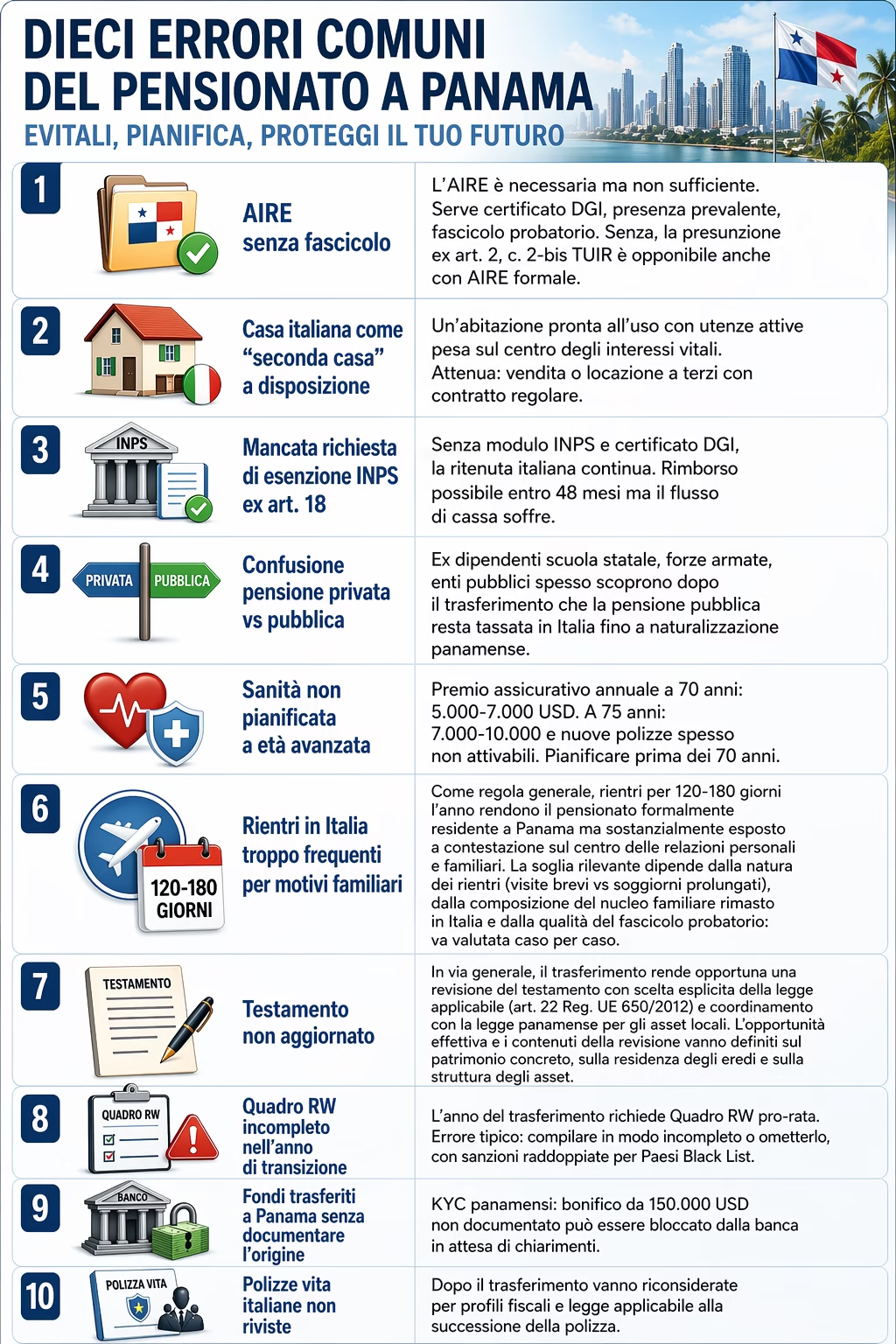
- AIRE without a supporting documentation. An AIRE is necessary but not sufficient to rebut the presumption of Italian residency. A DGI certificate, evidence of a significant physical presence in Panama, and a complete supporting documentation for each year of foreign residency are required. Without these, the presumption pursuant to art. 2, paragraph 2-bis of the TUIR (Consolidated Law on Income Tax) is enforceable against the pensioner even with a formally correct AIRE.
- An Italian home maintained as a "second home" is available. A ready-to-use home in Italy with active utilities is a significant consideration when assessing the center of vital interests. Mitigation strategies include selling the property or renting it to a third party under a registered contract.
- Failure to request the INPS exemption pursuant to Article 18. Without the INPS form accompanied by the DGI certificate, Italian pension withholding tax continues to apply. Reimbursement is possible within 48 months by submitting a request to the Pescara Operations Center, but this will impact interim cash flow.
- Confusion between private and public pensions. Former employees of state schools, the armed forces, and public institutions discover only after their transfer that their public pension remains taxed in Italy pursuant to Article 19 until they become Panamanian naturalized, contrary to their initial expectations of immediate tax exemption.
- Unplanned healthcare at a critical age. Private health insurance can cost $5,000–$7,000 per year at age 70, and $7,000–$10,000 at age 75. Without proper planning before age 70, retirees risk being left without coverage or facing unaffordable premiums.
- Excessively frequent returns to Italy for family reasons. As a general rule, returns for 120-180 days per year make the pensioner formally resident in Panama but essentially vulnerable to disputes regarding the center of personal and family relationships. The relevant threshold depends on the nature of the returns, the composition of the family unit remaining in Italy, and the quality of the evidence: it must be assessed on a case-by-case basis.
- Will not updated. Generally, the transfer makes it appropriate to revise the will, explicitly choosing the applicable law (Article 22 of EU Regulation 650/2012) and coordinating with Panamanian law for local assets. The actual opportunity and content must be defined based on the specific assets, the heirs' residence, and the asset structure.
- Incomplete RW form in the transition year. In the transfer year, two pro-rata completions are required: the period of Italian residence and the period of Panamanian residence. An incomplete RW form is a typical error, with doubled monitoring penalties for Blacklisted countries.
- Funds transferred to Panama without documentation of origin. Panamanian banks' KYC procedures require proof of origin. An undocumented transfer of $150,000 is typically blocked pending clarification and supporting documentation of origin.
- Italian life insurance policies not reviewed. Policies with family beneficiaries must be reviewed in light of new tax regulations, the applicable law on inheritance, and the residency of the beneficiary heirs.
Panamanian citizenship after five years of residence
An Italian pensioner can apply for Panamanian naturalization after five years of effective permanent residence. The legal basis is Article 10 of the Panamanian Constitution, supplemented by Law 2 of August 27, 2008, and subsequent amendments. The five-year period begins from the date of issuance of permanent residence, i.e., the date of delivery of the definitive Pensionado carnet. Panama permits dual citizenship with Italy, and the Panamanian passport allows visa-free entry to over 140 countries through 2026 (subject to verification of the bilateral agreements in force at the time of issuance).
Requirements for naturalization
The five requirements for Panamanian naturalization are five years of effective permanent residency, passing a basic Spanish oral exam at the Naturalization Office, passing a written exam on Panamanian history, geography, and institutions (prepared using public textbooks), demonstrating integration (economic, social, and family ties to Panama, such as property, associations, and a local social network), and no significant criminal convictions.
Dual citizenship Italy-Panama
Italy fully permits dual citizenship. Panama accepts dual citizenship with specific internal effects: within Panamanian territory, only Panamanian citizenship is used, a clause that has no effect on Italy. In practice, the naturalized pensioner has two passports (Italian and Panamanian), which can be used freely as needed for international travel and banking transactions.
What unlocks citizenship
The main tax benefit unlocks the Italian tax exemption on the public pension pursuant to Article 19 of the Convention, which is not available until citizenship is achieved. The Panamanian passport allows visa-free entry to over 140 countries according to the mobility indices updated to 2026, including the entire Schengen area and the United Kingdom. The exact list must be verified at the time of naturalization as it depends on constantly evolving bilateral agreements. Citizenship does not require renouncing Italian citizenship.
Return to Italy: reversibility of the transfer
Residency in Panama is fully reversible. Return to Italy requires cancellation of AIRE and re-registration with the municipality of the new residence, with an Italian lease or property deed. From the date of re-registration, the pensioner returns to the National Health Service (SSN) (general practitioner, specialist care, hospitalization, and medication under standard Italian conditions), and the pension is subject to standard Italian withholding tax again (Article 18 of the Convention ceases to have effect from the date of the change of residence).
In the year of return, a pro-rata RW form must be completed for foreign assets held during the period of Italian residence, with IVAFE and IVIE calculated pro-rata. Panamanian assets can be retained or disposed of, with specific tax consequences to be planned on a case-by-case basis (capital gains on realisation, Italian taxes on foreign interest and dividends upon return, annual RW form if the assets are retained).
Studio Panama Italia assists Italian retirees with their relocation to Panama and subsequent operational and fiscal management. The package includes a preliminary pension profile analysis, immigration visa selection, opening a Panamanian bank account, possible incorporation of a Panamanian company for mixed income, AIRE registration, DGI tax residency certificate, INPS exemption pursuant to art. 18 of the Convention, Italian compliance (RW Form, IVAFE and IVIE, foreign investiture risk analysis), succession planning through Private Interest Foundations and asset protection structures.
Relocating to Panama as an Italian Retiree: Personalized Consulting
We have been operating from Panama City since 2010, license no. 14465. If you are considering transferring your residency as a retiree to Panama, we can provide a personalized analysis of your specific situation: calculation of the expected tax relief on your private pension, simulation of the cost of living in the chosen area, verification of the Pension Visa requirements, documentation roadmap and operational timelines.
✉️ Write to us on WhatsAppFrequently Asked Questions about Retirement in Panama
What is the minimum pension requirement for a Panamanian pensioner's visa?
$1,000 net per month for life, certified by INPS (National Institute of Social Security) or the Italian Social Security Fund (Cassa di Categoria Italiana). Alternatively, $750 per month plus the purchase of a residential property in Panama with a minimum value of $100,000. Spouse included: +$250 per month towards the minimum threshold (couple total $1,250). Each minor child or student up to age 25: +$250 per month.
Is an Italian pension taxed in Panama?
No, Panama does not tax foreign-source income under the principle of territorial taxation. An Italian private pension is taxable only in Panama pursuant to Article 18 of the Italy-Panama Convention (Law 208/2016): in the typical case, effective taxation is zero, provided that the transfer of tax residence is effective and documented. An Italian public pension remains taxed in Italy pursuant to Article 19 until Panamanian citizenship is obtained.
How do you get the INPS exemption for a pensioner residing in Panama?
The Convention application form must be submitted to INPS along with the Panamanian tax residency certificate issued by the Directorate General (DGI), translated into Italian and apostilled. The initial requirements are a valid AIRE (Italian Income Tax Register), a Panamanian residency carnet, and physical presence in Panama for at least 183 days per year. INPS typically applies the exemption within 2-4 months. Withholdings already withheld can be refunded within 48 months by submitting a request to the Pescara Operations Center.
Are Italian public pensions tax-free in Panama?
Not immediately. Article 19 of the Convention maintains that Italian public pensions are taxed in Italy, unless the pensioner is also a Panamanian citizen. For former public employees (state teachers, military personnel, judges, and doctors with the National Health Service), full tax exemption is available only after Panamanian naturalization, which is accessible after five years of effective permanent residence.
How much does it actually cost to live in Panama as a retiree?
A single retiree typically spends $1,800–$2,500 per month in Boquete, Coronado, or El Valle de Antón; $2,500–$3,500 per month in Panama City. A couple typically spends $2,800–$4,500 per month. The cost of living is 35–50% lower than comparable Italian cities, with additional purchasing power provided by the USD conversion and the tax exemption on private pensions.
Do I have to register with AIRE if I move to Panama?
Yes, it is required by law (Law 470/1988) within 90 days of the actual transfer, at the Italian Embassy in Panama City. AIRE registration automatically removes the pensioner from the Italian National Health Service. Without AIRE, the transfer can be contested by the Revenue Agency, regardless of actual residence.
How does healthcare work for an Italian pensioner moving to Panama?
AIRE removes the pensioner from the Italian National Health Service (NHS). Panama has a private network comparable to the US (Hospital Punta Pacifica, affiliated with Johns Hopkins, Nacional, and Paitilla), with facilities also in David. Private health insurance typically costs $120-250 per month for those aged 55 to 60, and $400-700 per month for those aged 70 to 75. Insurance coverage should be purchased at least six months before moving to avoid uncovered coverage.
Is Panama on the Italian blacklist? What risks does a pensioner face?
Yes, Panama is still on the Ministerial Decree Blacklist of May 4, 1999. Legislative Decree 209/2023 has not amended paragraph 2-bis of Article 2 of the TUIR (Circular 20/E of November 4, 2024). The presumption of Italian residency applies: the pensioner must prove the actual transfer. The defense is the supporting evidence: Panamanian lease agreement, utilities in the pensioner's name, active Panamanian bank account, DGI certificate, physical presence for more than 183 days, termination of non-essential Italian ties.
How many days a year should I stay in Panama?
For immigration residency: no minimum stay requirement. For the DGI certificate: 183 days of physical presence or center of vital interests in Panama. To avoid Italian tax residency: fewer than 183 days in Italy in the calendar year. The optimal distribution is typically 220-280 days in Panama and 85-145 days in Italy.
Can I return to Italy if I change my mind after moving?
Yes, residency in Panama is fully reversible. You must cancel your AIRE (Italian National Insurance Registry) and re-register in Italy. From the date of re-registration, your SSN (National Health Service) is reinstated, and your pension will be subject to ordinary Italian withholding tax again (Article 18 of the Convention ceases to apply). In the year of re-entry, a pro-rata RW form must be completed for any foreign assets held.
Can I obtain Panamanian citizenship as a retiree?
Yes, after five years of effective permanent residency. Requirements include an oral Spanish exam, a written exam on Panamanian history and geography, proof of integration (property, associations, social ties), and no relevant criminal convictions. Panama allows dual citizenship with Italy. The Panamanian passport allows visa-free access to over 140 countries by 2026, including the Schengen area. Citizenship unlocks the tax exemption for Italian public pensions pursuant to Article 19.
Where is it best to live in Panama as an Italian retiree?
The top choices are Boquete (mountains, spring-like climate, over 3,000 expats), Coronado (Pacific Coast, gated community, golf), El Valle de Antón (volcanic crater, rural atmosphere, tranquility), Panama City (capital, health care in Punta Pacifica, urban life), and Pedasí (authentic coast of the Azuero Peninsula). Your choice depends on your healthcare profile, preferred climate, monthly budget, and the community you're looking for.
Can I transfer my Italian pension to a Panamanian account?
Yes. Once the Panamanian account is opened (Banco General, Banistmo, Scotiabank Panamá, Global Bank, Multibank), the pensioner provides the INPS with the IBAN and SWIFT of the Panamanian account. The transfer arrives within 2-5 business days with a fee of $15-35 per month. Many pensioners also maintain an Italian bank account during the first year of transition to quickly process INPS documentation requests.
How much do I actually save by moving my pension to Panama?
The savings are the result of three cumulative effects: tax relief under Article 18 (€200-700 per month on the private pension), a 35-50% lower cost of living, and increased purchasing power. For a retiree earning €2,200 per month, the typical improvement is €500-800 equivalent per month, or €120,000-195,000 over 20 years of remaining pensionable income. For a couple earning €3,800 per month, the difference is typically €8,000-14,000 per year, or €160,000-280,000 over 20 years.
