

S-Corp for Non-Resident Italians: Why You Can't Open One and What to Do Instead
The S-Corp is the most desired and most misunderstood US corporate structure among Italian entrepreneurs. According to a specific federal regulation, Section 1361(b)(1)(C) of the Internal Revenue Code, an S-Corp cannot have a nonresident alien as a shareholder: anyone who is not a US citizen or resident alien is automatically excluded from the capital of an S-Corporation. This means that an Italian entrepreneur resident in Italy, Malta, Dubai, or any other country cannot hold shares in an S-Corp, not even through a holding company or an ordinary trust.
This is a common mistake because the S-Corp is presented online as the most tax-efficient US structure, with pass-through taxation and no double taxation on dividends. This is true, but only for those who can own it. For non-residents, the S-Corporation is not an option that requires planning: it is an option that federal law precludes from the outset, unless specific tax residency or US citizenship is achieved.
This guide explains what an S-Corp really is, why a non-resident Italian is excluded, what happens if they become a shareholder by mistake, the three legitimate routes that still open the way to an S-Corp, and the correct alternative to adopt today: the C-Corporation. Data updated as of April 2026, with regulatory references including IRC, IRS, and the Italy-US treaty.
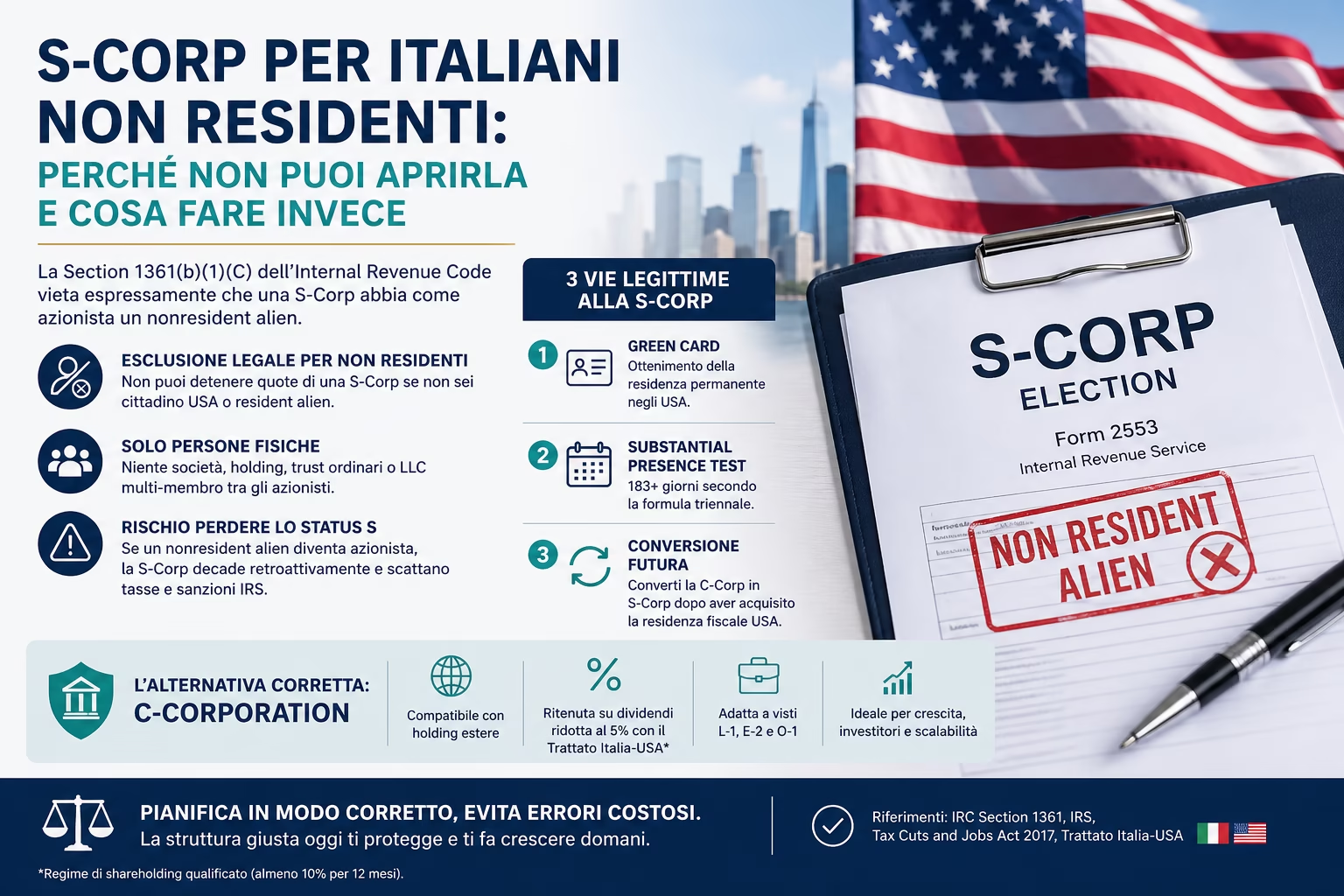
Key Elements of an S-Corp for Non-Resident Italian Entrepreneurs
- Statutory Exclusion for Nonresidents: Section 1361(b)(1)(C) of the Internal Revenue Code expressly prohibits an S-Corp from having a nonresident alien as a shareholder. This is a federal prohibition and cannot be circumvented by state or contractual provisions.
- IRS definition of nonresident alien: someone who is neither a US citizen nor a resident alien (green card test or substantial presence test). All Italian entrepreneurs residing in Italy, Malta, the EU, the UAE, and South America fall into this category.
- Individuals only: An S-Corp cannot be owned by a corporation, partnership, multi-member LLC, or foreign holding company. Anyone wishing to structure their US business as a subsidiary of a European company is completely excluded.
- Maximum 100 shareholders, only one class of shares: the S-Corp has rigid structural constraints that make it unsuitable for venture capital operations or the entry of institutional investors.
- Consequences of the error: If a nonresident alien becomes a shareholder for any reason, the S-Corp retroactively loses Subchapter S status and is reclassified as a C-Corp with double taxation on all past dividends, plus IRS penalties.
- ESBT Trusts as the only partial exception: After the Tax Cuts and Jobs Act of 2017, an Electing Small Business Trust can have nonresident alien beneficiaries, but the trust must be domestic and the shareholder remains the trust, not the foreign individual.
- Three legitimate routes to an S-Corp: obtaining a green card, satisfying the substantial presence test (183+ days with the three-year formula), and converting the C-Corp to an S-Corp after acquiring US tax residency.
- Current alternatives: A Wyoming or Delaware C-Corporation, offering comparable tax efficiency for non-residents, the option of a subsidiary of a European holding company, and compatibility with L-1, E-2, and O-1 visas.
- Italy-USA Treaty: A C-Corp can distribute dividends to an Italian or European parent with a reduced 5% withholding tax under a qualified shareholding regime, largely neutralizing the formal double taxation of the C structure.
What an S-Corporation Really Is
An S-Corp is a domestic corporation that has made a specific tax election with the Internal Revenue Service to be taxed under Subchapter S of Chapter 1 of the Internal Revenue Code, rather than Subchapter C like most U.S. corporations. The election is made by filing Form 2553 within the first part of the applicable tax year or within 75 days of the company's incorporation.
The tax effect of the S-Corp election is so-called pass-through taxation: the S-Corporation does not pay federal corporate income tax (except for a few residual cases such as the built-in gains tax). Net income, deductions, credits, and losses are allocated pro rata to shareholders, who declare them on their personal Form 1040. This eliminates the double taxation typical of C-Corps, where the corporation pays 21% federal tax on profits and shareholders pay a second rate on distributed dividends.
The S-Corp was created in 1958 with the stated goal of the US Congress to favor small family-run businesses and small American entrepreneurs. It was not designed for foreign investors, which explains why the eligibility requirements have historically been designed to exclude them.
Concrete tax benefits for those who can access them
For a US citizen or resident alien, an S-Corp offers concrete tax advantages over both a C-Corp and an LLC. The self-employment tax (15.3% of Social Security and Medicare) applies only to the "reasonable salary" that the shareholder-employee receives as compensation, while distributions beyond the salary are exempt from Social Security contributions. A traditional LLC, on the other hand, taxes all income as self-employment income.
Furthermore, since the Tax Cuts and Jobs Act of 2017 and until 2025, shareholders of an S-Corp operating in non-SSTB (Specified Service Trade or Business) sectors have been entitled to a Section 199A deduction equal to 20% of their Qualified Business Income, significantly reducing the pass-through federal effective tax rate. These advantages explain why so many US entrepreneurs choose an S-Corp and why Italian entrepreneurs hear about the S-Corp as the most efficient instrument.
The requirements of Section 1361 of the Internal Revenue Code
Access to S-Corporation status is governed by Section 1361(b)(1) of the Internal Revenue Code, which defines a "small business corporation" eligible for S status as a domestic corporation that cumulatively meets six requirements. All must be met at all times during the taxable year; violation of even one results in the automatic loss of S status.
The six requirements of Section 1361 are as follows.
- Domestic corporation: The S-Corp must be incorporated under the laws of one of the fifty U.S. states or the District of Columbia. Foreign corporations are excluded, even if they operate entirely in the U.S.
- Maximum 100 shareholders: The shareholder limit is one hundred people, with specific rules for counting households (a household can count as only one shareholder).
- Only natural persons, certain trusts, and certain estates: partnerships, other corporations, multi-member LLCs, and foreign holding companies cannot be shareholders of an S-Corp. Natural persons and certain qualified trust categories (grantor trusts, QSSTs, ESBTs, voting trusts, and testamentary trusts in the first two years) are eligible.
- No nonresident aliens as shareholders: the central prohibition, the subject of this page, contained in Section 1361(b)(1)(C). Nonresident alien is the tax category of non-US resident foreign natural persons, which includes almost all Italian entrepreneurs who have not moved to the USA.
- Single class of stock: The S-Corp cannot issue preferred stock, Class A/B shares with differentiated rights, shares with multiple voting rights, or convertible instruments that are equivalent to a second class of stock. Differentiation is permitted only in voting rights, not in economic rights.
- Non-ineligible corporations: banks and thrift institutions using the credit reserve method, Subchapter L insurance companies, DISCs, and possessions corporations are excluded from the S election.
The fourth requirement closes the door to non-resident Italian entrepreneurs. The third requirement closes the door to Maltese holding companies, Italian groups, and multi-member LLCs. The sum of these two rules out all the cross-border structures typical of European entrepreneurs seeking to operate in the US.
Why a non-resident Italian is automatically excluded
The IRS defines a nonresident alien as an individual who is neither a US citizen nor a resident alien. A person is considered a resident alien for US tax purposes if they meet the green card test (holding a Permanent Resident Card) or the substantial presence test, which requires physical presence for at least 31 days in the current year plus 183 days in the rolling three-year period, counted using a weighted formula: all days of the current year, one-third of the days of the previous year, and one-sixth of the days of the previous year.
All Italian entrepreneurs residing in Italy, Malta, the EU, Switzerland, Dubai, South America, or Asia who do not have a green card and fail to pass the weighted formula of the substantial presence test are nonresident aliens for the IRS and are therefore excluded from S-Corp membership pursuant to Section 1361(b)(1)(C). Exclusion is automatic and non-discretionary: there are no waivers, exemptions, registered exceptions, or exceptions for citizens of countries with which the U.S. has double taxation treaties.
The E-2 visa for treaty investors, the L-1 visa for intra-company transfers, and the O-1 visa for extraordinary ability do not automatically make an Italian a U.S. resident alien. This status is achieved only if, during the validity of the visa, the substantial presence test is met in terms of actual days of physical presence in the U.S. An Italian entrepreneur with an L-1 visa who frequently returns to Italy or travels to other countries may fail the test and remain a nonresident alien for years, consequently being excluded from the S-Corp even with an active visa.
The logic of Section 1361(b)(1)(C) is consistent with the pass-through nature of the S-Corp. If a nonresident alien were admitted as a shareholder, the S-Corp income would be attributed to him or her pro rata via Schedule K-1, but the IRS would have structural difficulties in exercising its taxing power on the individual nonresident shareholder. To avoid this situation, the legislator preferred to close access to the S regime at the outset, leaving nonresidents only the option of a C-Corp, which pays taxes directly as an independent legal entity.
The European, Italian or Maltese holding company cannot hold an S-Corp
The requirement under Section 1361(b)(1)(B) requires that S-Corp shareholders be individuals or certain qualified trusts and estates. All corporations and collective legal entities are excluded: U.S. corporations, foreign corporations, partnerships, multi-member LLCs, Italian Srls, German GmbHs, Spanish SAs, Maltese holding companies, Dutch holding companies, and offshore IBCs.
This means that an Italian entrepreneur wishing to structure their US business as a subsidiary of an existing European company—the classic model for those seeking an L-1 visa through intra-company transfer—cannot even theoretically choose an S-Corp: the European holding company could not hold the shares. The S-Corporation is designed for small, individual American entrepreneurs, not for multinational corporate groups. For the subsidiary of a European group, the only correct choice is a C-Corp.
What happens if you make a mistake and become a shareholder by mistake?
Even a temporary admission of a nonresident alien as a shareholder of an S-Corp automatically and retroactively terminates the S election, effective as of the day the disqualifying event occurred. This is not a discretionary IRS penalty; it is an automatic legal consequence under IRC Section 1362(d)(2).
The tax consequences are severe and cumulative. The company is reclassified as a C-Corporation starting from the date of disqualification, with the requirement to file Form 1120 (C-Corp tax return) instead of Form 1120-S (S-Corp tax return) for the remainder of the tax year. Corporate income is taxed at 21% federally as a C-Corp, losing the pass-through. Dividends distributed after disqualification are subject to secondary taxation at the U.S. qualified dividend rate. Distributions made before disqualification that exceed the stock basis are recalculated.
Added to these substantial consequences are the penalties for incorrect filing: filing a Form 1120-S when you should have filed a Form 1120 exposes you to Section 6651 penalties for failure to file or late filing the correct Form, plus interest on the unpaid tax. For companies with significant income, the total penalty can exceed tens of thousands of dollars before the actual tax is even incurred.
The subsequent disqualification period is equally significant: under Section 1362(g), a corporation that has lost S status due to disqualification cannot re-elect Subchapter S status for the next five tax years, unless the IRS exercises discretionary waiver, which is rare and costly. The S-Corp becomes a C-Corp and remains so for at least half a decade.
The most underestimated operational risk is transfer of shares. If a US shareholder of an S-Corp bequeaths shares to a non-US resident heir (for example, an Italian child residing in Italy), the heir becomes a shareholder and automatically terminates the company's S status. Estate planning for an S-Corp with foreign family members requires specific tools, typically qualified trusts, which must be established prior to the inheritance event.
ESBT Trust: The Only Partial Exception
There is a technical exception worth knowing, even if it rarely applies to individual Italian entrepreneurs. This is the Electing Small Business Trust, abbreviated ESBT, governed by Section 1361(c)(2)(A)(v) of the IRC. The ESBT is a US domestic trust that can hold shares in an S-Corp and, following the 2017 Tax Cuts and Jobs Act, can also have a nonresident alien as a potential current beneficiary.
The opening introduced by the TCJA is important for US-Italian family estate planning: a US citizen with Italian children or spouse residing in Italy can now include these family members as beneficiaries of an ESBT that holds shares in the family S-Corp, without losing their S status. Before 2017, this planning was precluded.
However, the ESBT does not solve the problem for Italian entrepreneurs who wish to directly own the S-Corp. The shareholder remains the domestic trust, not the Italian individual. The trust pays taxes on the S-Corp income distributed to the nonresident alien beneficiary at the full federal S-Corp rate (at most the marginal rate), significantly reducing the structure's tax efficiency. The ESBT is an estate planning tool, not an operational vehicle for foreign investors to access the S-Corp.
The Three Legitimate Ways to Access the S-Corp
For an Italian entrepreneur who is currently a nonresident alien, there are three legitimate paths that, once completed, open up full access to an S-Corp. All three require a change in U.S. tax status: the S-Corp is never "unlocked" for a nonresident as such; it is unlocked when the nonresident becomes, for IRS purposes, a resident alien or a U.S. citizen.
Step 1: Obtaining a Permanent Resident Card
The green card automatically converts the Italian entrepreneur into a U.S. resident alien upon issuance, satisfying the green card test pursuant to IRC Section 7701(b)(1)(A)(i). The green card holder may become a shareholder of an S-Corp from the day after the card is issued by filing a Form 2553 S election if the company has not already filed one.
Typical green card pathways for Italian entrepreneurs are the EB-5 (Investor Green Card, minimum investment of $800,000 in a Targeted Employment Area or $1,050,000 elsewhere), the EB-1C (Multinational Manager or Executive, possible after an L-1A period), and the EB-2 NIW (National Interest Waiver, for scientific or highly specialized profiles). Typical time between the start of the pathway and the actual green card: 18-36 months.
Route 2: Substantial presence test met
Physical presence in the US for at least 183 days in the current year, counted using the full formula, or 31 days in the current year plus 183 days using the weighted formula over the three-year period (all days of the current year plus one-third of the days of the previous year plus one-sixth of the days of the previous year), transforms the nonresident alien into a resident alien from the day the threshold is exceeded.
Once an Italian becomes a resident alien due to substantial presence, they can hold shares in an S-Corp. However, it should be noted that a resident alien is taxed in the US on their worldwide income, just like a US citizen: all worldwide income, including Italian income, must be declared to the US tax authorities, with the possibility of a tax credit on income also taxed in Italy. Planning requires carefully evaluating the trade-off between access to an S-Corp and expanding the US tax base to include worldwide income.
Route 3: Open a C-Corp today and convert it to an S-Corp tomorrow
The most common route taken by Italian entrepreneurs gradually migrating to the US is a two-step process: a C-Corporation is established today in Wyoming or Delaware, it operates as a C-Corp for one or more years, paying 21% federal tax, and when the entrepreneur acquires resident alien status (via a green card or the substantial presence test), Form 2553 is filed and the S-Corp election is made, effective from the following tax period.
The technical conversion from C-Corp to S-Corp is simple in terms of form (Form 2553 within the required timeframe), but requires tax verification of certain aspects: the presence of latent built-in gains at the time of conversion (taxed at 21% if realized within five years of the election), any earnings and profits accumulated as a C-Corp that may trigger the passive investment income tax, and an assessment of the continuity of the basis. For early-stage companies without significant built-in gains, the conversion is clean and produces immediate pass-through tax benefits.
The right alternative today: the C-Corporation
For the non-US resident Italian entrepreneur who wants to operate in the United States today, the correct alternative to the S-Corp is not a "slipped-around S-Corp" but the C-Corporation, in its classic form. The C-Corp has no restrictions on shareholder nationality, can be owned by an Italian or Maltese holding company, accepts multiple share classes to accommodate institutional investors, and is perfectly eligible for the L-1 visa in the parent-subsidiary regime.
The standard objection against a C-Corp is double taxation: the company pays 21% federal tax on net income, and dividends distributed to shareholders are paid a second time. For the Italian nonresident alien, this objection is essentially neutralized for two converging reasons. First, the dividend distributed to an Italian parent is subject to only a 5% US withholding tax under a qualified shareholding regime (at least 25% directly held), pursuant to the 1999 Italy-US Double Taxation Convention, ratified by Law 20/2009 and in force since 2009. Second, a C-Corp allows for the full deductibility of salaries, intercompany management fees, royalties, and interest on shareholder loans, reducing the residual tax base on which the 21% federal tax is calculated.
The C-Corp is also the standard market structure for venture capital investors or angel investors, who never invest in S-Corps (due to the exclusion of entity shareholders) or LLCs (due to the complexity of the K-1 filing on their LPs). If an Italian entrepreneur anticipates, even if only in the future, the entry of US institutional investors, starting with a C-Corp avoids subsequent conversions, which are feasible but costly.
The choice between Wyoming and Delaware as the state to incorporate a C-Corp depends on the expected growth profile. Wyoming is the most efficient choice for a consulting firm or engineering boutique that remains privately held: zero state income tax, low annual fees, and a high level of privacy. Delaware is the right choice if the plan is to raise funds from institutional venture capital, given the established case law of the Court of Chancery and the familiarity of US investors with Delaware corporate law. For an in-depth analysis of this choice, see the C-Corporation guide for Italian entrepreneurs.
L-1, E-2, O-1 and the relationship with S-Corp
The three most relevant U.S. work visas for Italian entrepreneurs (L-1 for intra-company transfer, E-2 for treaty investor, O-1 for extraordinary ability) have different effects on S-Corp access. The general rule is that the visa itself does not make the individual a resident alien for tax purposes: one becomes one only if they pass the substantial presence test. Therefore, issuing the visa is a necessary but not sufficient condition for S-Corporation access.
The L-1 visa requires a qualifying relationship between a foreign Italian or European company and a U.S. company: parent-subsidiary, branch, or affiliate. To accommodate the L-1, the U.S. subsidiary must be a corporation or LLC with ownership of the parent, a structure that is radically incompatible with an S-Corp (the entity shareholder is excluded from Section 1361(b)(1)(B)). The only valid choice for the L-1 setup is a C-Corporation.
The E-2 visa requires a substantial investment in a U.S. entity by a citizen of a country with a bilateral treaty of friendship and trade with the United States (Italy is included). The investment can be made in a C-Corp, LLC, or, theoretically, an S-Corp if the investor is already a resident alien or U.S. citizen. In practice, the E-2 visa is granted to a nonresident who becomes an investor through the visa, so at the time of granting the visa, the investor is still a nonresident alien. For the E-2 visa, an S-Corp is also precluded upon initial setup; it may become possible after the E-2 holder meets the substantial presence test through physical presence in the United States.
The O-1 visa for extraordinary ability is the most structurally flexible: it requires no minimum investment or specific corporate relationship, and the O-1 holder can be a shareholder in a US corporation. However, the general rule applies here too: the O-1 itself is not a resident alien; one becomes one only after passing the substantial presence test. For the initial setup with an O-1, a C-Corp remains the dominant choice; conversion to an S-Corp is reasonable after the first or second year of actual US physical residency.
For a complete map of US visas for Italian entrepreneurs and the choice of corporate structure for each, see the US work visa guide.
Quick comparison of S-Corp, C-Corp, and LLC for non-residents
Summarizing the four crucial variables for Italian entrepreneurs (non-resident access, tax regime, subsidiary options, visa compatibility), the comparative picture is clear.
- S-Corp: Nonresident access prohibited by Section 1361(b)(1)(C). Pass-through taxation. Subsidiary of foreign parent prohibited. Visa compatibility: only after obtaining U.S. tax residency. Verdict for Italian nonresidents today: not available.
- C-Corp: Non-resident access fully permitted, including 100% ownership. Corporate tax rate: 21% federal, withholding tax on dividends to the foreign parent reduced to 5% in shareholdings qualified by the Italy-US treaty. Subsidiary of foreign parent fully permitted, standard form. Visa compatibility: optimal for L-1, good for E-2 and O-1. Verdict: primary choice for non-residents.
- LLC: Non-resident access permitted. Default taxation as a disregarded entity (single member) or partnership (multi-member), with income traced to foreign members, exposing them to permanent establishment in the US and Form 5472 requirements with penalties of $25,000 for omission. Subsidiary of a foreign parent is technically possible but fiscally sensitive. Visa compatibility: eligible for E-2 and O-1, more complex for L-1. Verdict: niche option, not default.
For the typical case of a non-resident Italian entrepreneur looking to operate in the US today, the right choice is almost always a C-Corp in Wyoming, with consideration for Delaware if funding from institutional venture capital is expected. The S-Corporation is a long-term goal, to be achieved after acquiring US tax residency through a green card or substantial presence.
Costs and times for correct incorporation
Incorporating a C-Corporation in Wyoming, the ideal alternative to an S-Corp for non-residents in Italy, is cost-effective and timely. Studio Panama Italia performs the complete incorporation process at an all-inclusive cost of $800, which includes the Wyoming state filing fee, a first-year registered agent, drafting the articles of incorporation and standard bylaws, obtaining an EIN from the IRS, organizational minutes, and the initial share register. The turnaround time is four business days from receipt of the client's documents to delivery of the incorporated corporation.
The annual maintenance cost of a Wyoming C-Corp includes the registered agent (typically $100–$150), the state annual reporting fee (minimum $60 in Wyoming), the Form 1120 federal tax filing with professional tax compliance, and any bookkeeping. For early-stage companies with no US employees, the typical annual maintenance is $1,500–$2,500 in total.
For a structured calculation of the complete setup (entity, EIN, banking referral, legal counsel immigration), as well as a comparison with other jurisdictions such as Delaware, New Mexico, and Florida, see Studio Panama Italia's guide to US Corporate services
Mistakes to avoid when choosing a US facility
Three common mistakes we receive from Italian entrepreneurs interested in S-Corps are: Knowing them beforehand will help you avoid wasting time and money.
- Incorporating an S-Corp via online providers without verification: Some online company formation services in the US do not verify the client's tax status when electing an S-Corp. The S-Corp is formally incorporated and elected, but its eligibility is flawed from day one. Disqualification occurs upon the first IRS audit, typically the first Form 1120-S filed.
- Contemplating concealing nonresident alien status: The declaration of eligibility on Form 2553 is subject to perjury. Knowingly failing to disclose nonresident alien status constitutes a federal tax offense, with consequences far beyond the simple loss of S status. This is not an option.
- Relying on an LLC with an S election: An LLC can elect an S status and be taxed as an S-Corp under Treasury Regulation 301.7701-3. However, the S election requires the LLC itself to meet all the requirements of Section 1361, including the prohibition on nonresident aliens as members. An LLC with a nonresident Italian member cannot elect S status, just like a corporation.
Conclusion: the right path for the Italian entrepreneur
An Italian entrepreneur wishing to operate in the US today has a straightforward and well-defined path ahead, starting with a C-Corporation rather than an S-Corp. A C-Corp is established in Wyoming, or in Delaware if venture capital is envisioned, possibly as a subsidiary of one's Italian or European company to access the L-1 route. It operates as a C-Corp, paying 21% federal tax, with full salary planning, management fees, and dividend distribution to the parent company under treaty arrangements.
If in the medium term the entrepreneur acquires green cards directly (EB-5, EB-1C, EB-2 NIW) or meets the substantial presence test through physical presence in the US, he or she can then evaluate converting the C-Corp to an S-Corp via Form 2553, finally accessing the pass-through regime and the benefits of Subchapter S. Conversion is a future plan, not a day-one worry.
The S-Corp is not a goal that non-resident Italians should try to circumvent. It is a US tax law provision designed for small, resident American entrepreneurs, with nationality and tax residency requirements that by law exclude almost all European entrepreneurs. Recognizing this limitation from the outset and pursuing a C-Corporation as a strategically sound choice is the professional way to enter the US market. Studio Panama Italia assists Italian and European entrepreneurs in establishing C-Corps in Wyoming and Delaware, coordinating work visa arrangements with a legal counsel partner specializing in immigration law.
Frequently Asked Questions about S-Corps for Non-Resident Italians
Can I open an S-Corp if I am an Italian citizen residing in Italy?
No. Section 1361(b)(1)(C) of the Internal Revenue Code expressly excludes nonresident aliens from the capital of an S-Corp. An Italian citizen residing in Italy is a nonresident alien for the IRS and cannot be a shareholder of an S-Corporation. The correct structure to adopt today is a C-Corporation, which can be converted into an S-Corp after acquiring U.S. tax residency through a green card or substantial presence test.
Can I open an S-Corp with an E-2 treaty investor visa?
Not automatically. The E-2 visa itself does not make the holder a resident alien in the eyes of the IRS. One becomes a resident alien only if they meet the substantial presence test (physical presence in the US for 183 days with a weighted three-year formula). An E-2 holder who stays in Panama City, Rome, or Dubai for most of the year remains a nonresident alien and cannot access an S-Corp. Conversion is possible only when physical US presence is sufficient to satisfy the test.
Does a green card automatically make me eligible for an S-Corp?
Yes. The IRC Section 7701(b)(1)(A)(i) green card test automatically qualifies the holder as a resident alien for U.S. tax purposes from the day the Permanent Resident Card is issued. From that moment the holder can hold shares in an S-Corp and can make the S election on an existing U.S. corporation by filing Form 2553 within the required timeframe.
Can my brother, who is a US citizen, open an S-Corp and let me join as a partner?
No. If you join as a nonresident alien shareholder, the S-Corp retroactively loses its Subchapter S status from the day you join, and the company is reclassified as a C-Corp with double taxation. Your brother can open and maintain the S-Corp alone or with other eligible shareholders. To involve you as a foreign family member, there are other options: electing a Small Business Trust with you as the beneficiary, or establishing a separate C-Corp that operates as a joint venture with your brother's S-Corp.
Is an LLC with an S election a solution for a non-resident?
No. An LLC can elect an S status pursuant to Treasury Regulation 301.7701-3 and be taxed as an S-Corp, but to be eligible for the election, the LLC must meet all the requirements of Section 1361, including the prohibition on nonresident alien members. An LLC with a nonresident Italian member cannot elect S status, just like a corporation. The restriction is substantive, not formal: it applies to any entity taxed as an S, regardless of its state legal form.
Can my Italian LLC be a member of an American S-Corp?
No. IRC Section 1361(b)(1)(B) allows only natural persons and certain qualified trusts and estates to be shareholders of an S-Corp. Corporations are excluded: neither U.S. corporations, foreign corporations, partnerships, multi-member LLCs, Italian Srls, German GmbHs, nor Maltese holding companies can be shareholders of an S-Corp. For the subsidiary of a European corporate group, the only correct choice is a C-Corporation.
What happens if I accidentally become a shareholder in an S-Corp?
The S-Corp retroactively loses Subchapter S status from the date of disqualification, pursuant to Section 1362(d)(2) of the IRC. It becomes a C-Corporation subject to a 21% federal corporate income tax and a second tax on dividends. The corporation must file Form 1120 instead of Form 1120-S, subject to Section 6651 penalties for prior filing errors. Reelection as an S corporation is barred for five years. Disqualification has severe and cumulative effects: prevention through proper structure selection is the only rational approach.
Is an ESBT trust a solution for indirectly owning an S-Corp?
The Electing Small Business Trust is an estate planning tool, not an operational vehicle for nonresidents wishing to hold an S-Corp. Following the 2017 TCJA, the ESBT can also have a nonresident alien as a potential current beneficiary, opening up US-Italy estate planning opportunities, but the shareholder remains the domestic trust. Taxes on S-Corp income distributed to the nonresident alien beneficiary are paid in the US at the maximum marginal rate, reducing the tax efficiency of the pass-through. The ESBT is useful when a US patriarch wishes to leave S-Corp holdings to Italian heirs without losing S status, not when an Italian entrepreneur wishes to "buy" an S-Corp.
How much does the C-Corp alternative to the S-Corp cost?
Incorporating a Wyoming C-Corporation with Studio Panama Italia costs $800 all-inclusive, and takes four business days. The package includes the state filing fee, first-year registered agent, articles of incorporation, standard bylaws, obtaining an EIN from the IRS, organizational minutes, and the initial share register. Typical annual maintenance is $1,500–$2,500, including the registered agent, state annual reporting fee, federal Form 1120, and basic bookkeeping. Costs and time are comparable to or less than those required to incorporate a standard S-Corp, with the crucial advantage that a C-Corp is truly accessible to non-Italian residents.
Can I convert my C-Corp to an S-Corp after I get my green card?
Yes. The conversion from a C-Corporation to an S-Corporation is accomplished by filing Form 2553 with the IRS by the first part of the desired initial tax year. This is a common plan: an Italian entrepreneur currently establishes a C-Corp in Wyoming, operates it for two or three years during the green card process, and upon issuance of the Permanent Resident Card, converts to an S-Corp by accessing the pass-through. The checks to be performed before the conversion concern latent built-in gains (taxed at 21% if realized within the following five years) and the earnings and profits accumulated as a C-Corp. For early-stage companies without significant built-in gains, the conversion is clean.
Wyoming or Delaware for the C-Corp alternative to the S-Corp?
Wyoming is the standard case for the Italian consulting or engineering-driven entrepreneur who remains privately held: zero state income tax, low annual fees, high privacy, and minimal maintenance costs. Delaware is the preferred option if funding is expected from US venture capital or institutional angel investors, due to the established case law of the Court of Chancery and investors' familiarity with Delaware corporate law. Nevada is less competitive after recent increases in commercial license fees. Florida may be considered if a physical operational presence is planned in the state, otherwise Wyoming remains the lowest total cost option.
Is the L-1 visa compatible with an S-Corp?
No, never. The L-1 intra-company transfer visa requires that the US subsidiary be owned by the foreign parent (the Italian, Maltese, or European company transferring the manager). An S-Corp cannot have an entity as a shareholder (Section 1361(b)(1)(B) IRC), so the US subsidiary for the L-1 must be a C-Corporation or an LLC with election C. For the L-1 setup, the correct choice is always C-Corp. The S-Corp remains unavailable even after the L-1 manager obtains a green card, because the foreign parent would continue to be an ineligible shareholder.
Incorporation of a US C-Corporation with Studio Panama Italia
Wyoming C-Corp all-inclusive for $800, four business days, federal EIN obtained, first-year registered agent, complete corporate documents. Coordination with legal counsel partner for L-1, E-2, or O-1 visa.
