

RW Framework: Guide to Tax Monitoring of Accounts, Companies, Real Estate, and Cryptocurrencies Abroad
The RW section of the Italian tax return is where every individual with tax residence in Italy must declare their assets and financial assets held abroad. This requirement includes foreign bank accounts, shares in foreign companies (LLC, SA, IBC, Ltd), real estate held outside Italy, cryptocurrencies held on exchanges or wallets, foreign insurance policies, safe deposit boxes, stock options on shares of non-resident companies, precious metals, and works of art held abroad. This requirement is set forth in Article 4 of Legislative Decree 167/1990, and also applies to those holding assets through trusts, foundations, or fiduciaries. It applies regardless of whether the activity generates income. Penalties for failure to complete the form or for incorrect filing range from 3% to 15% of the undeclared value, doubled (from 6% to 30%) for assets held in former Black List countries. The obligation ceases entirely when the taxpayer transfers tax residence abroad and is no longer resident in Italy.
This guide, updated for 2026 and in accordance with the Revenue Agency's instructions for the Personal Income Tax Form, explains who is required to complete it, what must be declared, how the values are determined, the exemption thresholds for current accounts, how IVAFE and IVIE related to the RW Form work, what penalties apply, and how to regularize past omissions through effective repentance. For those who have a bank account in Panama , an LLC in the United States , a Panamanian corporation , an offshore account , or cryptocurrency accounts on foreign exchanges, this page contains complete operating instructions for Italian tax compliance and information on how to eliminate the obligation by transferring residency.
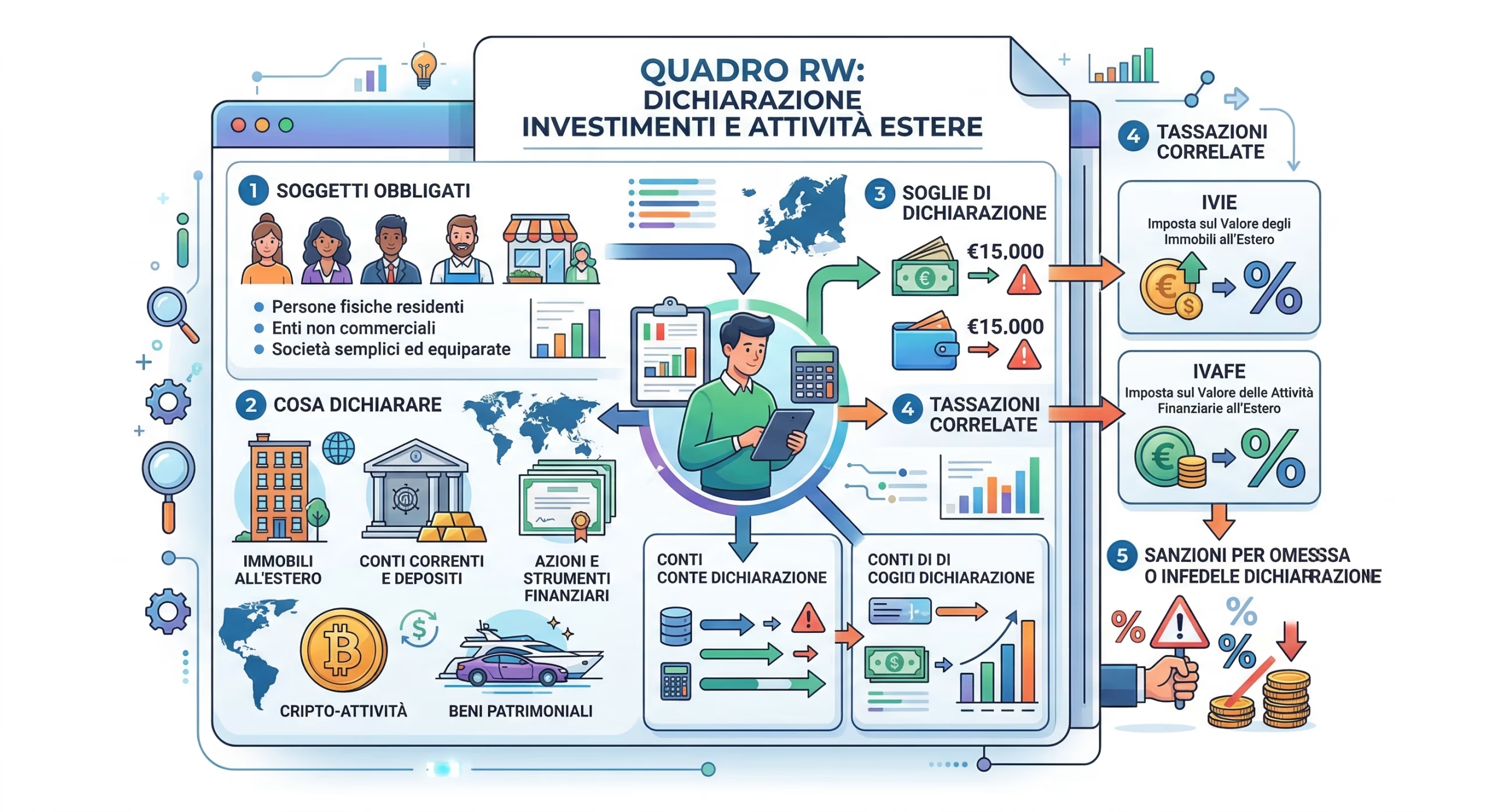
Operational summary
- What it is: section of the Personal Income Tax Form (or Section W in the 730 form, from 2024) for monitoring foreign activities, provided for by art. 4 of Legislative Decree 167/1990
- Who is required: natural persons, non-commercial entities and simple partnerships tax resident in Italy, including beneficial owners of foreign entities
- What to declare: foreign bank accounts, company shares, real estate, cryptocurrencies, foreign insurance policies, safe deposit boxes, stock options, valuables, works of art
- Current account threshold: mandatory monitoring if maximum daily value > €15,000, IVAFE due if average balance > €5,000
- White List Penalties: 3% to 15% of the undeclared value for each year of omission
- Black List penalties: from 6% to 30% of the undeclared value, with the presumption of income not subject to taxation
- Deadline: October 31, 2026 for the Income Tax Form, September 30, 2026 for the 730 Form
- How to eliminate the obligation: effective transfer of tax residence abroad (AIRE registration + vital interests center outside Italy)
What is the RW Framework and what is it used for?
The RW form is a non-income-related form of the Italian tax return, introduced by Legislative Decree No. 167 of June 28, 1990 (converted into Law No. 227 of August 4, 1990), significantly reformed by Legislative Decree No. 4/2014, and subsequently updated by the Common Reporting Standard (CRS) and the US FATCA. Its primary function is twofold: to allow the Revenue Agency to monitor the foreign assets of Italian residents (tax monitoring), and to form the basis for calculating wealth taxes on foreign assets, namely the IVAFE (Tax on the Value of Foreign Financial Assets) and the IVIE (Tax on the Value of Foreign Real Estate).
Starting in 2024, with the introduction of Section W in the 730 Form, employees and pensioners can also declare foreign assets directly in the 730 Form, without having to submit the Income Tax Form. Section W of the 730 Form and Section RW of the Income Tax Form have the same function and follow the same completion rules. In this guide, the term "Section RW" is used to refer to both, except where necessary.
Who is required to complete the RW form?
The obligation to complete the form applies to all individuals, non-commercial entities, and partnerships resident in Italy for tax purposes who hold, directly or indirectly, assets and financial assets abroad. Tax residency is determined according to the criteria set out in Article 2 of the Consolidated Law on Income Tax (TUIR) (Presidential Decree 917/1986, amended by Legislative Decree 209/2023): registration in the population registry, domicile (place of personal and family relations), or physical presence in Italy for at least 183 days per year.
Direct and formal owners
All those who are formally registered as holders of foreign current accounts, deposits, company shares, real estate, and other assets must complete the RW Form. This requirement applies even if the business does not generate income during the year.
Beneficial owners
The obligation extends to individuals who, while not formally registered as owners, are the beneficial owners of foreign assets. This applies in particular to those who hold assets through foreign companies (such as a Panamanian SA or a US LLC ), trusts, private interest foundations , or non-resident fiduciaries. The beneficial owner is the individual who has the availability and power to move the assets, even if they are formally registered in another's name (Cass. No. 9320/2003).
Exempted subjects
The following are not required to complete the Form: Italian state employees working abroad, cross-border workers for accounts that receive only a salary, and taxpayers whose foreign assets are managed by intermediaries resident in Italy who apply withholding taxes. For foreign current accounts, the exemption from monitoring applies if the maximum total value reached in the year does not exceed €15,000, not even for a single day. Anyone who is no longer a tax resident in Italy (registered AIRE and has a vital interest center abroad) is completely exempt from the Form RW.
What needs to be declared in the RW table
The RW form requires disclosure of all foreign assets held as of December 31 of the reporting year, as well as those held during the year and subsequently disposed of. The main categories are:
Foreign current accounts and deposits
All current accounts and savings accounts held at non-resident banks and intermediaries, including accounts on digital platforms such as Wise, Revolut, N26 (a German institution), and accounts held at banks in Panama , the USA , Switzerland, Singapore, and Hong Kong. For each account, the following must be indicated: balance as of December 31, maximum daily value reached during the year, average annual balance, number of days held, and percentage of ownership (if jointly held). The balance and balance must be converted into euros at the December 31 exchange rate published by the Bank of Italy.
Operating thresholds: If the maximum total value of all accounts held with the same intermediary has never exceeded €15,000 during the year, not even for a single day, exemption from monitoring is permitted. However, if the average balance exceeds €5,000, the fixed IVAFE (€34.20) is still due, and Form RW must be completed accordingly. In summary: if the average balance is less than €5,000 and the daily peak is less than €15,000, the account does not need to be declared. In all other cases, Form RW is mandatory.
Shareholdings in foreign companies
Shares, quotas, or participations in any type of non-resident company: US LLC , Panamanian SA , British Ltd, Belizean IBC , Seychelles IBC , German GmbH, French SAS. The value to be reported is the cost of purchasing or establishing the shareholding, plus any capital contributions. For listed companies, the market value as of December 31st is used.
Real estate abroad
All properties (residential, commercial, land) held outside Italy, whether by ownership, usufruct, bare ownership, or other real right. The value to be indicated is the foreign cadastral value (if available in the country of location) or the purchase price. For a property in Panama , the Panamanian cadastral value (valor catastral) is determined by the Directorate of Land Registry of the Ministry of the Economy and Finance and is generally much lower than the market price, with a positive impact on the IVIE calculation. For properties in EU or EEA countries, the local cadastral value can be used; for non-EU properties, the purchase price or market value.
Cryptocurrencies and crypto-assets
Starting in 2023, cryptocurrencies are specifically included among the assets subject to tax monitoring in the RW table (investment code 14). All cryptocurrencies held on foreign exchanges (Binance, Coinbase, Kraken, Bybit) and in personal wallets (hardware wallets, MetaMask, cold wallets) must be declared, indicating for each exchange or wallet a separate line with: initial value on January 1st, final value on December 31st, and number of days held. The euro value is determined according to the exchange rate published by CoinMarketCap or an equivalent source on the reference date.
Other activities subject to monitoring
In addition to the main categories, the RW Form requires the declaration of: life and capitalization policies issued by non-resident insurance companies, foreign pension funds, stock options on shares of foreign companies (if the exercise price at year-end is lower than the current value of the underlying asset), foreign bonds and government securities not held by Italian intermediaries, precious metals and ingots held abroad, works of art stored outside Italy, foreign-flagged boats and yachts, loans and financing granted to non-residents, and safe deposit boxes held abroad.
IVAFE and IVIE: taxes linked to the RW table
The RW Form is not just a monitoring requirement: it also serves as the basis for calculating the two wealth taxes on foreign assets.
IVAFE (Tax on foreign financial assets)
The IVAFE applies to all financial assets held abroad. For current accounts and passbooks: a flat tax of €34.20 per account, due only if the average annual balance exceeds €5,000 (calculated by adding the balances of all accounts held with the same intermediary). For financial products (shares, bonds, funds, ETFs, insurance policies): a rate of 0.2% (0.2%) on the market value as of December 31st. If a similar wealth tax is due in the foreign country, it can be deducted from the IVAFE up to the amount due in Italy.
IVIE (Foreign Property Tax)
The IVIE applies to all properties owned abroad by Italian tax residents, with a rate of 0.76% on the foreign cadastral value or purchase price. For properties in EU/EEA countries that determine a local cadastral value, that value (often much lower than the market price) is used. Real estate tax paid in the foreign country (Impuesto de Inmuebles in Panama, Property Tax in the USA, Council Tax in the United Kingdom) is deductible from the IVIE up to the amount of the tax.
For an in-depth discussion of both taxes, consult the dedicated guide to IVAFE and IVIE .
Penalties for failure to complete or incorrect completion
Violations are subject to a five-year statute of limitations from the date the declaration should have been filed (seven years for failure to file). For activities in non-cooperative countries, the doubling of the assessment deadlines used to apply (Legislative Decree 78/2009, art. 12, paragraph 2-bis), but with the expansion of CRS agreements and the removal of many countries from the Black List, the scope of application has narrowed.
CRS, FATCA, and Automatic Exchange: Why Omissions Get Discovered
The era of holding accounts and assets abroad without the knowledge of the Italian tax authorities is finally over. With the implementation of the Common Reporting Standard (CRS) , banks and financial intermediaries in over 100 jurisdictions, including Panama, Switzerland, Singapore, Hong Kong, Belize, the Seychelles, and Luxembourg, automatically and annually transmit to the Italian Revenue Agency the financial data of account holders who are tax residents in Italy: account balances, financial income (interest, dividends, sales proceeds), and the value of policies and funds held in custody.
The FATCA ) operates similarly for accounts held at US intermediaries. The Italian Revenue Agency systematically cross-references CRS/FATCA data with Italian tax returns and the RW Form. A Panamanian account not declared in the RW Form, an offshore account , or a stake in an undeclared US LLC are automatically identified through these cross-references. Preventive compliance is not a prudent option; it's the only rational strategy.
Voluntary repentance for past omissions
Anyone who has failed to complete the RW Form for one or more previous years can regularize their situation through voluntary disclosure (Article 13, Legislative Decree 472/1997), submitting a supplementary return for each missed year and paying reduced penalties, legal interest, and any taxes due (IVAFE, IVIE). The applicable reductions depend on the time elapsed since the violation:
Quick repentance (within 14 days): penalty reduced to 1/10 of the minimum for each day of delay. Short repentance (within 30 days): penalty reduced to 1/10 of the minimum. Intermediate repentance (within 90 days): penalty reduced to 1/9 of the minimum. Long repentance (within the deadline for filing the following year's tax return): penalty reduced to 1/8 of the minimum. Very long repentance (over one year, within two years): penalty reduced to 1/7 of the minimum. Over two years : penalty reduced to 1/6 of the minimum. After the violation is confirmed (PVC): penalty reduced to 1/5 of the minimum.
Payment of reduced penalties is made with tax code 8911 via Form F24. Voluntary regularization, before a formal assessment is initiated, significantly reduces financial exposure. For complex situations (accounts in multiple jurisdictions, foreign companies, cryptocurrencies on multiple exchanges), consulting an accountant specializing in international taxation is recommended.
Special cases of compilation
Joint accounts and withdrawal delegation
In the case of a joint account, each joint account holder must complete the RW Form, indicating the full value of the account and their percentage of ownership. If there is merely a power of attorney to withdraw funds from another person's account, the delegate is still required to complete the RW Form for the value corresponding to the actual availability, unless the account holder is a close family member and the delegate has independent power of action.
Foreign trusts, foundations and fiduciaries
The use of trusts, private interest foundations , or foreign fiduciaries does not exempt them from tax monitoring. The settlor (founder), the trustee resident in Italy, and the identified beneficiaries are all required to complete the RW Form for the value of the assets held by the entity. Anyone who establishes a Panamanian foundation to hold real estate or bank accounts, while remaining tax resident in Italy, must declare these assets in the RW Form as the beneficial owner. Believing that the use of a foreign legal vehicle eliminates the monitoring requirement is one of the most costly and common mistakes in practice.
Shareholdings in foreign companies and the risk of foreign investment
Anyone who holds a stake in a foreign company (US LLC, Panama SA, IBC) and is tax resident in Italy must declare it in Form RW, indicating the purchase or incorporation cost. This obligation is cumulative with any obligations arising from CFC regulations (Article 167 of the TUIR) and the risk of being reclassified as Italian . Compliance with Form RW is necessary but not sufficient: the foreign company must also have economic substance in the country of incorporation to avoid reclassification of its tax residence as Italian.
Box W in Form 730: new features from 2024
Starting with the 2024 tax period, the 730 Form includes Section W , which replicates the functions of Section RW of the Income Tax Form. This allows employees and retirees to declare foreign assets, calculate IVAFE and IVIE, and fulfill monitoring obligations directly in the 730 form, without having to submit a separate form. Section W also includes Section T (for financial capital gains, including cryptocurrencies) and Section M (for foreign income subject to separate taxation, such as dividends and interest). The compilation rules, thresholds, and penalties are identical to those of Section RW.
Deadlines and payment methods
The RW form must be submitted with the tax return: by October 31, 2026 for the electronic PF Income Tax Return Form, and by September 30, 2026 for the 730 Form. IVAFE and IVIE payments are made using the F24 Form with the same deadlines as income taxes: first instalment by June 30, second instalment by November 30, and the balance must be settled with the following year's tax return. The tax codes are: 4043/4044/4045 for IVAFE (first instalment instalment, second instalment instalment, balance) and 4041/4042/4046 for IVIE.
How to eliminate the obligation: transferring tax residence
The RW Form applies exclusively to Italian tax residents. When a taxpayer transfers their tax residence abroad, completing AIRE , deregistration from the Italian registry, and establishing their center of vital interests in the new country, the monitoring obligation ceases entirely from the first year of foreign residence. With the transfer, the IVAFE and IVIE payment obligations also cease.
Practical examples of filling in the RW form
Example 1: Bank account in Panama
An Italian tax resident holds a personal account at a bank in Panama City with the following data in 2025: balance as of January 1st of USD 35,000, balance as of December 31st of USD 52,000, maximum value reached for the year USD 68,000 (in July), average annual balance USD 44,000, EUR/USD exchange rate as of December 31st 1.0850. Completing the RW form requires: initial value = EUR 32,258 (35,000 / 1.0850), final value = EUR 47,926 (52,000 / 1.0850), holding days = 365, ownership interest = 100%. IVAFE is due because the average balance (EUR 40,553) exceeds 5,000 euros: fixed amount of EUR 34.20. Monitoring is mandatory because the daily peak (EUR 62,672) exceeds 15,000 euros.
Example 2: Participation in a US LLC
An Italian entrepreneur, a tax resident in Italy, incorporated an LLC in Delaware in 2023 with an initial contribution of USD 5,000 and a subsequent contribution of USD 15,000 in 2024. The LLC is a single-member disregarded entity for U.S. tax purposes. In Form RW, the participation must be reported with: investment code 2 (participations), value = historical cost of contributions = USD 20,000 (EUR 18,433 at the December 31 exchange rate), country US, ownership interest 100%. IVAFE does not apply to corporate participations (it applies only to financial assets and current accounts). The LLC's bank account at a U.S. bank must be declared separately on a separate line, following the same rules as foreign current accounts.
Example 3: Cryptocurrencies on multiple exchanges
An Italian taxpayer holds Bitcoin on Binance (based in the Seychelles) and Ethereum on Coinbase (based in the US), plus a small amount of stablecoins in a Ledger hardware wallet. Completion requires three separate lines in Form RW: one line for Binance (code 14, initial and final value in EUR on January 1st and December 31st, country SC), one line for Coinbase (code 14, country US), and one line for the hardware wallet (code 14, country: indicate the taxpayer's country of residence for cold wallets, or cross out column 20 for non-custodial wallets). VAT (IVAFE) is not due on cryptocurrencies. Capital gains realized from the sale or conversion must be declared separately in Form RT (or Form T in the 730 tax return) at a 33% rate starting in 2025.
Example 4: Property in Panama held through SA
An Italian family resident for tax purposes in Italy owns an apartment in Panama City worth USD 260,000, registered in the name of a Panamanian joint-stock company. The Panamanian cadastral value (valor catastral) is USD 150,000. Two separate assets must be declared in Form RW: the participation in the Panamanian joint-stock company (code 2, value = cost of incorporation of the joint-stock company) and the indirectly held property (code 15, value = Panamanian valor catastral in EUR). The IVIE is calculated on 0.76% of the cadastral value: 0.76% × EUR 138,248 (150,000 / 1.0850) = EUR 1,050.69. If the property benefits from the Panamanian 20-year exemption from the Impuesto de Inmuebles (Impuesto de Inmuebles), there is no deductible tax credit and the IVIE must be paid in full.
Reference legislation
Article 4, Legislative Decree no. 167 of June 28, 1990 (converted into Law 227/1990): mandatory tax monitoring of foreign assets. Article 5, Legislative Decree no. 167/1990: penalties for violating monitoring obligations (3-15% White List, 6-30% Black List). Article 4, Legislative Decree no. 4 of January 28, 2014: reform of tax monitoring, expansion of the entities and activities subject to reporting. Article 2, Consolidated Law on Income Tax (TUIR) (Presidential Decree 917/1986): tax residency criteria for natural persons. Article 19, paragraphs 13-22, Legislative Decree no. 201/2011: establishment of IVAFE and IVIE. Article 197 of December 29, 2022 (2023 Budget Law): explicit inclusion of cryptocurrencies in tax monitoring. Law No. 207 of December 30, 2024 (2025 Budget Law): Increase in the cryptocurrency capital gains tax rate to 33%. Legislative Decree No. 209 of December 27, 2023: Reform of the tax residency criteria for individuals (domicile, physical presence, rebuttable presumption). Revenue Agency Circular No. 20/E of November 4, 2024: Operational clarifications on the new residency criteria. Article 13 of Legislative Decree No. 472 of December 18, 1997: Voluntary Disclosure. Ministerial Decree No. 4 May 1999: List of countries with preferential tax regimes (Black List). OECD Common Reporting Standard (CRS): Automatic exchange of tax information between over 100 jurisdictions. FATCA (Foreign Account Tax Compliance Act): Automatic exchange of US-Italy financial account data.
The seven most common errors when completing the RW form
1. Don't declare accounts on digital platforms like Wise, Revolut, PayPal, Stripe, or Binance, thinking they aren't "foreign accounts." They are, if the intermediary is registered outside of Italy.
2. Confusing the €5,000 threshold with the €15,000 threshold. Below €5,000 in average balance: no IVAFE. Below €15,000 in daily peak: no monitoring. But the two thresholds operate independently and on different calculation bases.
3. Don't declare cryptocurrencies under the assumption that they aren't "foreign assets" because they aren't stored in a specific country. Cryptocurrencies are always considered foreign for monitoring purposes, regardless of where they're stored.
4. Omit the declaration of participation in a foreign company (US LLC, Panamanian SA), declaring only the company's bank account. The requirement applies to both the participation and the account, separately.
5. Do not declare assets held through trusts or foundations , believing that this eliminates the obligation. It does not eliminate it: the beneficial owner remains obligated.
6. Using the wrong exchange rate to convert to euros. The correct exchange rate is the December 31st rate published by the Bank of Italy, not the average exchange rate for the year or the exchange rate at the time of the transaction.
7. Do not correct past omissions before the automatic CRS/FATCA cross-checking. The voluntary disclosure procedure allows for significant reductions in penalties, but only if performed before the Revenue Agency initiates a formal investigation.
Assistance with RW compliance and tax planning
Studio Panama Italia assists its clients in the proper structuring of foreign businesses and compliance with Italian tax monitoring requirements. We offer advice on the RW framework, IVAFE, IVIE, CFC regulations, and voluntary disclosure, working with Italian accountants specializing in international taxation. For those wishing to permanently eliminate these obligations, we assist in transferring tax residency to Panama. We have been operating from Panama City since 2010, license no. 14465.
✉️ Write to us on WhatsAppFrequently Asked Questions about the RW Framework
Do I have to declare a Panamanian account in the RW table?
Yes, if you are a tax resident in Italy and the maximum daily balance on your account exceeds €15,000, even for a single day during the year. If your average balance exceeds €5,000, you are also subject to IVAFE (a fixed €34.20). If your account has never exceeded either threshold, you are not subject to any obligations.
If I register with AIRE, do I still have to fill out the RW form?
No, provided that the transfer of tax residence is effective and not merely formal. From the first tax year in which you are resident abroad (AIRE registration + vital interests center outside Italy), the requirement to submit Form RW, IVAFE, and IVIE forms ceases completely.
Do cryptocurrencies need to be declared in the RW table?
Yes, always. Cryptocurrencies are considered foreign assets for tax monitoring purposes (code 14), regardless of where they are held. They must be reported on a separate line for each exchange or wallet. They are not subject to IVAFE (Italian VAT), but the monitoring requirement does not have an exemption threshold. Capital gains are taxed at 33% starting in 2025.
What do I risk if I don't declare an offshore company in the RW table?
Penalties range from 3% to 15% of the value of the undeclared shareholding for each year of omission (from 6% to 30% if in a former Black List country). With the automatic exchange of CRS/FATCA data, the Revenue Agency receives foreign bank details annually and cross-references them with Italian declarations: omissions are systematically identified.
Does the Wise or Revolut account go into the RW Framework?
Yes, if the intermediary is registered outside of Italy. Wise is based in the United Kingdom, Revolut in Lithuania, and N26 in Germany. These are fully-fledged foreign accounts and follow the same rules as traditional bank accounts: monitoring if the peak balance exceeds €15,000, and IVAFE (VAT) if the average balance exceeds €5,000.
Can I regularize past omissions in the RW table?
Yes, through voluntary disclosure. By submitting supplementary tax returns for each missed year and paying reduced penalties (up to 1/7 of the minimum if within two years, 1/6 thereafter), interest, and taxes due (IVAFE, IVIE), you can regularize your situation before the Revenue Agency initiates an audit. The tax code for penalties is 8911.
Does a Panamanian Foundation exempt me from the RW Framework?
No. If you are a tax resident in Italy and the founder, beneficiary, or beneficial owner of a Private Interest Foundation in Panama, you must declare the Foundation's assets in Box RW. The use of a foreign legal entity does not eliminate the monitoring requirement. The obligation ceases only when you transfer your tax residence out of Italy.
Is Panama still on the Black List for RW Framework?
No. Panama left the Italian tax blacklist in 2023 and is now on the OECD whitelist. This means lower penalties for failure to report (from 3% to 15% instead of 6% to 30%), no presumption of embezzled income, and no doubling of assessment deadlines.
Also find out how to obtain residency in Panama in 6 steps , register with AIRE , avoid foreign investiture , open a bank account in Panama , and open a company in Panama . For asset protection and Private Interest Foundations , consult the dedicated guides.
