

Buying Real Estate in Panama: A Complete Guide to Investing in Houses, Apartments, and Land
Buying real estate in Panama is a legal, safe transaction, open to any foreign citizen without restrictions based on nationality, residency, or residence permit. The Constitution of the Republic of Panama (Article 47) guarantees private property with the same protection for both Panamanian citizens and foreigners, and property rights are registered in the Panama Public Registry with universal effect. No special visas are required to buy a home in Panama, there are no limits on the number of properties that can be purchased, permanent residency is not required, and the entire process is conducted in US dollars, the country's official currency since 1904. The only exceptions are properties located within 10 kilometers of the international border (Costa Rica or Colombia) and lands in indigenous communities, both of which are closed to foreigners.
This guide covers every aspect of real estate investment in Panama: from choosing a zone to square meter prices, from the step-by-step purchase process to transfer taxes, from the annual property tax (Law 66/2017) to the 20-year exemptions for new construction, from bank financing for foreigners to realistic rental returns, from structuring through a Panamanian corporation (SA) or Private Interest Foundation to residency through real estate investment (Visa de Inversionista Qualificado). For tax residents in Italy, the guide includes Italian tax implications: Quadro RW , IVIE, taxation of foreign rental income, and monitoring requirements.
Operational summary
- Who can buy: any foreigner, without visa, residency or special permit, with the same rights as a Panamanian citizen
- Currency: United States Dollar (USD), no exchange rate risk
- Property title: Finca registered in the Registro Público, a system equivalent to the European land registry.
- Transfer tax: 2% of the registered value or the sales price (whichever is greater)
- Annual tax: from 0% to 1% based on the cadastral value and the regime (Law 66/2017)
- New Construction Exemption: Up to 20 Years on Property Tax for the Best (DGI)
- Mortgages for foreigners: available with a 30-50% down payment and interest rates between 5% and 7%
- Average rental yield: between 5% and 9% gross per year in Panama City
- Residency by Investment: Qualified Investment Visa with a minimum investment of USD 300,000
- Unique restriction: prohibition of purchase within 10 km of international borders and in indigenous communities
Why Invest in Real Estate in Panama in 2026?
Dollarized economy and GDP growth
Panama has used the U.S. dollar as its official currency since 1904, eliminating any exchange rate risk for investors operating in USD. The Panamanian economy has experienced an average GDP growth rate of over 5% annually over the past decade, driven by the logistics sector (Panama Canal, the Colón Free Zone, and the Tocumen airport hub), the financial sector (over 70 licensed banks), and the real estate sector itself. The International Monetary Fund estimates growth of between 5% and 6% for the 2025-2026 period.
Constitutional protection of private property
Private property in Panama is protected by the Constitution (Article 47) and the Civil Code. Over a dozen specific laws protect foreign investments, including the Law on Legal Stabilization of Investments, which prevents the government from retroactively changing the tax conditions applicable to an investment for a guaranteed period. The legal system is traditionally civil law, with notarial deeds (escrituras públicas) registered in the Public Registry with full evidentiary value.
Equal rights between foreigners and Panamanians
Unlike many Latin American countries that impose restrictions on foreign ownership in coastal or border areas, Panama guarantees full equality of rights for foreigners and citizens in the purchase, sale, rental, mortgage, and inheritance of titled real estate. The only exceptions are properties within 10 km of international borders and regional lands. All major investment zones, including Panama City, Coronado, Boquete, Pedasí, and Bocas del Toro, are outside these restricted areas.
What you can buy: types of properties
Apartments and Condominiums (Horizontal Property)
The apartment market accounts for approximately 90% of real estate transactions in Panama City. Buildings under the Horizontal Property (PH) regime, governed by Law 31/2010, provide for individual ownership of the unit and co-ownership of the common areas. Each apartment has its own private property in the Public Registry. Maintenance fees range from $80/month for affordable buildings to $800/month for luxury towers.
Detached houses and villas
Detached houses and villas are available on the outskirts of the capital (Panama Pacifico, Clayton), in mountain towns (Boquete, El Valle de Antón), and on the coast (Coronado, Pedasí). The housing market involves higher land costs and direct responsibility for maintenance, but offers greater privacy and, in many cases, access to the Patrimonio Familiar Tributario regime, with a total property tax exemption up to USD 120,000 in cadastral value.
Land: title of ownership vs right of ownership
Panama has two radically different land ownership regimes. A titled land (título de propiedad) is a piece of land registered in the Public Registry with a farm number, a cadastral description, and the owner's name. It is the most secure form of ownership, equivalent to a titled property in Europe. A right of possession (derecho posesorio) is a piece of land not registered in the Public Registry, where the occupant has a right of possession recognized by ANATI but not by the Registry. It does not offer the same legal guarantees and is difficult to mortgage and resell. The purchase of land in right of possession by foreigners is discouraged.
Commercial properties
Panama City offers an active market for commercial real estate: office space in the towers along Avenida Balboa and in the banking district, space in shopping centers, and industrial warehouses in the Panamá Pacífico and Juan Díaz areas. Commercial yields tend to be higher than residential (7-12% gross annualized) but with higher vacancy risks.
Where to buy: the areas with the best price/performance ratio
Panama City
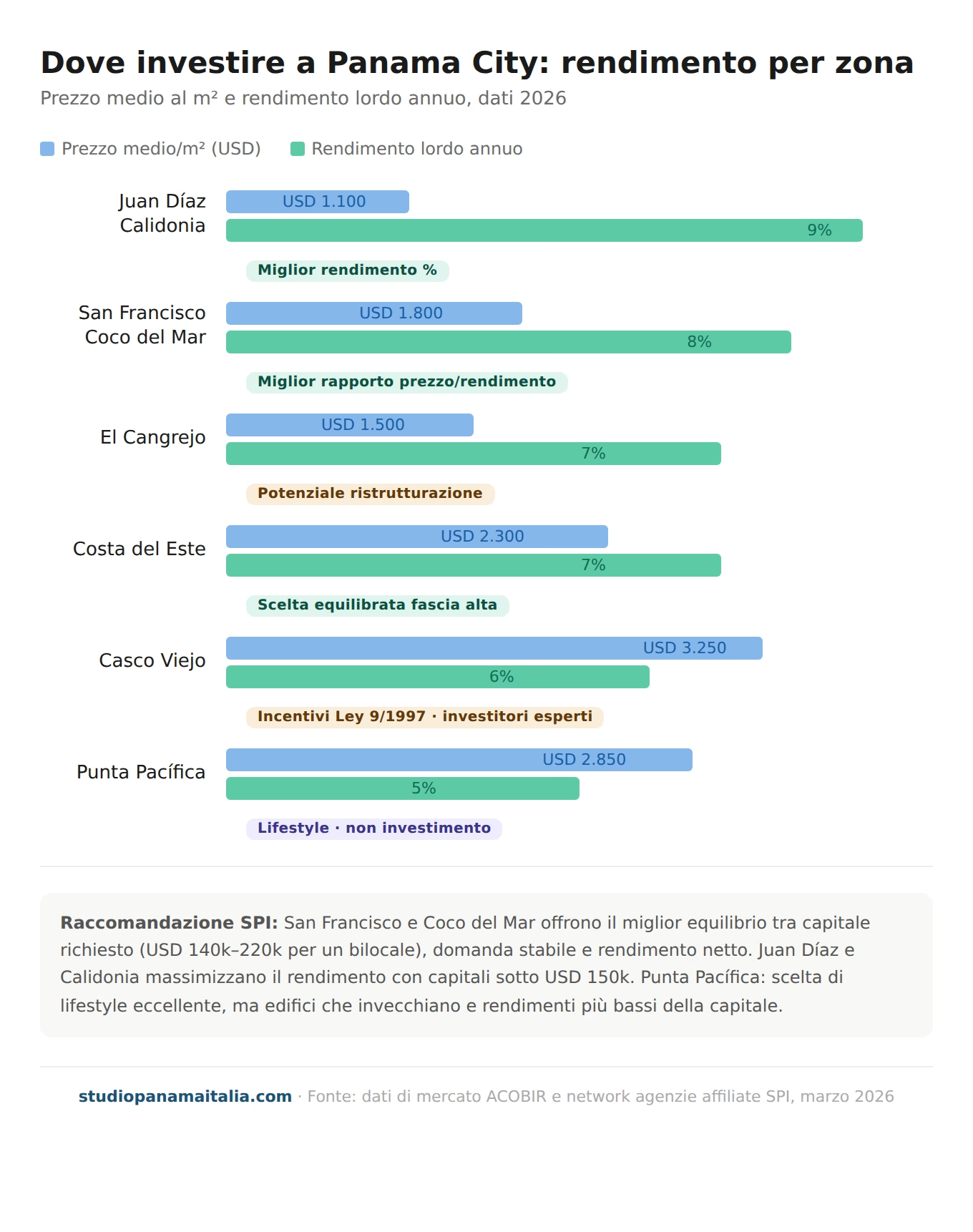
Punta Pacífica: the neighborhood most advertised by real estate agencies to foreign buyers, as it's invariably the first place every tourist ends up on their first trip to Panama. The towers are imposing, the ocean views are spectacular, and Punta Pacífica Hospital (a Johns Hopkins affiliate) and the Multiplaza Pacific are just steps away. Prices per square meter range between $2,200 and $3,500. However, those buying here as an investment should be aware that many buildings are over 15 years old and are starting to show signs of aging : common areas are not always well-maintained, facades are losing their luster, and elevators are dated. The rental yield is 4-6%, the lowest in the capital, because rents don't rise proportionally to the high purchase prices. For those who want to live in Punta Pacífica, it's an excellent lifestyle choice, but for those seeking the best rental return, there are areas that yield better with less capital.
Costa del Este: the truly modern alternative to Punta Pacífica. It's a newly developed area with wide streets, parks, sports centers, international schools (International School of Panama, Balboa Academy), and first-class infrastructure. Most corporate and banking headquarters have relocated here, generating steady rental demand from corporate expats with relocation contracts. Prices per square meter range between $1,800 and $2,800. Yields range from 5% to 7%. Metro Line 2 connects Costa del Este to the city center. If your budget exceeds $200,000, Costa del Este is probably the best choice for a balanced mix of value appreciation, quality of life, and rental yields at the high end of the market.
San Francisco and Coco del Mar: the area with the best quality/price ratio for a rental investment in Panama City. San Francisco has the highest density of restaurants, bars, cafes, and walking distance to amenities in the entire capital, and is connected to the city center by subway and bus. Coco del Mar is the more modern version of San Francisco, with newer buildings and better finishes. Prices per square meter range between $1,400 and $2,200. Yields of 6-8%, the highest among quality residential areas. Demand comes from young professionals, international remote workers, university students (USMA, Universidad de Panamá), and upper-middle-class Panamanian families. If you have to choose just one area for a buy-to-let investment under $250,000, San Francisco and Coco del Mar are the answer in most cases.
El Cangrejo: A cosmopolitan and multicultural neighborhood, historically a favorite among the Panamanian Jewish community and long-term expats. The buildings are older than those in San Francisco and Coco del Mar, but prices are lower (USD 1,200-1,800/m²) and security is high thanks to private surveillance. There's good potential for those who buy an older apartment at a discount, renovate it, and rent it out at a competitive rate. It's not the first choice for those seeking a new, turnkey property.
Casco Viejo (Old Town): the UNESCO colonial historic center, undergoing restoration and gentrification. Law 9/1997 offers extraordinary incentives: income tax exempt for 10 years, 100% deduction for renovation costs, and zero property taxes for 30 years. Prices per square meter range between USD 2,500 and USD 4,000 for restored properties. Beware: the neighborhood is beautiful, but day-to-day management is more complex (historic buildings with recurring structural issues, strict regulations from the National Directorate of Historic Heritage for any modifications, proximity to neighborhoods not yet gentrified). For experienced investors with a long-term horizon.
Calidonia, Juan Díaz, and Condado del Rey: affordable neighborhoods, rapidly expanding thanks to the metro lines. Prices per square meter range between USD 800 and USD 1,400. Yields of 7-9%, the highest overall, with extremely low vacancy rates because the market is geared toward Panamanian families and local workers, a segment with steady demand and little sensitivity to international economic cycles. Juan Díaz is the neighborhood with the highest number of new affordable housing projects, with studios and one-bedroom apartments under USD 100,000. For those with a budget under USD 150,000 and looking to maximize their percentage return, these areas are the best performing. The tradeoff is the lower expected capital gain over time compared to central areas.
Pacific Beaches
Coronado: A major beach destination 80 km from the capital, with a comprehensive infrastructure, $1,500-2,300/m². Pedasí: A coastal village on the Azuero Peninsula, land $30-80/m², an emerging destination for ecotourism and surfing.
Mountain: Boquete, El Valle, Volcán
Boquete: 1,200 m altitude, spring-like climate year-round, large expat community, homes $150,000-$500,000+. El Valle de Antón: 120 km from the capital, in the crater of an extinct volcano, more affordable prices. Volcán: A less touristy alternative in the same province.
Bocas del Toro
Caribbean archipelago with properties on tropical islands. Tourism-oriented market. Prices range from $50,000 for lots on secondary islands to millions for resorts. Beware of landownership rights on the islands.
Prices per square meter by area (reference 2026)
| Area | Price/m² (USD) | Gross return | Our investment rating |
|---|---|---|---|
| Punta Pacifica | 2.200 – 3.500 | 4 – 6% | Excellent lifestyle, modest returns. Aging buildings. Best for personal use. |
| East Coast | 1.800 – 2.800 | 5 – 7% | The most balanced choice in the high-end segment. New location, stable corporate demand. |
| San Francisco, Coco del Mar | 1.400 – 2.200 | 6 – 8% | Best price/yield ratio for buy-to-let properties in the capital. First choice under $250,000. |
| El Cangrejo | 1.200 – 1.800 | 5 – 7% | Good renovation and rental potential. Dated buildings but high security. |
| Casco Viejo (restored) | 2.500 – 4.000 | 5 – 7% | Extraordinary Legislative Decree 9/1997 incentives. For experienced investors with a long-term horizon. |
| Calidonia, Juan Díaz | 800 – 1.400 | 7 – 9% | Highest % yield . Minimal vacancy. Best choice under $150k. |
| Coronado (Pacific Coast) | 1.500 – 2.300 | 5 – 8% | Vacation rentals outside Panama City (Airbnb allowed). Seasonal. |
| Pedasí (Azuero Peninsula) | 30 – 80 (land) | Emerging | Land speculation. The market is still immature, not for those seeking immediate returns. |
| Boquete (Chiriquí) | 1.000 – 2.000 | 4 – 6% | A consolidated pension market. Slow but steady capital gains. |
| The Valley of Antón | 800 – 1.500 | 3 – 5% | Weekend getaway, limited demand during the week. Personal use. |
| Bocas del Toro | 500 – 3.000 | Variable | High risk (widespread possession rights). Only with thorough due diligence. |
The prices listed are average market values updated to 2026. Variations may be significant depending on the floor plan, view, finishes, year of construction, and condition of the building. For a specific evaluation of available opportunities in the area you're interested in, contact us on WhatsApp : our network of affiliated real estate agencies, all ACOBIR-licensed, covers every area of Panama with direct access to listings not published on portals.
Step-by-step purchasing process
Step 1, Selection and Offer
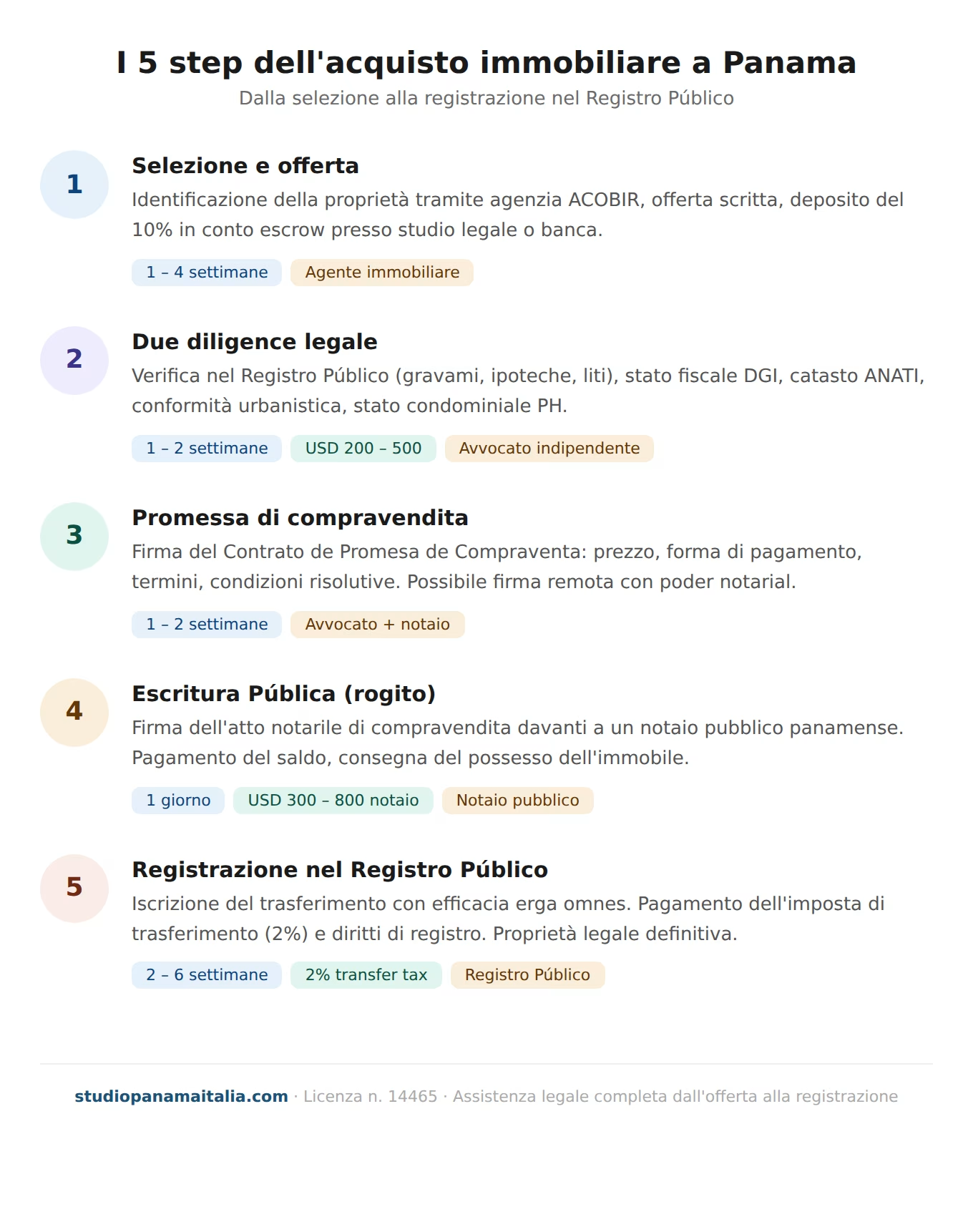
The buyer submits a written offer specifying the price, payment terms, and conditions. If accepted, they deposit 10% in an escrow account managed by a law firm or bank. A real estate agent registered with ACOBIR (Panameña Association of Real Estate Agents and Promoters) is recommended.
Step 2, Legal Due Diligence
The buyer's attorney (who must be independent of the real estate agent and the seller to avoid conflicts of interest) conducts a thorough due diligence on the property. This step is the most critical of the entire process and should never be skipped or cut short to save time or money. Checks include:
Public Registry Verification: Confirms that the property exists, that the seller is the actual registered owner, and that there are no liens (hipotecas), seizures (embargos), pending litigation (anotaciones), undeclared easements, or third-party rights on the property. Verification is performed online through the Public Registry's digital system or by formally requesting a Public Registry certificate.
Tax audit at the DGI: confirms that all property taxes have been paid and there are no outstanding debts, rechargings, or accrued interest. If the property has an active exemption (mejoras exemption or PFT/VP), the expiration date and exemption status must be verified.
Land registry check at ANATI: confirms that the registered cadastral value corresponds to the property's actual value, that the improvements (constructions) have been declared and registered, and that there are no discrepancies between the land registry and the Public Registry.
Urban Planning Verification: Confirms that the property has an occupancy permit (permiso de ocupación), that the land use complies with municipal zoning regulations, and that there are no demolition orders or pending building violations.
For apartments in PH: check the status of the condominium fees, the maintenance fees paid, the condominium regulations, recent meetings, the condition of common areas, and any building reserve funds. A building with significant condominium arrears or disputes between condominium owners is a warning sign.
Step 3, Promise of Sale
The parties sign the Contract of Promise of Purchase, a binding preliminary contract that specifies: the agreed-upon price, payment method (cash, installments, mortgage), payment terms and due dates, expected closing date (signature of the Public Deed), termination conditions (e.g., subject to approval of the bank loan), penalties in the event of default by either party, apportionment of notary and registration fees between buyer and seller, and the condition of the property upon delivery (furnished, unoccupied, specific conditions). The contract is drafted in Spanish (Panama's official language) and signed in the presence of a notary or with certified signatures. If the buyer cannot be physically present in Panama, the signature can be made through a notarized power of attorney (poder notarial) issued in the buyer's country of residence and apostilled.
Step 4, Public Writing
The transfer occurs through the signing of the Escritura Pública before a Panamanian notary public. The notary verifies the identity (passport for foreigners), certifies the signatures, and draws up the deed. The buyer pays the balance, and the seller delivers possession.
Step 5, Registration in the Public Registry
The deed is submitted to the Public Registry for registration of the transfer. From this moment, the buyer is the legal owner with effect for all. Processing time: 2-6 weeks. Transfer taxes and registration fees are paid upon registration.
Purchase through a company (SA) or Foundation vs. personal name
Benefits of Sociedad Anónima (SA)
The majority of foreign investors in Panama purchase real estate through a Sociedad Anónima (SA), rather than in their personal names. The SA is a joint stock company under Panamanian law, governed by Law 32/1927, which can be incorporated in 3-5 business days with a low initial cost (USD 1,200-1,800 including registration fees). The SA holds the finca in the company's name in the Public Registry, and the investor owns the shares of the SA.
The main advantages of purchasing through a limited liability company (SA) are: simplified estate planning (the transfer of the property occurs by transferring the SA shares to an heir or third party, without the need to reopen a Panamanian inheritance process, without a new escritura (deed) or a new registration in the Public Registry), potential tax savings on resale (the transfer of SA shares does not trigger the 2% real estate transfer tax, although it does trigger a share transfer tax equal to 2% of the nominal value of the shares or 5% of the sale price, whichever is less, which in many cases is lower than the real estate transfer tax), asset protection (the SA is a legal entity separate from the shareholder's personal assets, meaning the investor's personal creditors cannot directly seize the property registered in the SA's name), and administrative management (the SA can open bank accounts, sign lease agreements, issue invoices, and manage the property as a business).
Private Interest Foundation for Inheritance Protection
For high-value investments or for families with complex estate planning needs (for example, families with heirs in multiple jurisdictions, remarriages, protection of minors or vulnerable individuals), the property may be held by a Panamanian Private Interest Foundation (Fundación de Interés Privado), governed by Law 25 of June 12 , 1995. The Foundation is a legal entity without members or shareholders, created by a founder (fundador) to allocate assets to specific beneficiaries according to rules established in the Internal Regulations.
The advantages of a foundation for holding real estate include: protection from forced heirs (Italian law on legitimate inheritance does not apply to a Panamanian foundation, which distributes its assets according to the rules of the Reglamento, not the inheritance laws of the founder's country of origin), protection from creditors (the foundation's assets are separated from the founder's personal assets three years after their incorporation or transfer), management of the assets according to the founder's wishes without the need for a will (the foundation survives the founder's death and continues to operate according to the Reglamento), and confidentiality (the internal Reglamento is not a public document and is not filed in the Public Registry).
Financing and mortgages for foreigners
Banking requirements for non-residents
Several Panamanian banks offer mortgage loans to non-resident foreigners, including Banco General, Global Bank, Banistmo (HSBC Group), Multibank, and Scotia Bank Panama. Typical terms for a foreign buyer without permanent residence include a down payment of 30% to 50% of the property price (the exact percentage depends on the bank, credit history, and property type), a fixed or variable interest rate between 5% and 7% per annum (variable rates are indexed to Libor or the reference rate of the Superintendencia de Bancos de Panama), and a maximum mortgage term of 15-20 years (significantly shorter than the 30-year term offered to Panamanian residents with demonstrable local income).
Documentation required for pre-approval includes: a valid passport, bank references from the buyer's country of origin (at least two reference letters from banks where the buyer holds active accounts), proof of income (tax returns, pay stubs, company financial statements for entrepreneurs) translated into Spanish and apostilled, personal financial statement (list of assets and liabilities), bank statements for the last 6-12 months, and criminal records from the buyer's country of origin. The pre-approval process typically takes 2-4 weeks, but may be extended if the documentation is incomplete or if the bank requires additional verification.
For foreigners who have already obtained permanent residency in Panama and can demonstrate income in the country (salary, business income, rental income), the conditions are radically improved: a 10% to 20% down payment, lower interest rates (4-5.5%), terms of up to 30 years, and access to preferential interest programs (tasa de interés preferencial) offered by the Panamanian government for properties under $180,000, which provide preferential rates for the first few years of the mortgage.
Direct funding from the developer
Many real estate developers in Panama offer direct payment plans during the pre-sales phase (pre-construction), typically structured as follows: 10% upon signing the purchase agreement (enganche), monthly installments of 5-10% of the price during the construction phase (18-36 months), and the remaining balance of 70-80% upon delivery of the property (via the buyer's own funds or a bank loan). This model allows the price to be locked in during construction and allows for appreciation upon delivery, but it carries specific risks: construction delays (common in Panama, where delivery times often exceed initial estimates by 6-12 months), lower-quality finishes than promised in promotional materials, and, in the worst cases, bankruptcy of the developer with partial or total loss of deposits.
To mitigate these risks, it is recommended to: verify the developer's track record (completed projects, references from previous buyers, financial stability); require that deposits be deposited in an escrow account (fideicomiso) at a Panamanian bank rather than directly into the developer's account; verify that the developer has a building permit (permiso de construcción) issued by the Municipality and that the project is registered with the Ministerio de Vivienda; and include termination clauses in the contract with refund of deposits in the event of delays exceeding an agreed-upon period.
Taxes and costs for purchasing property in Panama
Transfer fee (2%)
The real estate transfer tax in Panama is 2% , calculated on the property's registered value in the Public Registry or the sale price declared in the Public Deed, whichever is greater. The tax is normally split 50/50 between the buyer and seller, unless otherwise agreed by the parties. In some cases, especially in transactions between private individuals, the split is negotiable and may be entirely borne by one of the parties.
Notary, legal and registration costs
Additional costs related to the purchase include: the buyer's lawyer's fees (typically 1-2% of the price, with a minimum of USD 1,500-3,000 for standard transactions), notary fees for drafting and certifying the Public Deed (USD 300-800 depending on the complexity of the deed and the value of the property), registration fees in the Public Registry (variable based on the value, approximately USD 200-500), and due diligence and certification fees (USD 200-500 for verification in the Public Registry, at the DGI, and at ANATI). There are no separate stamp duties or additional VAT-type taxes on the purchase of used residential properties (the 7% ITBMS applies only to the first sale of new commercial properties by the developer).
The real estate agent's commission (usually 5% of the sale price) is traditionally paid by the seller, not the buyer. However, this split is a market convention, not a legal requirement, and in some transactions, it may be agreed otherwise.
Estimate of total purchasing costs
For an apartment valued at USD 250,000, the estimated total costs to the buyer are: half of the 2% transfer tax = USD 2,500, lawyer's fees = USD 2,500–3,000, notary and registry fees = USD 500–1,000, due diligence and certificates = USD 300–500. Total buyer costs: approximately USD 5,800–7,000 , equivalent to 2.3–2.8% of the purchase price. This is one of the lowest transaction cost structures in the world, significantly lower than in Italy (where registration fees or VAT, notary, agency, and land registry fees can exceed 10% of the price), Spain (8–12%), the United Kingdom (5–15% with Stamp Duty Land Tax), and France (7–8%).
Annual Property Tax (Impuesto de Inmueble)
Law 66/2017: progressive tax rates
The annual property tax in Panama is governed by Law 66 of October 17, 2017 , which came into effect on January 1, 2019. This comprehensively reformed the Panamanian real estate tax system, replacing the previous flat-rate system. The tax is calculated on the cadastral value (valor catastral), which corresponds to the value registered in the Public Registry at the time of purchase or the last transaction, and includes both the value of the land and the value of the buildings (mejoras). The cadastral value is not automatically updated to the market value: it remains fixed at the registration value until the owner sells the property (in which case the new selling value becomes the valor catastral) or until ANATI performs an official appraisal.
For properties not declared as a primary residence, the progressive rates are: from USD 0 to USD 30,000 of cadastral value, the property is completely exempt . From USD 30,001 to USD 250,000, the rate is 0.6% . From USD 250,001 to USD 500,000, the rate is 0.8% . Above USD 500,000, the rate is 1.0% . The tax is paid in three quarterly installments (April, August, December) or in a single payment by April 30th with a 15% discount if there are no arrears.
Tax Family Assets and Vivienda Principal
If the property is registered with the DGI as Patrimonio Familiar Tributario (PFT) , meaning the owner's family's primary residence, or as Vivienda Principal (VP) , meaning the primary residence of a single person, significantly reduced rates apply: up to USD 120,000 of cadastral value, total exemption . From USD 120,001 to USD 700,000, a rate of 0.5% . Above USD 700,000, a rate of 0.7% . This regime is also available to foreigners who have obtained residency in Panama and use the property as their primary residence. The application is made online through the DGI's e-Tax 2.0 system.
Exemptions for new construction
Panama offers some of the most generous tax exemptions in the world for new residential construction. Mejoras (constructions and improvements) duly registered in the Public Registry and with ANATI enjoy a property tax exemption for a period of up to 20 years from the date of construction, as certified by the DGI based on the property type and applicable legislation. For buildings under the Propiedad Horizontal (Horizontal Property) regime, during the mejoras exemption period, only 1 % per year is paid on the cadastral value of the land assigned pro rata to the unit. For first-time sales of properties with a cadastral value between USD 120,000 and USD 300,000, there is an additional 3-year exemption provided for by Law 66/2017 (Paragraph 1, Article 766 of the Tax Code).
Taxation on Rental Income and Capital Gains in Panama
Rental Income Tax (IRS)
Rental income generated from a property located in Panama is subject to the Income Tax (ISR) at Panamanian progressive rates. For individuals, the rates are: 0% for income up to USD 11,000 per year, 15% for income between USD 11,001 and USD 50,000, and 25% for income over USD 50,000. For corporations (Sociedad Anónima), the rate is a flat 25% on net income. All expenses directly related to generating rental income are deductible: condominium fees, ordinary and extraordinary maintenance, property insurance, mortgage interest, property depreciation (calculated based on the registered value, with a typical annual rate of 2.5-5% depending on the type of construction), property manager's fees, legal fees for managing rental agreements, and advertising and promotion of the property.
The Panamanian tax system is strictly territorial : only income generated within Panama is taxable. Rent paid by a tenant living and working in Panama is Panamanian-source income and must be declared and taxed in Panama, regardless of the property owner's nationality or tax residency. Conversely, income generated outside Panama (e.g., income from employment in another country, dividends from foreign companies, interest on foreign bank accounts) is not taxable in Panama, even if the owner is a Panamanian tax resident. This principle of territoriality is one of the most significant structural advantages for international investors moving to Panama.
Capital gains tax and new provisions of Law 468/2025
The sale of real estate in Panama generates a capital gains tax (ganancia de capital), calculated using one of two methods, depending on which is applicable: 10% of the actual realized gain (difference between the sale price and the registered purchase price, plus capitalized gains), or 3% of the total sale price declared in the deed of sale. The tax is withheld by the notary upon signing the deed of sale and paid directly to the DGI. In addition to the capital gains tax, a 2% transfer tax is applied to the sale price.
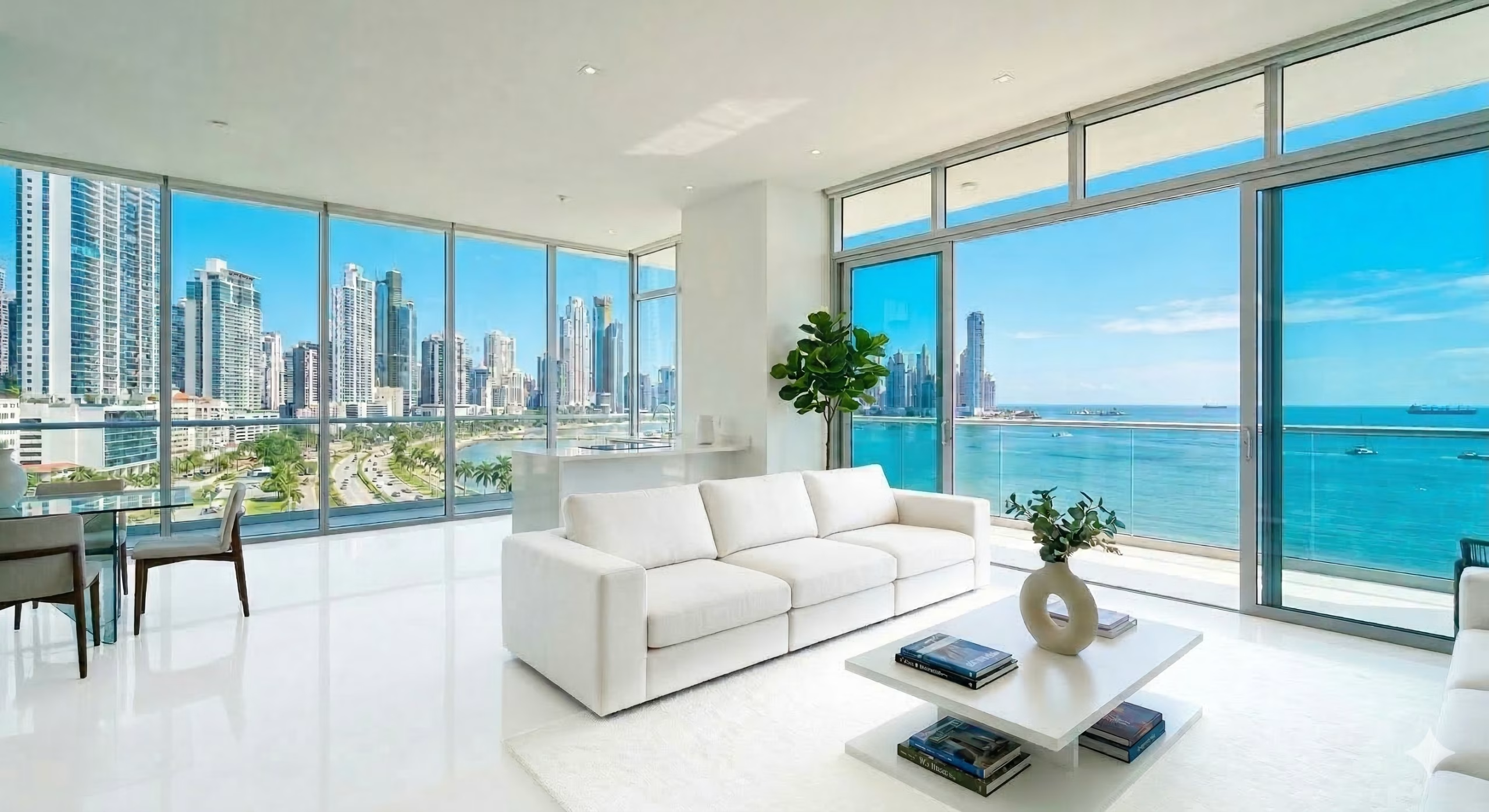
Rental Income: What to Realistically Expect
Gross rental yields in Panama City for well-located, professionally managed apartments are realistically between 5% and 9% gross per year , depending on the area, price range, and rental type (long-term vs. medium-term). The best-performing price ranges for buy-to-let are between $150,000 and $300,000, which capture the broadest market demand: young professionals, families, corporate expats, and university students. Properties above $500,000 tend to yield lower percentage returns because rents do not increase proportionally to the price and demand in the luxury segment is more limited and volatile.
Concrete example: A 75 m² apartment in San Francisco purchased for $165,000 and rented for $1,100/month (a realistic rent for the area) generates a gross annual yield of 8%. Factors that reduce the net yield include: vacancy, estimated at 5-10% of the annual rent (approximately 0.5-1 month without a tenant), condominium fees ($150-250/month), rental income tax (ISR, variable based on the tax structure), property manager's fees (typically 8-12% of the gross rent if using a property manager), ordinary and extraordinary maintenance (estimated at 3-5% of the annual rent), and property insurance ($300-600/year for a standard apartment).
A realistic net return after all expenses is between 4% and 6% per year in US dollars, which remains significantly higher than the net returns achievable in Italy (2-4% in the best Italian markets, in euros and with a much higher overall tax burden including IMU, IRPEF on rental income, flat-rate tax, management costs and extraordinary maintenance required by law).
Beware of short-term rentals in Panama City: Panamanian law prohibits short-term rentals (less than 45 days) within Panama City, with fines ranging from $5,000 to $50,000 and the possibility of business closure. Exceptions apply only to licensed hotels and properties in mixed-use zones with a specific commercial license. In coastal and mountainous areas outside Panama City (Coronado, Boquete, Bocas del Toro, Pedasí), Airbnb-style short-term rentals are generally permitted and represent a rapidly growing segment with potentially superior long-term returns, but with higher operating costs and turnover.
Case Study: Buy-to-Let Investment in San Francisco
An Italian entrepreneur with a tax residence in Panama (registered with AIRE, permanent residence under the Italy-Panama Treaty) purchased a 75 m² two-bedroom apartment in San Francisco, Panama City, in 2024 through a Panamanian limited liability company advised by Studio Panama Italia. The transaction figures:
Purchase. Purchase price: USD 168,000 (USD 2,240/m²). 2% transfer tax (half paid by the buyer): USD 1,680. Attorney, notary, registry: USD 3,200. Total acquisition cost: USD 172,880. The apartment is in a 2019 building with a mejoras exemption still active for 15 years. Annual property tax during the exemption period: 1% of the assigned land value (USD 12,000) = USD 120/year.
Rent. The apartment is rented to a Panamanian professional couple for USD 1,150/month with a one-year renewable contract. Gross annual income: USD 13,800.
Annual expenses. Condominium fees: USD 185/month = USD 2,220/year. Property tax: USD 120/year. Annual SA fee (resident agent + single tax): USD 600/year. Maintenance and repairs (estimated): USD 500/year. Property insurance: USD 350/year. Property manager (10% of gross rent): USD 1,380/year. Estimated vacancy (1 month/year): USD 1,150. Total annual expenses: USD 6,320.
Yield. Net income before taxes: USD 13,800 - USD 6,320 = USD 7,480/year. Panamanian ISR due (individual, income under USD 11,000 net after deductions): USD 0. Net return on acquisition cost: USD 7,480 / USD 172,880 = 4.33% net in dollars , after all expenses, including vacancy. No IVIE or Quadro RW is due because the investor is a tax resident in Panama. If the same investor had remained a tax resident in Italy, the net return would have dropped to 2.8-3.1% due to IVIE (0.76% on USD 168,000 = USD 1,277/year), IRPEF on foreign rental income, and Quadro RW compliance costs.
Panama residency through real estate investment
Italy-Panama Treaty and Friendly Nations Visa
Italian citizens can obtain residency in Panama through the Italy-Panama Treaty (Convention of Commerce and Navigation of 1965), which offers a preferential path to the general Friendly Nations Visa. The Treaty requires incorporation of a Panamanian company, a minimum bank deposit of $5,000 at a bank with a general license in Panama, an apostilled criminal record, and physical presence in Panama for the process (5-8 business days). Purchasing real estate in Panama is not a formal requirement for residency through the Treaty, but it significantly strengthens the process by demonstrating the investor's economic ties and roots in the country.
Certified Inversionist Visa
The Permanent Residency Program for Qualified Investors (Executive Decree 722 of October 15, 2020, subsequently amended in 2024) allows you to obtain immediate permanent residency in Panama with a minimum investment of $300,000 in real estate registered in Panama. The investment can be spread across multiple properties, as long as they are all registered in the applicant's name (either an individual or a company controlled by the applicant) and duly registered in the Public Registry. The Qualified Investment Visa offers significant advantages: permanent residency from day one (no need to convert from temporary to permanent residency), no requirement to reside permanently in Panama, the option to include your spouse and dependent children as dependents on the same application, access to Panamanian citizenship after five years of permanent residency (with basic knowledge of Spanish and Panamanian history requirements), and no requirement to work or engage in any other economic activity beyond real estate investment.
Pensioner's Visa and Real Estate Investment
Foreign retirees with a monthly pension income of at least USD 1,000 can obtain residency in Panama through the Pensionado, Jubilado, or Rentista Visa, which offers significant discounts on medical services, transportation, restaurants, entertainment, and vehicle imports. Purchasing property in Panama is not required for the Pensionado Visa, but many retirees moving to Panama combine residency with property purchase, benefiting from both the Pensionado program discounts and real estate tax exemptions (PFT/VP).
Restrictions for foreigners
Purchases prohibited within 10 km of international borders (parts of Chiriquí, Bocas del Toro, Darién). Indigenous communities (Ngäbe-Buglé, Emberá-Wounaan, Guna Yala): collective lands are not purchasable. Some islands are subject to government concessions (renewable for 20-40 years) rather than full ownership.
Italian tax obligations for those who own property in Panama
Anyone who is a tax resident in Italy and owns property in Panama is subject to Italian tax obligations that are in addition to those in Panama. The property must be declared in Section RW of the Personal Income Tax Form or in Section W of the 730 Form, indicating the Panamanian cadastral value (valor catastral) or, alternatively, the purchase price. For properties in non-EU countries such as Panama, in the absence of an "official" cadastral value comparable to the European one, the purchase price resulting from the Public Record registered in the Public Registry is used.
The value declared in Table RW is subject to the IVIE (Foreign Property Value Tax) at a rate of 0.76% . The property tax actually paid in Panama (Impuesto de Inmueble) is deductible from the IVIE, up to the amount due. If the Panamanian property is fully exempt from the Impuesto de Inmueble (as is the case for new construction during the twenty-year exemption period), there is no deductible tax credit and the IVIE must be paid in full in Italy.
Rental income generated from property in Panama must be declared in Italy in the RL (other income) or RM (separately taxed income) sections, with the right to a tax credit for the ISR (Impuesto Sobre la Renta) paid in Panama pursuant to Article 165 of the TUIR. There is no specific bilateral double taxation agreement between Italy and Panama, but the tax credit for taxes paid abroad is recognized under Italian law up to the proportional share of Italian tax on foreign income.
The capital gain from the sale of Panamanian property is taxable in Italy if realized within five years of purchase (Article 67, paragraph 1, letter b, TUIR), unless the property was used as a primary residence for most of the period of ownership. Capital gains realized after five years of purchase are not taxable in Italy.
The structural solution to eliminate all these obligations, from the RW Form to the IVIE (Income Tax Return) and the taxation of rental income, is to effectively transfer tax residency to Panama through AIRE and establishing the center of vital interests in the country. In Panama, rental income from Panamanian properties is taxed only at the local ISR (0-25%), there is no IVIE, no RW Form, and taxation is exclusively territorial: foreign-source income is completely exempt.
The Ten Most Common Mistakes When Buying Real Estate in Panama
1. Buying land in derecho posesorio without understanding the risks. Derecho posesorio is not titled property and does not offer the same legal guarantees. The owner can lose the land if a third party proves a prior right or if the government reclaims the land. It is nearly impossible for foreigners to obtain a mortgage on land in derecho posesorio.
2. Do not check the property's status in the Public Registry. Unpaid mortgages, liens, pending litigation, judicial seizures, and third-party rights can only be identified through a formal verification. An updated Public Registry certificate is the first document to request before making any offer.
3. Use the same attorney as the seller or real estate agent. The buyer's attorney must be independent to avoid conflicts of interest. A lawyer representing both parties cannot adequately protect the buyer's interests, especially if issues arise during due diligence.
4. Underestimate ongoing costs. Condominium fees (USD 100–400/month in mid-range buildings), property tax (even during the exemption period, land can generate tax), ordinary and extraordinary maintenance, insurance, and the annual SA tax (if purchased through a company, approximately USD 500–650/year) reduce net returns and must be factored into the investment calculation.
5. Ignoring the ban on short-term rentals in Panama City. Renting an apartment in Panama City on Airbnb for periods of less than 45 days is illegal, with fines ranging from $5,000 to $50,000 and the risk of foreclosure. Many foreign investors ignore this rule and expose themselves to serious legal and financial consequences.
6. Don't vet the developer before buying pre-construction. Check their track record (completed and on-time projects), references from previous clients, financial strength (balance sheets, bank debts), and reputation with ACOBIR and the Chamber of Commerce. Ask for down payments to be deposited in a bank guarantee rather than directly into the developer's account.
7. Buy above the $300,000 threshold for pure rental investment. Properties above this threshold have lower percentage yields, higher vacancy (the rental market above $2,000/month is much tighter), and a limited resale market. For those investing for income, three apartments at $150,000 each yield better returns than a single apartment at $450,000.
8. Failure to update the land registry (ANATI) or request exemption from the DGI after purchase. If the improvements (constructions) have not been declared or the property tax exemption has not been requested or transferred to the new owner, the tax is calculated on the full cadastral value without any reduction, generating debts with interest and recharging charges that can accumulate for years.
9. Do not declare the property in the RW table if you are a tax resident in Italy. Italian penalties for failure to declare range from 3% to 15% of the undeclared value for each year of failure. With the automatic exchange of CRS/FATCA information, the Italian Revenue Agency receives financial data from over 100 jurisdictions, including Panama. Failure to declare is no longer a viable strategy.
10. Believing that purchasing a property automatically confers residency. Purchasing a property does not confer any right of residency: a separate immigration procedure is always required (Italy-Panama Treaty, Friendly Nations Visa, Qualified Inversionist Visa, Pensionado). Property may be a requirement or a support for the process, but it does not replace the procedure.
Official Resources and How We Shop for You
Panama Public Registry ( registro-publico.gob.pa ): Verify property titles, liens, and farm status. DGI/MEF ( dgi.mef.gob.pa ): Property tax status, e-Tax 2.0, and request exemptions. ANATI ( anati.gob.pa ): Land registry, land registry updates, and land adjudication. ACOBIR ( acobir.com ): Official association of licensed real estate agents in Panama.
Our network of affiliated real estate agencies
Studio Panama Italia is not a real estate agency: we are a law and corporate firm that coordinates the entire purchasing process from a legal, fiscal, and structural perspective. For property research and selection, we work through a network of affiliated Panamanian real estate agencies , all ACOBIR licensed and with proven experience in transactions with international clients. The advantage of this model is twofold: buyers have access to multiple agencies' listings simultaneously (they are not tied to a single agent's portfolio), and each phase of the transaction is supervised by a dedicated professional: the real estate agent for research and negotiations, and the law firm for due diligence, signing, and registration.
Our affiliate agencies cover all major investment areas: Panama City (from the luxury of Punta Pacífica to the affordable condos of Juan Díaz), the Pacific Coast (Coronado, Playa Blanca, Río Hato), the mountains (Boquete, El Valle de Antón), the Azuero Peninsula (Pedasí, Las Tablas), and Bocas del Toro. For each area, the affiliate agency knows the local market, real prices (not the inflated ones on portals), reliable developers and those to avoid, and unlisted opportunities.
The buyer does not pay additional commissions to Studio Panama Italia for the real estate brokerage service: the agent's commission (5% paid by the seller) is managed directly by the affiliated agency. Our fee covers only legal services (due diligence, signing, registration, corporate structuring), which are due regardless of the purchase method. This model ensures transparency, the absence of conflicts of interest, and alignment of incentives among all parties involved.
Regulatory framework
Panamanian Constitution, art. 47: Protection of Private Property. Civil Code, Book II: Property and Real Rights. Law 31/2010: Horizontal Property. Law 66/2017: Real Estate Tax, Progressive Rates, PFT and VP. Law 28/2012: 10-Year Exemption for New Construction. Law 9/1997: Casco Viejo Incentives. Law 468/2025: Abolition of Capital Gains Exemption for First Sale by Developer. Law 25/1995: Private Interest Foundations. Law 129/2020: Register of Beneficial Owners. DE 722/2020: Qualified Investment Visa. Art. 4, DL 167/1990: RW Form. Art. 19, Legislative Decree 201/2011: IVIE.
Invest in real estate in Panama with full assistance
Studio Panama Italia has been operating in Panama City since 2010 with license no. 14465. We offer a comprehensive service covering the entire real estate investment cycle: property selection through our network of ACOBIR-licensed affiliated agencies, independent legal due diligence, preparation of the Public Contract, registration in the Public Registry, structuring through a limited liability company (SA) or Private Interest Foundation, requesting tax exemptions from the DGI, and coordinating with banks for financing. For those wishing to transfer their tax residency, we integrate the real estate purchase process with the residency process through the Italy-Panama Treaty or the Qualified Investment Visa. A single Italian-speaking contact, from investment analysis to key delivery.
✉️ Write to us on WhatsAppFrequently Asked Questions: Buying Real Estate in Panama
Can a foreigner buy a house in Panama?
Yes, without any restrictions. The Constitution guarantees foreigners the same rights as citizens. No visa, residency, or special permit is required. The only restrictions are: property within 10 km of the borders and lands belonging to indigenous communities.
How much does it cost to buy an apartment in Panama City?
Prices per m²: USD 800-1,400 suburbs, USD 1,400-2,200 central area (San Francisco, El Cangrejo), USD 2,200-3,500 premium area (Punta Pacífica, Costa del Este). An 80 m² in the central area: USD 112,000-176,000.
What taxes are paid on the purchase?
Transfer tax: 2% (split 50/50). Total buyer costs (tax, notary, lawyer, registry): approximately 2.3-2.8% of the price, much lower than the European average.
How much property taxes do you pay each year?
From 0% to 1% based on the cadastral value. Up to USD 120,000 exempt if primary residence. From USD 120,001 to USD 700,000: 0.5%. New construction: exemption for up to 20 years on mejoras.
Can I get a mortgage as a foreigner?
Yes. 30-50% down payment, 5-7% interest, term up to 20 years. Passport, bank references, and proof of income required. Permanent residents: 10-20% down payment, lower interest rates.
Does buying a house give you the right to residency?
Not automatically. With a USD 300,000 investment in real estate, you can obtain a Qualified Investment Visa (immediate permanent residence). For smaller amounts, the property can be strengthened through other programs.
Is it worth buying through SA?
In most cases, yes: it simplifies succession, offers asset protection, and can reduce resale taxes. Annual costs: USD 500-650 (resident agent + one-off tax).
Can I rent on Airbnb in Ciudad de Panama?
No. Rentals under 45 days are prohibited in Panama City (fines range from $5,000 to $50,000). Outside the capital (Coronado, Boquete, Bocas del Toro), they are generally permitted.
Do I have to declare the property in Italy?
Yes, in the RW table. IVIE (0.76%) is paid, and the tax paid in Panama is deductible. Rental income must be declared with a credit for Panamanian ISR. Solution: transfer tax residency to Panama.
What is derecho posesorio?
A right of possession over land not registered in the Public Registry. It does not offer the same guarantees as a title de propiedad, is risky, and difficult to mortgage and resell. For foreigners: only purchase properties with a title de propiedad.
Also find out how to obtain residency in Panama in 6 steps , open a bank account in Panama , set up a Panamanian SA , fill out the RW form for foreign real estate , and avoid foreign investment .
