

Moving to Panama: A Complete Guide 2026
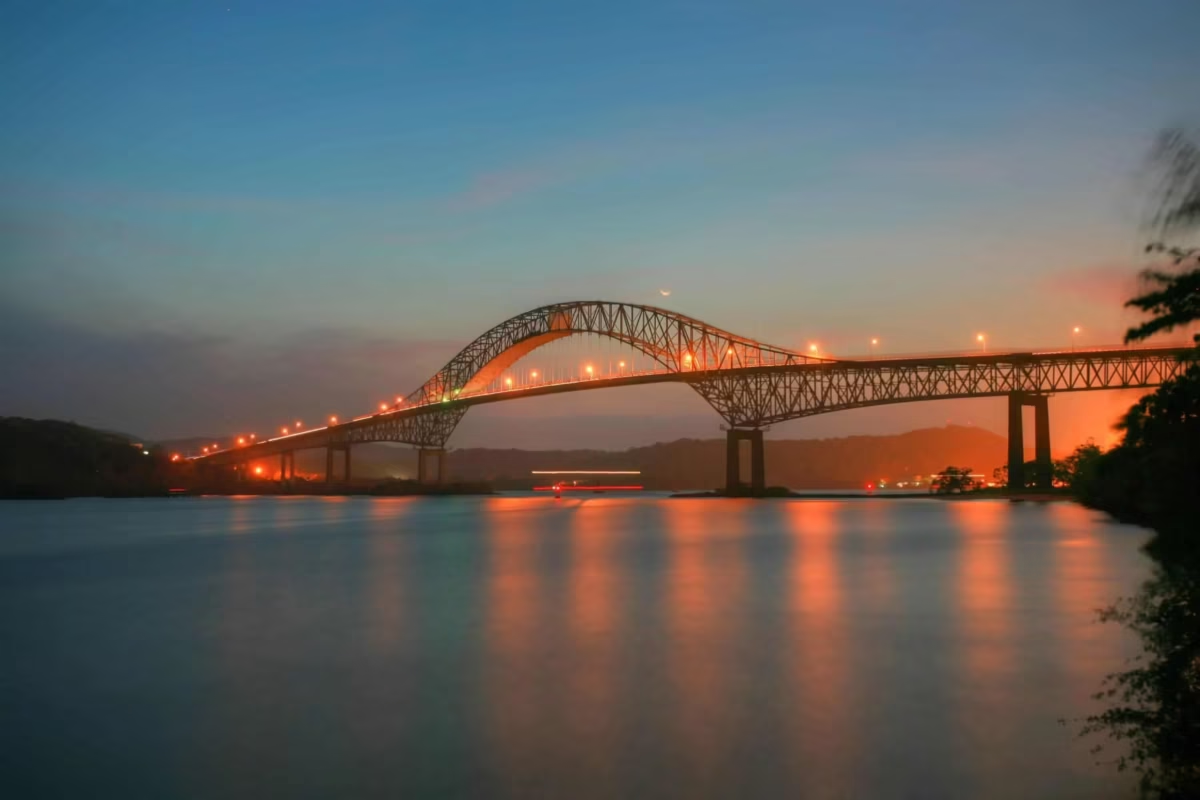
Why move to Panama?
Moving to Panama is possible by obtaining Panamanian residency . The country offers a tropical paradise with unique tax advantages, provided you obtain a valid residence permit. The procedure is standardized, the cost is low, and proof of financial solvency is accessible. The required Panamanian documents are: a criminal record, birth certificate, and bank reference, all apostilled. The Panamanian tourist visa is valid for 180 days, but to stay, you need residency.
Panama attracts expats who choose the country to start a new life: retirees, rentiers, investors, digital nomads, or simply people looking for a new home. The rate of foreign residents per 100,000 inhabitants is among the highest in the world, ensuring a strong international community and unique opportunities for those seeking a new lifestyle.
Key points for moving to Panama
- Territorial taxation — 0% on income earned abroad, ideal for digital nomads and international entrepreneurs
- Panama-Italy Treaty — simplified, rapid (5–8 days) and accessible procedure for all Italian citizens
- USD currency — absolute monetary stability, no exchange rate risk
- Financial center — the largest offshore hub in the Americas with banking secrecy and anonymous companies
- No physical residency requirement — you do not need to live in Panama to maintain residency
- Citizenship in 5 years — Possibility of obtaining a Panamanian passport after 5 years of permanent residence
- Concrete Plan B — second international residence in a stable, safe and politically neutral country
Panama as Plan B in life
For many, moving to Panama represents a true Plan B of a lifetime. Plan B Panama involves obtaining a second Panamanian residence to protect your personal, financial, and tax assets—useful when you feel the risk of losing your freedom of movement, financial stability, or fiscal independence. Moving to Panama means moving both personally and financially, planning your future well in advance.
Expatriating to Panama—emigrating to Panama—is increasingly a strategic decision, even for those with no legal, fiscal, or financial problems in their home country. Moving to Panama today is a preventative, not a reactive, choice. More and more people are organizing their lives in a more free and resilient way, now obtaining a second residence in a stable country while it is still possible to do so at advantageous conditions.
The reason is simple: no one can guarantee that in 10 or 20 years it will still be possible to move to Panama through the Panama-Italy Treaty, or that current regulations will remain unchanged. Many expats choose to move to Panama even many years before actually moving, precisely to secure their future options.
Panama: The Offshore Financial Center of the Americas
Moving to Panama means moving to Latin America's largest financial center. Offshore companies enjoy benefits such as access to comprehensive banking services, confidentiality, free movement of capital, and complete tax exemption, provided they conduct business exclusively outside Panamanian territory. Panama's offshore ecosystem is among the most established in the world.
Other common legal entities are Private Interest Foundations , which are completely tax-exempt and commonly used as holding companies, for asset protection, confidentiality, estate and tax planning, or for philanthropic purposes.
Advantages of Residency in Panama
- Panamanian citizenship — applicable after five years of permanent residency
- Affordable and fast procedure — only USD 5,000 bank deposit, recoverable after obtaining
- No minimum income requirement — there are no income requirements for residency
- No physical residency requirement — you do not need to live in Panama to maintain status
- Territorial taxation — zero taxes on foreign-source income
- Access to TiEAs — agreements for the exchange of structured tax information
- Constantly growing economy — GDP among the most dynamic in Latin America
- Spanish language — easy for an Italian to learn
How to Move to Live and Work in Panama
How to move to Panama? To move to Panama, you must obtain residency. Residency in Panama can be converted into tax residency (Panama tax residency) when you meet the legal requirement of staying in the country for at least 183 days per year or register with the Italian Embassy in Panama.
The application begins from home, in Italy. The first step is to apply remotely to open a company in Panama (also called a Panama company), a prerequisite for subsequently applying for residency. The company is opened remotely approximately 40–45 days before flying to Panama.
The Panama-Italy Treaty
The official name is the Convention on Commerce and Navigation between the Republic of Panama and the Italian Republic , amicably known as the Panama–Italy Friendship Treaty. This bilateral agreement allows Italian citizens a simplified, rapid, and much more affordable residency procedure than other available visas.
Panama offers several options for relocating, but the advice for Italians is to move exclusively through the Panama-Italy Treaty, explained on the Procedures and Visas for Panama . The Panama Friendly Nations Visa, a treaty between Panama and approximately 50 "friendly" countries, does not apply to Italy, which has its own, more advantageous procedure.
The complete process for obtaining Panamanian residency through the Panama-Italy Treaty is detailed step-by-step in our dedicated guide. It's a six-step process, from opening the company remotely to receiving the permanent residency certificate, which can be completed in just a few days in Panama City.
Discover the complete procedure in 6 steps
Operational guide with requirements, documents, timelines, and costs updated to 2026.
Panama Residency in 6 Steps →General information about Panama
Geography, climate and population
The Republic of Panama is located in southeastern Central America, on the isthmus connecting South America and Central America. It borders the Caribbean Sea to the north, the Pacific Ocean to the south, Colombia to the east, and Costa Rica to the west. It has a population of over 4 million, half of whom live in the metropolitan area of the capital, Panama City. The official language is Spanish, and the legal tender currencies are the U.S. dollar (USD) and the Balboa (PAB), pegged 1:1 to the dollar.
The climate is hot and humid tropical for about 9–10 months of the year. Rainfall is frequent and often heavy, torrential but concentrated in periods of 2–6 hours per day. In the rainiest months, temperatures exceed 30 degrees Celsius with humidity above 90%. The best season is from December-January to April-May.
Economy and currency
Panama's economy is the most stable in Latin America. Its main economic activities are finance, banking, hedge fund creation, offshore incorporation, asset protection, medical tourism, logistics, and, to a lesser extent, agriculture. The transportation and logistics services conglomerate is geared toward global trade, centered around the Panama Canal, home to container ports, free zones, railways, and Latin America's largest passenger air hub.
The Panama Canal
The Panama Canal is one of the world's most important infrastructure projects: a feat of engineering approximately 82 kilometers long—the famous Panama Canal—connecting the Atlantic and Pacific Oceans. Opened in 1914, it allows the transit of over 14,000 ships annually and generates revenues of approximately $2 billion annually. The canal was returned to the Panamanian nation on December 31, 1999, in accordance with the Torrijos-Carter Accords signed in 1977.
Panama has invested heavily in modernization, including the expansion inaugurated in 2016, which allows the passage of Neo-Panamax class vessels. Management is considered a model of efficiency and transparency, ensuring neutrality and equal access for all nations. The canal remains Panama's sovereign property and a symbol of progress and independence for the country.
The Panama Canal and US controversies
In recent years, former US President Donald Trump's statements have caused an international stir. Trump expressed the opinion that the US should reclaim ownership of the Panama Canal, asserting that its management should return to US control. These statements ignore some fundamental facts.
The Panama Canal was returned to the Panamanian nation on December 31, 1999, in accordance with the Torrijos-Carter Accords signed in 1977. These treaties granted complete sovereignty of the Panama Canal to the Panamanian government, ending nearly a century of U.S. management. Any attempt to regain control would be a violation of international law and would jeopardize diplomatic relations between the U.S. and Panama.
Trump's ideas are politically unsound and unworkable. Panama has demonstrated exemplary management of the Panama Canal, transforming it into an economic engine for the entire Western Hemisphere. The international community firmly supports Panamanian sovereignty, making any change of control not only unlikely but virtually impossible. The Panama Canal remains one of the world's most influential infrastructure projects.
Infrastructure, Internet, and Transportation in Panama
Panama's internet is fast and reliable, with fiber optics available throughout the capital (average speeds of 100–300 Mbps). Panama Tocumen Airport (PTY) is the most important air hub in Central America, with direct flights to Europe, North America, and South America via Copa Airlines. Panama's transportation network includes the Panama Metro (two lines in operation, with a third under construction), buses, taxis, and Uber.
Electricity in Panama
Panama uses the standard 120 volt AC, 60 Hz . Electrical outlets are the same flat two-pin type used in the United States, so those coming from Europe will need an adapter. Electricity service is reliable and safe throughout the country, with standards comparable to those of North America.
Drinking water in Panama
Tap water is safe to drink throughout mainland Panama. Drinking water levels are equal to those considered standard in California, Germany, and the United States: among the highest in the world. Only those who decide to relocate to the islands should opt for bottled water. This represents a significant advantage over most Latin American countries.
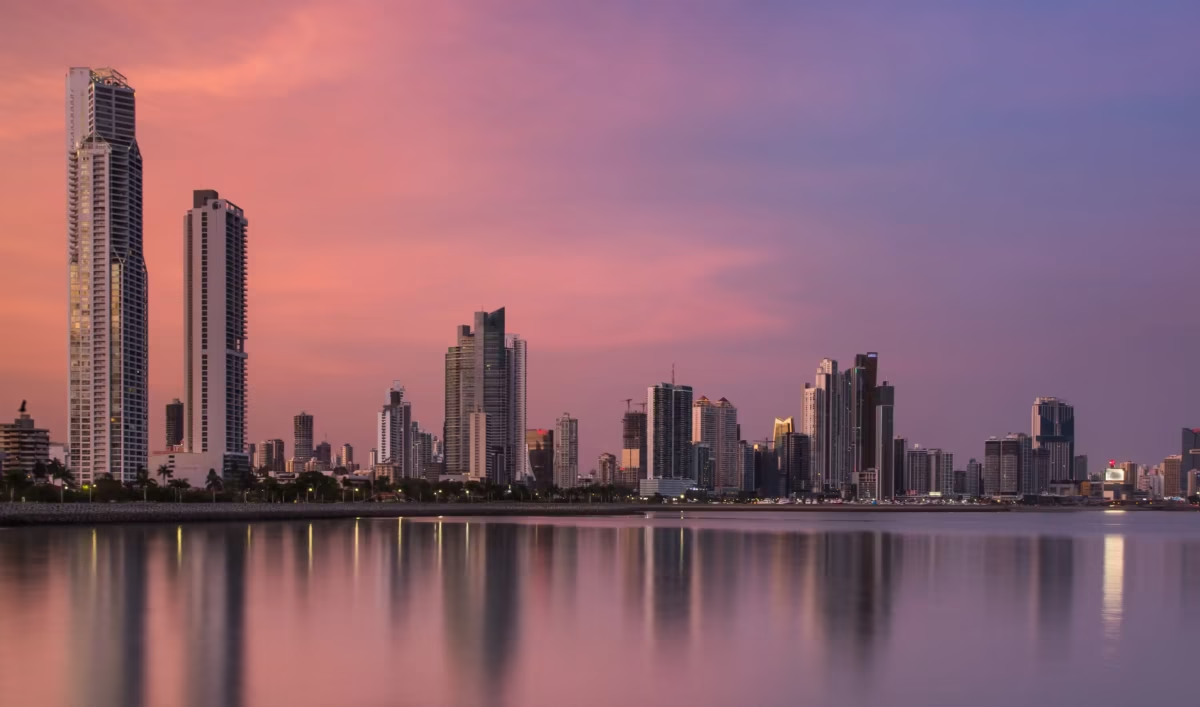
What is life like in Panama?
Pros and cons of moving to Panama
Moving to Panama is currently one of the most solid plan Bs for those seeking to safeguard their personal, financial, and fiscal freedom. For many expats, living in Panama isn't an escape but a strategic choice to protect their future.
It should be noted that approximately 9 out of 10 people use Panama primarily for tax, banking, and international residency purposes, without spending long periods in the country. Many expats, after obtaining residency, choose to live in cheaper and more climate-stable countries—such as Mexico, especially Playa del Carmen—while maintaining Panama as their fiscal and financial base.
Cost of living in Panama
How much does it cost to live in Panama? The cost of living is one of the main factors to consider. Panama's cost of living is among the highest in Latin America: prices are in line with those of an international city. The average local salary in Panama is around $700–$1,200/month, but a European expat needs at least $2,000–$3,500/month for a comfortable lifestyle. Panama City is a small, financially-driven city that relies largely on foreign capital. The ecosystem is made up of bankers, lawyers, multinationals, and international investors, putting upward pressure on prices. A $6 cappuccino is not uncommon.
Another determining factor is the use of the US dollar and the fact that almost 100% of consumer goods are imported, with prices up to 50% higher than in Mexico and around 30% higher than in Colombia.
Rentals in Panama
Rents for those looking to live in Panama City, even in merely decent neighborhoods, average between $800 and $1,000 per month. Rents in Panama City vary greatly by neighborhood and rise rapidly in the central areas. For a 122 m² apartment, prices range from $1,600 in the outskirts to $3,200 in the central areas. A 50 m² loft in the center costs around $1,350.
How much do you need to earn to live in Panama?
Living in Panama costs an average of about USD 3,000 per month for a single person in non-central areas. Closer to the center—for example, Avenida Balboa—the cost rises to about USD 4,500 per month. To live comfortably, a single person should earn at least USD 5,500 per month, and a family of three should have an income of about USD 12,500 per month.
To relocate for 12 months without employment, the required budget is approximately USD 32,000 , including airfare, annual rent, and current expenses.
Panama's "mañana attitude"
An often overlooked factor is the so-called "mañana" attitude. Despite the modern image of skyscrapers, banks, and advanced infrastructure, those who choose to live in Panama discover that the country retains a profoundly Latin American mentality when it comes to time management. Anything that isn't urgent tends to be postponed: "mañana" can mean a few days, weeks, or even months away. Missed appointments and 40-minute delays are considered normal.
For this reason, many foreigners choose to use Panama exclusively as a tax and banking base, living elsewhere. Those seeking a more organized Latin American culture often prefer Mexico.
Security in Panama
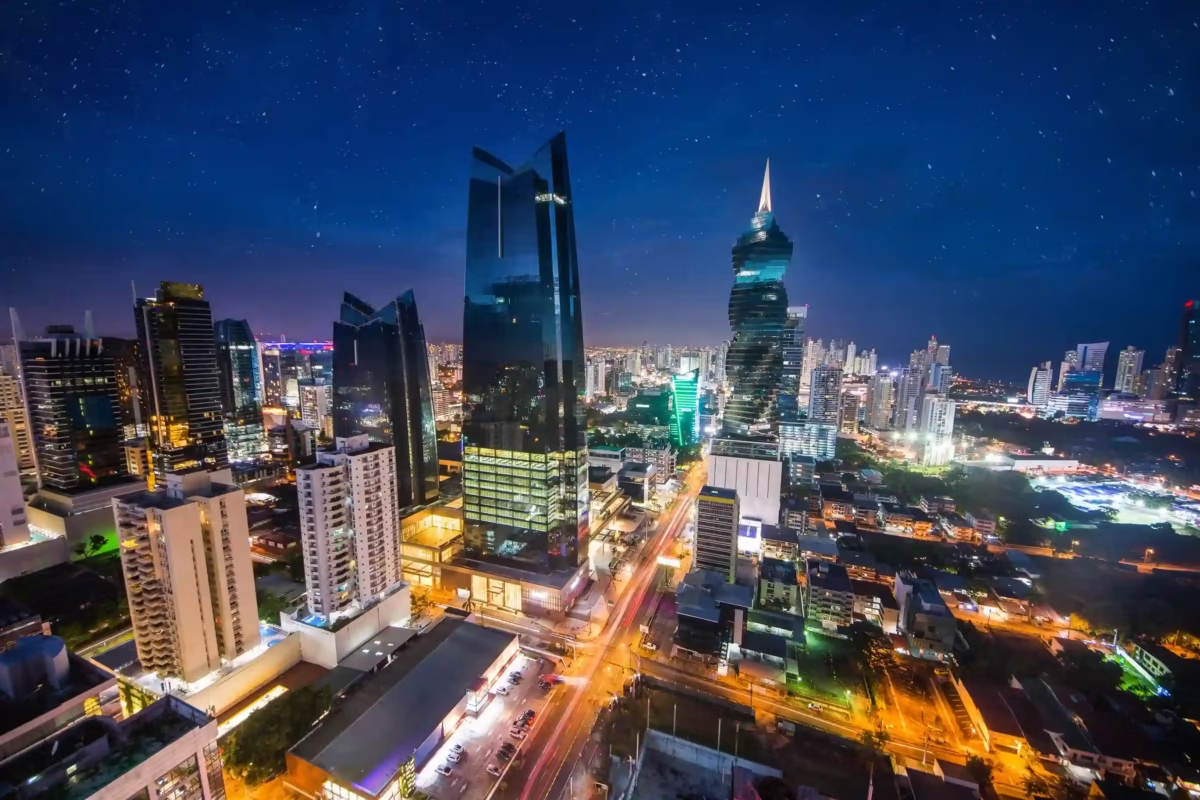
Panama is one of the safest countries in Latin America. It's no coincidence that it's often called the "Singapore of Latin America" due to its high level of urban, banking, and social security. Is Panama dangerous? The answer is no: Panama is a myth. Safety in Panama (Panama security) is high: crime rates in Panama are among the lowest in Central and South America, significantly lower than neighboring countries like Colombia, Ecuador, and Mexico.
The feeling of safety in Panama is very high, both day and night. The quality of life in Panama is excellent. Those who decide to move to Panama can move freely throughout much of the country, including Panama City and the entire metropolitan area, without feeling any real risk. Violent crime is rare in the residential, financial, and commercial areas frequented by residents and expats. Phenomena such as pickpocketing, robberies, or petty crime are virtually nonexistent in central, well-controlled areas.
One of the most obvious indicators of safety in Panama is the daily behavior of the population: people wear expensive clothing, use expensive smartphones, and drive luxury cars at all hours. High-value watches, jewelry, and luxury goods are displayed without fear. In a country where opulence is visible and socially accepted, urban safety becomes a structural necessity—and Panama has built its reputation on this very fact.
Law enforcement is present, efficient, and focused on prevention, especially in urban and tourist areas. Residual crime is concentrated in very specific and easily avoidable areas. For those considering living in Panama as an expatriate destination, security is one of the country's main strengths.
Healthcare in Panama
From a healthcare perspective, living in Panama offers a significant advantage. Panama's healthcare system is among the best in Latin America. Panama's hospitals—particularly Hospital Punta Pacífica (a Johns Hopkins affiliate), Hospital Nacional, and Centro Médico Paitilla—offer international standards at lower costs than those in the US and Europe. The country boasts modern clinics, specialists trained in the US and Europe, and multilingual staff.
When to visit Panama
Panama's climate is tropical with two seasons: dry (December–April) and wet (May–November). Panama's beaches (Panama beaches)—from the San Blas Islands to Bocas del Toro, from Santa Catalina to the Pearl Islands—offer Caribbean and Pacific seas just a few hours from the capital. Panama's restaurants (Panama restaurants) range from local cuisine to top international chefs, with prices affordable compared to Miami or Madrid.
For Europeans, the best time to visit and consider living in Panama is from December to the end of May, corresponding to the Panamanian dry season and the European winter. Moving to or traveling to Panama does not expose you to the risk of tropical diseases: the country has potable water in all facilities and there is no risk of malaria in urban areas.
A flight from Italy to Panama costs between €550 and €1,800 depending on the season. It's important to book at least 4–6 months in advance.
Entertainment and nightlife in Panama
Living in Panama also means enjoying Panama's nightlife and entertainment. Panama's nightlife is among the liveliest in Latin America, from restaurants to the nightlife of Casco Viejo, with clubs like Casa Casco, Chupito 507, Wahaka Party, and La Rana Dorada (an excellent craft beer bar). Top casinos include Sortis Casino, Ocean Sun Casino, Starbay Casino, Royal Casino, and Princess Casino.
Italians in Panama
The Italian community in Panama (Italian community Panama) includes thousands of Italians who live permanently in Panama. Expatriates in Panama of Italian origin are among the largest European communities in the country, attracted by the closely related Spanish language, the climate, the local tax system, and the quality of life.
According to Migration of Panama, over 150,000 Italians reside in Panama. For the AIRE office, where registration is optional, approximately 28,000 Italians are formally registered. Moving to Panama is the number one choice for Italians and Brazilians. The Italian Embassy in Panama is located at PH Plaza 58, Calle 58 Este with Avenida Ricardo Arango, Obarrio: telephone +507 225 8948 , website ambpanama.esteri.it .
Where expats live and meet in Panama
Most expats who choose to live in Panama are concentrated in the capital. Panama's expat community is among the largest in Latin America relative to its population. Panama City and its surrounding areas are the main hub for those who decide to move to Panama as digital nomads, entrepreneurs, or expats, thanks to the presence of international banks, co-working spaces, world-class restaurants, and excellent air connections.
Punta Pacífica is a modern and safe area, highly regarded by expats in the financial and medical sectors, with high-end condominiums. Costa del Este is particularly popular with digital nomads and families for its urban planning, international schools, and strong foreign community. San Francisco offers the perfect balance for young expats: here, you'll find coworking spaces, bars, restaurants, and nightclubs frequented daily by Europeans, Americans, and Canadians. It's one of the areas where it's easiest to socialize with expats.
Obarrio is the city's business hub, frequented by those working in banking, law, and corporate life. Outside the capital, Boquete attracts expats seeking cool weather, nature, and a slower pace, home to one of the country's largest expat communities. Coronado and the Pacific coastal areas are favored by those seeking a beachfront residence, often as a second home.
As for meeting places, expats gather in coworking spaces, networking events, international meetups, and local venues. Casco Viejo is a major evening hotspot, with bars, rooftops, and restaurants where it's easy to socialize. There are also numerous online communities and local groups that organize weekly events, dinners, and professional meetings, making living in Panama one of the easiest ways to quickly integrate as an expat in Latin America.
Working in Panama
Work permit in Panama
For those who have moved to Panama, a work permit is required after obtaining residency and allows them to work legally without risk of deportation. The process to obtain one is simple and requires paying the relevant fee to qualify as a legal worker in the country.
What work can I do in Panama as a resident?
Panama is a country of entrepreneurs, companies, and banks. If you want to live and work in Panama, you must arrive as a company, startup, investor, or entrepreneur. You cannot work as a graduate professional in the medical, legal, or engineering fields—except as an employee under certain conditions—as these management roles are reserved for citizens only.
White-collar salaries, combined with the high cost of living, make Panama not the ideal destination for those looking to change their life without being an entrepreneur or having a lot of capital. If you lack capital, creativity, or a business plan, our advice is to opt for residency in Paraguay .
How to find work in Panama
Looking for work in Panama requires residency first. More and more expats are choosing to work remotely from Panama, taking advantage of its fast internet connection, US-aligned time zone (EST -0/UTC -5), and the absence of foreign income taxes. For those who work remotely, Panama is one of the most competitive bases in the world.
Once you've decided to live and work in Panama, you need to start looking for employment or self-employment opportunities. It's very important to understand that without Panamanian residency, you cannot work . Furthermore, you must apply for a work permit, an essential document for legally working in the country.
In Panama, there is no such thing as illegal work : no one hires illegally because the consequences are severe—jail for the employer and deportation with loss of residency for the foreign worker. Even looking for work becomes impossible if you enter as a tourist, and as a tourist, you can stay in Panama for a maximum of 180 days.
Italian pensioners in Panama
Retiring in Panama is the choice of a growing number of European retirees. Retiring in Panama means enjoying discounts of 20% to 50% on essential services, thanks to the Pensionado program. Panamanian pension benefits include discounts on flights, restaurants, pharmacies, cinemas, hotels, medical care, and public transportation—unique benefits worldwide.
Retirement in Panama has only positives. Retirees in Panama—both Italian and non-Italian—who decide to move there enjoy an excellent quality of life thanks to the numerous benefits provided by Panamanian law:
- 50% off entertainment (cinema, sporting events, music, theatre)
- 35% discount on transportation (cruises, ferries, metro)
- 25% discount on airline tickets
- 50% off hotels
- 20% discount on medicines not covered by health insurance
- 20% discount on professional services
- Duty-free for household goods up to USD 10,000
Investing in Panama
Panamanian investments range from real estate to offshore companies, bank accounts, and private foundations. Buying a Panama apartment (Panama apartment) in the capital is the most popular investment among expats, with rental yields between 6% and 9% gross per annum in US dollars.
Living and investing in Panama means operating in US dollars. Moving to Panama and owning hard assets such as real estate listed in USD allows you to avoid the currency fluctuations typical of countries like Colombia (COP) or Brazil (BRL). Investing in Panama also guarantees easy access to the quick-sales market, as the country attracts capital flight from all over the world.

Investing in Real Estate in Panama
The Panamanian real estate market is open to foreign investment without any particular restrictions. Foreign residents and non-residents can purchase houses, apartments, commercial properties, and land with rights almost identical to those of citizens. Buying property in Panama does not require residency and does not require permanent residence in Panama.
Purchase as an individual or through a company
Purchasing through a Panamanian company is often preferred for estate planning, asset protection, and efficient succession management. In both cases, ownership rights are fully recognized.
Investing in rental apartments
Panama City offers a dynamic market for long-term and temporary rentals. Modern apartments in central locations are highly sought after by managers, diplomats, and international expats. Average prices per square meter range from $1,100 in suburban areas to $1,850 in central locations.
How to buy a house in Panama
For those wishing to live in Panama and purchase property, the process involves a notarized public deed and subsequent registration in the Panama Public Registry. Before proceeding, a real estate due diligence , verifying that the property is free of mortgages, encumbrances, tax debts, or legal disputes. It is essential to check the "Paz y Salvo ," the certificate certifying the absence of debt.
Real estate purchase procedure
- Price negotiation — through a real estate agent or directly with the owner, assisted by a Panamanian lawyer
- Promise to Purchase Agreement — the buyer formally commits to the purchase. A deposit is required upon signing. The agreement must be registered in the Public Registry.
- Title Search — Verify that the seller is the true owner and that there are no liens, mortgages, or issues
- Purchase Agreement — Final Purchase Deed, with possible escrow agency for the funds
- Transfer of ownership — registration of the contract in the Public Registry (equivalent to "Closing" in the USA)
Studio Panama Italia offers this service through a licensed real estate agency in Panama for approximately USD 2,500. Contact us to invest in Panama →
Investing in Casco Viejo
With Law No. 9 of August 27, 1997, the Panamanian government created significant incentives for those wishing to move to Panama and invest in the Casco Viejo (Old Town) of Panama City: income from sales or rentals exempt from income tax for 10 years, a 100% deduction for renovation costs, no duties on imported renovation materials, and no property tax for 30 years.
Tourism investments in Panama
In 1994, Panama passed Law No. 8 , considered the most modern and comprehensive law for the promotion of tourism investment in Latin America and the Caribbean. Since the law was enacted, dozens of the world's largest hotel chains have established themselves in the country to take advantage of it. But Panama's attractive tourism investment laws aren't just for large companies: anyone willing to invest a minimum of $50,000 in the rest of the country (or $3,000,000 in the metropolitan area, as per Law 58/2006) can enjoy significant tax benefits.
A minimum investment of USD 50,000 (outside the metropolitan area) entitles you to: a 20-year exemption on all import taxes for materials, furniture, equipment, and vehicles; a 20-year exemption on real estate taxes; exemption from all airport and pier use fees; and an accelerated depreciation rate of 10% per year on real estate. If you start a tourism business in one of the designated tourism zones, you also receive a 15-year exemption on income taxes .
The opportunities are endless: from a guesthouse in the hills of Boquete to whitewater rafting in Chiriquí Viejo, from surfboard rentals in Playa Santa Catalina to trekking tours through the wild Darién Gap, to marinas, hotels, restaurants, and nightclubs along the beaches of the Pacific Coast.
Panama vs. Costa Rica vs. Uruguay vs. Paraguay: Full Matchup
| Criterion | Panama 🇵🇦 | Costa Rica 🇨🇷 | Uruguay 🇺🇾 | Paraguay 🇵🇾 |
|---|---|---|---|---|
| Tax system | Territorial — 0% foreign income | Territorial — 0% foreign income | Territorial + 11-year tax holiday on foreign income | Territorial 10-10-10 |
| ISR (max on local income) | 25% | 25% | 36% (progressive work) / 12% (capital) | 10% |
| VAT | 7% (ITBMS) | 13% (VAT) | 22% (VAT) | 10% (VAT) |
| Currency | USD (US Dollar) | CRC (Colón) | UYU (Uruguayan Peso) | PYG (Guaraní) |
| Residence — time | 5–8 days (Treaty Italy) | 60–90 days | 30–90 days | 5–7 days |
| Minimum Deposit/Investment | USD 5,000 (recoverable) | USD 2,500/month pensioner income | Proof of income (auto-solvencia) | None (only procedural costs) |
| Mandatory company | Yes | No | No | No |
| Physical residence requirement | No | Yes (183 days/year for tax purposes) | Yes (183 days/year for tax purposes) | No |
| Citizenship | 5 years | 7 years | 3–5 years | 3 years |
| DTC with Italy | Yes | No | No | No |
| Cost of living | Medium-high | Medium | Medium | Very low |
| Real estate tax | 0.5–2.1% (progressive) | 0.25% (cadastral value) | 0.5–1.25% (departmental) | 1% (cadastral value) |
| Capital gains | 10% (local source only) | 15% | 12% (7% new residents option) | 10% (local source only) |
| Offshore financial center | Yes — the largest in the Americas | No | Partial | No |
| Quality private healthcare | Excellent (US standard) | Good | Good | Acceptable |
| Safety | High | Media (petty crime) | High | Average |
| Residence link | Residence in Panama | Residence in Costa Rica | Residence in Uruguay | Residence in Paraguay |
Panama vs. Costa Rica: Which country to choose for living, investing, and moving to?
The Panama vs. Costa Rica comparison is one of the most sought-after by those considering moving to Panama or Costa Rica. Both countries offer political stability and a tropical climate, but living in Panama offers significant advantages. The differences are profound, especially in taxation, investments, residency, and the cost of living. In almost all of these aspects, Panama is more advantageous.
Panama vs. Costa Rica: Economic and Monetary Stability
One of the main advantages of comparing Panama vs. Costa Rica is monetary stability. Panama uses the US dollar as its official currency, completely eliminating the risk of devaluation. Costa Rica uses the Costa Rican colón, a currency subject to fluctuations and devaluations in the medium to long term. For those looking to relocate to Panama, using the dollar represents a huge advantage, especially for real estate investors, entrepreneurs, and expats with international income.
Panama vs. Costa Rica: Taxes and Duties
In the tax comparison, Panama clearly wins. Panama applies a territorial tax : only income earned domestically is taxed, with foreign income completely exempt—Panama is a tax haven par excellence. In recent years, Costa Rica has introduced a more aggressive tax system, extending taxation to foreign income in certain circumstances and imposing a higher overall tax burden. For those seeking tax-efficient residency, moving to Panama is significantly more convenient.
Residency Panama vs. Costa Rica
Obtaining Panamanian residency is generally easier, faster, and cheaper. Panama offers clear residency programs, with defined requirements and rapid application deadlines—especially for European citizens through the bilateral treaty. Residency in Costa Rica is often slower, more bureaucratic, and requires more stringent proof of continuous income. Living in Panama is more flexible and expat-friendly.
Investing in Panama vs. Costa Rica
Living in Panama offers a significantly more favorable investment environment. Investing in Panama means access to an international financial hub , with a solid banking system, modern infrastructure, and a real estate market geared toward foreign investors. Costa Rica is more oriented toward a tourism and agricultural economy, with greater environmental, regulatory, and tax constraints. For real estate investments and business, Panama offers greater operational freedom.
Panama vs. Costa Rica: Cost of Living
The cost of living is often perceived as lower in Costa Rica, but in reality, many areas have become expensive, especially in tourist areas. High rents, expensive services, and higher taxes reduce the real economic advantage. Panama City can be expensive in some areas, but living in Panama offers greater flexibility: it allows you to live elsewhere while maintaining your residency and tax structure in the country.
Panama vs Costa Rica for expats
Panama is more international, more business-oriented, and better connected to the rest of the world. Panama International Airport is one of the main hubs in the Americas. Panama also offers better banking services, high-quality private healthcare, and greater openness to investors and foreigners. Costa Rica remains a good choice for those seeking a more rural and natural lifestyle, but less suitable for those seeking tax efficiency and wealth planning.
Conclusion: Panama or Costa Rica?
In the final comparison, Panama emerges as the best choice for those seeking tax-efficient residency, monetary stability, real estate and financial investments, international wealth planning, and freedom of movement. Costa Rica remains attractive from a naturalistic perspective but is less competitive from a fiscal, financial, and strategic perspective. For a detailed overview, also see Residency in Costa Rica .
Fact Check: Myths and Realities About Residency in Panama
Standard ODG • IFCN • Reuters. For those who want to live in Panama, each line shows the widespread myth and the reality verified with official sources.
| Theme | Myth | Reality |
|---|---|---|
| Residence in Panama | "Permanent residency is obtained in 24 hours." | FALSE. The provisional Panama Cedula E can be obtained in 48–72 hours with perfect application; a complete application process at the SNM is required. After three months, it is upgraded to a permanent Cedula E. Source: SNM |
| Citizenship | "Panamanian passport in 2 years." | FALSE. General route: 5 years of permanent residency and legal requirements. Source: Constitution of Panama |
| Panama-Italy Treaty | "The Treaty provides direct passport." | FALSE. The Treaty grants permanent residency, not citizenship. Source: SNM |
| Taxes in Panama | "With companies in Panama you don't pay taxes anywhere." | PARTIAL. Panama taxes only Panamanian-source income (territoriality); tax residency in the country of origin remains. Source: DGI Panama , OECD Art. 4 |
| Tax residence | "Migratory residence = tax residence." | FALSE. Different concepts. The center of interest and OECD/country of origin rules matter. |
| Company in Panama | "Forming a company = automatic residency." | FALSE. The company supports the economic reason but does not replace a visa/residency. Source: SNM |
| Bank account | "Express opening and no checks." | FALSE. Strict KYC/AML requirements for Panama bank accounts: proof of income, references, and traceable source of funds. Panamanian banking secrecy is protected by law. Panamanian offshore accounts require the same controls. A Panamanian offshore company is the primary means of operating in the Panamanian financial center, where the Panamanian dollar (Balboa pegged 1:1 to the USD) eliminates any exchange rate risk. Source: Superintendencia de Bancos , Law 23/2015 |
| Friendly Nations Visa | "It's still permanent immediately." | PARTIAL. From 2021 (Decree 226): first provisional for 2 years, then permanent application. Italy is not included. Source: Executive Decree 226/2021 |
Methodology: ODG • IFCN • Reuters. Official primary sources. Informational content: does not replace personalized legal advice.
Panama vs. Dubai: Why Choose Panama?
Panama or Dubai? Moving to Panama or Dubai? The two destinations are often compared by expats and entrepreneurs. Both offer significant tax advantages, but the differences are substantial. Panama uses the US dollar as its currency, has real territorial taxation, and a significantly lower cost of living. Living in Panama costs much less: Dubai requires a much higher investment for residency, offers no comparable path to citizenship, and imposes high fixed costs (housing, cooling, mandatory health insurance).
Panama also offers a common law legal system with elements of civil law, asset protection through private interest foundations, residual banking secrecy, and a decades-long established offshore ecosystem. For those seeking a base in the Americas with political stability, international neutrality, and proximity to the United States, Panama remains the most logical choice.
Panama vs. Dubai Comparison Table
| Criterion | Panama 🇵🇦 | Dubai (UAE) 🇦🇪 |
|---|---|---|
| Personal income tax | 0% on foreign income (territorial) | 0% (no income tax) |
| Corporate tax (local) | 25% (Panamanian source income only) | 9% above AED 375,000 (from 2023) |
| VAT / Consumption Tax | 7% (ITBMS) | 5% (VAT) |
| Currency | USD (US Dollar) | AED (Dirham, pegged to the USD) |
| Residence — minimum investment | USD 5,000 (Treaty Italy, recoverable) | USD 545,000 (Golden Visa — AED 2M real estate) |
| Residence — entrepreneurial path | Company + USD 5,000 | Freelance Visa: AED 7,500–15,000/year + free zone license |
| Duration of residence | Permanent (since first release) | 5–10 years (Golden Visa, renewable) |
| Physical residence requirement | No | Return every 6 months (except Golden Visa) |
| Citizenship | 5 years of permanent residence | 30 years (ordinary naturalization), almost impossible |
| Cost of living (single/month) | USD 3,000–4,500 | USD 4,000–6,000 |
| 1BR apartment for rent in the center (average) | USD 1,000–1,600 | USD 1,800–2,500 |
| Climate | Tropical (25–33°C, humid) | Desert (20–48°C, extreme in summer) |
| Banking secrecy | Yes (residual, with CRS exceptions) | Partial |
| Foundations / Trusts | Private Interest Foundations (exempt) | DIFC Trust (regulated) |
| Offshore financial center | Yes — the largest in the Americas | Yes — DIFC, Asia/Europe/Africa hub |
| Time zone vs Italy | UTC−5 (−6h vs Italy) | UTC+4 (+3h vs Italy) |
| Direct flight from Italy | No (Madrid/Miami stopover, 1–4 pm) | Yes (Rome/Milan, 6 hours direct) |
| Tongue | Spanish (easy for Italians) | Arabic/English |
| Health insurance | Optional (private recommended) | Mandatory (USD 1,200–3,600/year) |
| Personal freedom | High (no cultural restrictions) | Media (cultural and religious restrictions) |
| Foreign Real Estate Ownership | Everywhere, same citizens' rights | Only in designated Freehold Zones |
| Alcohol and nightlife | Free, no restrictions | Licensed, designated areas |
| Geopolitical stability | Super stable — international neutrality, no regional conflicts | Unstable — Persian Gulf tensions, Iran/Yemen/Saudi Arabia regional rivalries |
| Risk of attacks on the ground | Virtually zero — no neighboring enemy states | Highly likely — Iran and hostile states within a few hundred kilometers, previous drone and missile attacks in the region |
Frequently Asked Questions about Moving to Panama
Here are the most frequently asked questions from those who want to move to Panama and live there as an Italian, with answers updated to 2026.
How do Italians obtain residency in Panama?
How much does it cost to move to Panama?
What taxes are paid in Panama?
Do I have to live in Panama to maintain residency?
Is Panamanian society mandatory?
Is the USD 5,000 deposit recoverable?
How long does it take to obtain Panamanian citizenship?
Is Panama safe to live in?
What is the cost of living in Panama?
How much does it cost to buy a house in Panama?
How much does it cost to rent in Panama?
Is Panama suitable for digital nomads?
What is the minimum age for residency in Panama?
How does the Friendly Nations Visa work?
How do I contact the Italian Embassy in Panama?
What are the benefits for retirees in Panama?
Can I work in Panama with residency?
Panama or Paraguay: Which is better for residency?
What happens if the residence is done badly?
How can I apply geo-arbitrage with Panama?
How to send money abroad
To send money abroad quickly, securely, and conveniently, use Remitly , our official partner for international transfers. The service offers instant transfers with competitive exchange rates, transparent fees, and real-time tracking. Ideal for expats who need to transfer funds between Italy, Panama, and other countries.
Advice and assistance for residency in Panama
Book your residence in Panama
I've been studying Panama Italy since 2010. Money-back guarantee. Arrival in 5–8 days.
✉️ Write to us on WhatsAppOnce you have decided to move to Panama, you may also be interested in obtaining a Residency in Paraguay (same tax advantages, very low cost of living), a Residency in Mexico (the North American giant, easy and fast), a Residency in Uruguay (dynamic and modern country), a Residency in Chile (Mediterranean climate and wine), a Residency in Ecuador (the most underrated, loved by North Americans and Swiss) or a Residency in El Salvador .
Also learn how to open a company in Panama , open an offshore bank account in Panama , obtain tax residency in Panama , or Panamanian citizenship and a passport . For more information on Private Interest Foundations and asset protection ,
For a comprehensive look at geographic arbitrage , learn how to combine Panama with other jurisdictions to maximize purchasing power.
