

Residence in Puerto Rico
A complete guide to residency in Puerto Rico for Italian citizens. Puerto Rico, a US territory with a dollar currency, offers extraordinary tax incentives through Act 60: 0% capital gains tax for individual residents and a 4% tax for exported services businesses. Residency requires passing the bona fide test (183+ days/year). On this page: Act 60, residency test, US naturalization, corporations, tax comparison, and FAQs.
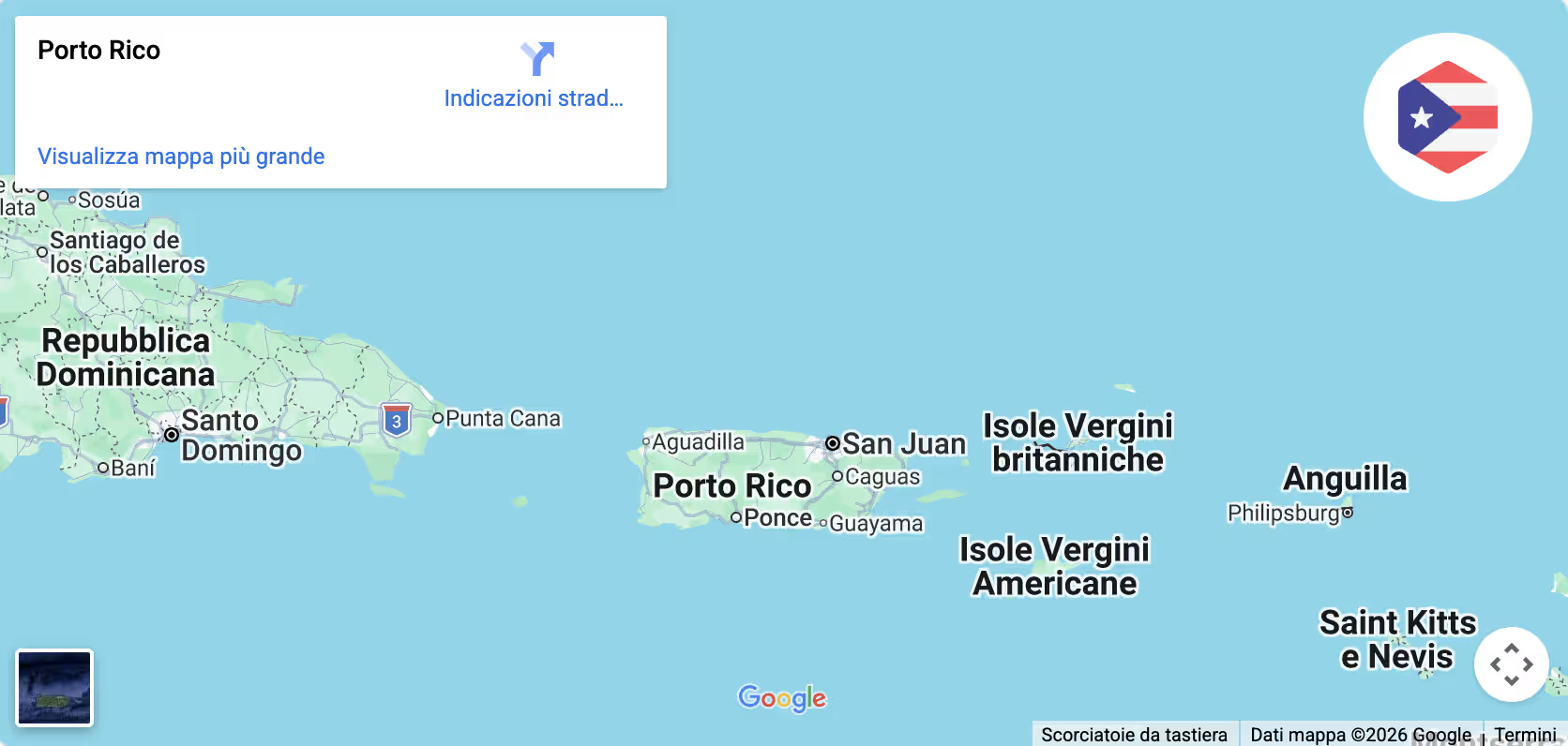
The government of Puerto Rico is an unincorporated territory of the United States of America. As a result of this political relationship, control of entry and exit from its borders is held by the federal government of the United States.
The Puerto Rican Department of State is responsible for guiding foreigners interested in visiting the island and acts as a liaison with federal authorities to clarify or expedite visa procedures. Visitors to Puerto Rico have the same immigration restrictions and privileges as any other destination in the United States.
For immigration purposes, traveling from any part of the United States to Puerto Rico does not constitute a departure from the United States, as long as the flight is direct. Likewise, travelers arriving in the United States from Puerto Rico do not need to go through immigration. However, for identification purposes, they must carry a valid form of identification, such as a driver's license, a document issued by a state or federal agency, or an original birth certificate.
Act 60: Puerto Rico's Tax Incentives
At the heart of Puerto Rico's attractiveness to investors and entrepreneurs is Act 60-2019 (Puerto Rico Incentives Code), which consolidated the previous laws, Act 20 (Export Services) and Act 22 (Individual Investors), into a single tax incentives code. Act 60 is divided into chapters, each dedicated to a specific category of beneficiaries.
We work in coordination with local law firms in San Juan and support the entire process, from the eligibility assessment to obtaining the tax exemption decree.
Chapter 2 — Resident Individual Investor (ex Act 22)
Chapter 2 of Act 60 provides a full exemption from Puerto Rican taxes on dividends, interest, and capital gains accrued after establishing bona fide in Puerto Rico. Combined with Section 933 of the federal Internal Revenue Code, Puerto Rican-source income is also not subject to U.S. federal taxes.
| Benefit Act 60 — Individuals | Details |
|---|---|
| Capital gains | 0% on capital gains accrued after residency |
| Dividends | 0% on Puerto Rican source dividends |
| Interests | 0% interest from Puerto Rican sources |
| Mandatory annual donation | USD 10,000 to local non-profits (including USD 5,000 to address child poverty) |
| Property purchase | Mandatory within 2 years of the decree (primary residence, not rentable) |
| Annual filing fee | USD 5,000 |
| Validity of the decree | Until December 31, 2035 |
Chapter 3 — Export Services and Commerce (formerly Act 20)
Chapter 3 of Act 60 is aimed at businesses that provide services to customers located outside Puerto Rico. The goal is to promote the island as an international export services center. Income derived from services performed in Puerto Rico for outside customers is taxed at 4%.
| Benefit Act 60 — Export Services | Details |
|---|---|
| ISR business rate | 4% on eligible income |
| Dividends from exempt activities | 100% exempt |
| Property tax | Exemption up to 75% |
| Municipal license tax | Exemption up to 50% |
| Duration of the decree | 15 years, renewable for an additional 15 years |
| Eligible Activities | Consulting, marketing, software development, financial services, R&D, design, IT services and many more |
Why Puerto Rico is a strategic destination for residence
- 0% capital gains for individuals — on capital gains accrued after bona fide residency
- 4% tax on exported services businesses — among the lowest in the world for a US territory
- No renunciation of citizenship — Puerto Rico is a U.S. territory; you retain your passport and U.S. or foreign citizenship.
- US dollar as currency – no exchange rate risk, access to the US banking system
- "Made in USA" label — goods produced in Puerto Rico may be labeled as Made in USA
- 863 Qualified Opportunity Zones — 100% of low-income areas are designated as QOZs
- Tropical climate and quality of life — no winter, Caribbean beaches, bilingual and vibrant culture
How to obtain residency in Puerto Rico
Foreigners wishing to move to Puerto Rico are subject to the same immigration laws and regulations as the United States. Immigrating to Puerto Rico therefore involves the same rules that apply to emigrating to any U.S. state. U.S. citizens and permanent residents enjoy the right to live in Puerto Rico the same way Puerto Ricans can live in the continental United States.
The Puerto Rico Bona Fide Residency Test
To benefit from the tax incentives of Act 60, you must become a bona fide of Puerto Rico. This qualification requires meeting three cumulative tests established by the IRS:
Attendance test
The applicant must be "present" in Puerto Rico for a specified period. To pass this test, at least one of the following conditions must be met:
- 183 days of presence in Puerto Rico in the fiscal year
- 549 days in a 3-year period (current year + 2 previous years), with at least 60 days for each fiscal year
- Maximum 90 days in the continental US during the tax year
- Maximum USD 3,000 of income from work in the US and more days spent in Puerto Rico than in the US
- No significant connections to the continental US during the fiscal year
Tax Home Test
The applicant must not have a tax domicile outside of Puerto Rico. This means that the island must be their primary residence or principal place of work. To benefit from Act 60, it is mandatory to purchase property in Puerto Rico within two years of obtaining the decree. The property must be the primary residence and cannot be rented to third parties.
Closer Connection Test
The applicant must not have a closer connection to the continental United States or a foreign country than to Puerto Rico. Eligible factors include: permanent residence, family, assets, primary bank account, business, professional, cultural, religious, social, and political affiliations in Puerto Rico.
Service Details
| Voice | Details |
|---|---|
| Type of service | Bona fide residence + Act 60 decree |
| Territory | Puerto Rico 🇵🇷 (US territory) |
| Total price | Upon request (varies based on the type of decree) |
| What's included | Legal and tax advice, preparation of applications for Act 60, support for opening a bank account and purchasing property |
| General requirements | Valid US visa (or US citizenship/permanent residence), passport, proof of financial resources, background check |
| Document issued | Tax Exemption Decree Act 60 (contract with the Government of Puerto Rico) |
| Decree timelines | 3–6 months from submission via the Single Business Portal (SBP) |
| Payments accepted | International wire transfer, cryptocurrencies (BTC, USDT, ETH) |
| Annual obligations | Filing fee USD 5,000 + donation USD 10,000 to local non-profit organizations |
Naturalization and U.S. Citizenship in Puerto Rico
For foreigners who have obtained permanent residence (Green Card) in the United States and reside in Puerto Rico, the path to American citizenship follows federal USCIS regulations. The application for naturalization (Form N-400) is submitted to the local USCIS office in San Juan.
Requirements for naturalization
| Requirement | Details |
|---|---|
| Minimum age | 18 years old |
| Permanent residence | 5 years (3 years if married to a US citizen) |
| Good moral conduct | Request |
| Maximum absences | Do not exceed 915 days (30 months) outside the US in the last 5 years |
| Application cost (N-400) | USD 725 (money order) |
| Documents | Completed Form N-400, Green Card, passport for the last 5 years, 2 photos 2×2 |
| English language exceptions | 50 years + 20 years of residence, or 55 years + 15 years of residence |

Puerto Rico vs. Panama vs. Paraguay: A Tax Comparison for Italians
| Criterion | Puerto Rico 🇵🇷 | Panama 🇵🇦 | Paraguay 🇵🇾 |
|---|---|---|---|
| Taxation | Territorial (de facto per Act 60) | Territorial | Territorial 10-10-10 |
| ISR company (eligible) | 4% (Act 60) | 25% (standard) | 10% |
| Capital gains (individuals) | 0% (post-residency) | 0% (foreign source) | 0% (foreign source) |
| VAT / ITBMS | 11.5% (SUT) | 7% (ITBMS) | 10% (VAT) |
| Currency | USD | USD + PAB | PYG |
| Banking system | USA (FDIC) | International Offshore Center | In development |
| Mandatory company | No | Yes (for Italians, Treaty of Friendship) | No |
| Property purchase | Mandatory within 2 years (Act 60) | Not mandatory | Not mandatory |
| Annual donation | USD 10,000 + fee USD 5,000 | None | None |
| Time for citizenship | 5 years (US naturalization) | 5 years | 5 years (3 permanent) |
| Cost of living | High | Medium | Very low |
Opening a company in Puerto Rico
Puerto Rico offers a corporate ecosystem integrated into the U.S. legal system. Companies registered in Puerto Rico can operate as fully-fledged U.S. entities. Registration occurs through the Registry of Corporations at the Puerto Rican Department of State.
Types of Companies in Puerto Rico
- LLC (Limited Liability Company) — the most popular form among Act 60 investors. Flexible, with no minimum capital requirements. It can elect to be taxed as a partnership or corporation.
- Corporation (Inc.) — equivalent to a joint-stock company. Used for more structured activities and for businesses requiring the Export Services Act.
- S-Corporation — Available only to U.S. citizens and residents. Offers pass-through taxation.
Standard corporate taxation in Puerto Rico
Outside of Act 60, Puerto Rico applies a progressive corporate income tax rate of up to 37.5% (including the surcharge). Businesses that obtain Act 60 for Export Services benefit from a reduced rate of 4%. Goods produced in Puerto Rico can be labeled "Made in USA," providing credibility and access to the U.S. and international markets.
Request your residency in Puerto Rico
Contact us for a personalized consultation on Act 60 and tax transfers.
✉️ Write to us on WhatsAppIn addition to obtaining residency in Puerto Rico, you may be interested in securing your tax liability by taking up a second residence in a country with territorial taxation, such as a residence in Panama or a residence in Paraguay . You may also want to explore the benefits of taking up residency in Mexico .
You may also be interested in an offshore account to complement your tax strategy.
