Residency in Ecuador
Moving to Ecuador requires applying for one of the many residence visas the country offers. Moving to Ecuador is an excellent choice if you're looking for a truly affordable country with a high standard of living and a stable currency thanks to the use of the US dollar as the national currency. Moving to Ecuador is still relatively simple for Italians. Ecuador is an easy country to move to and obtain temporary residency. Furthermore, Ecuadorian citizenship, the next step after residency, is still a simple process. Remember that moving to Ecuador to live or work requires meeting financial requirements. Obtaining residency in Ecuador allows you to obtain a residence permit for an initial fixed period in a dollarized country. Applying for a residence visa in Ecuador is relatively simple. The residence permit in Ecuador is issued based on financial requirements that the applicant must meet. Obtaining residency in Ecuador for Italians means being able to demonstrate certain financial solvency requirements, such as a steady salary or an income of at least USD 1,275 per month. Transferring residency to Ecuador also requires a clean criminal record. A residence visa for Italians in Ecuador is obtained like almost any other visa from other countries in the region and requires a lawyer to process the process locally. There are numerous residence visas in Ecuador, which we'll discuss later.
Moving to Ecuador: Accessible Residence, Jobs, and Investments
Ecuador is the perfect destination for those seeking a fresh start with incredibly low costs and unique benefits. Obtaining residency in Ecuador is easy, whether for retirees wishing to enjoy the mild climate, professionals, or digital nomads seeking a life rich in cultural experiences. With real estate investments starting at a fraction of the cost of Panama, Mexico, or Colombia, you can easily obtain a residency visa and live in the heart of a natural paradise. Discover Ecuador: an affordable future full of opportunities awaits you!
The Republic of Ecuador is a Latin American country and an associate member of Mercosur. Located in the northwestern part of South America, bordered by Colombia and Peru by land and Costa Rica by sea, its territory is divided by a volcanic section of the Andes mountain range. To the east lies the dense Amazon rainforest. To the west lies the Gulf of Guayaquil, bordered by the Pacific Ocean, overlooking the incredible natural landscapes of the Galapagos Islands. Ancient colonial cities, multicultural communities, volcanoes, and an exciting flora and fauna abound. Ecuador has also been called the world's most biodiverse country. The nation boasts the finest, most sought-after, and most refined coffee in the world, with varieties such as Caffè de Loja and Galapagos making it an extremely exclusive destination for coffee connoisseurs and avant-garde coffee lovers. Ecuador is also the birthplace of the world's first cocoa plant. Today Ecuador is the undisputed home of the best and finest quality cocoa which is used in the chocolate industry Switzerland, France, Austria and Belgium
Ecuador has a population of over 18,200,000. Its political capital is Quito, although its most populous city is Guayaquil, the country's financial and industrial capital. Despite being a Spanish-speaking country, there are more than 13 recognized indigenous languages. Ecuador's economy is officially dollarized; the US dollar has been the sole legal tender since 2001. Ecuador has the highest rate of female entrepreneurs in Latin America and the world, according to GLOBAL ENTREPRENEURSHIP MONITOR.
Its economy is based on exports, primarily oil, but also bananas, processed fish and gold, shrimp, fish, and rice, and is highly dependent on fluctuations in commodity prices. Ecuador also has a growing tourism sector. Other significant industries include raw materials and manufactured goods, textile production, mining, and chemicals. The country has a mild climate and diverse geography, with abundant fertile land and numerous investment opportunities in the agricultural sector. It offers four consistently consistent climates within the same territory and a very low population density, perfect for hermits.
How to obtain residency in Ecuador
As mentioned, moving to Ecuador is still quite simple and recommended as a Plan B. Ecuador has one of the most liberal immigration policies in the world, with almost no restrictions on settling. One example is the dozens of visas designed for every social, economic, and cultural background.
Moving to Ecuador is therefore up to you to choose the visa that best suits your needs. There are several ways to become an Ecuadorian resident, and the process is fairly simple. While you must submit your immigration visa application to the Ecuadorian consulate closest to your former residence, it is actually approved by the Ministry of Foreign Affairs, so expect the approval process to take four to eight weeks. Visa applications for dependents, however, can be processed directly by the consulate once the application has been approved.
We strongly recommend contacting one of our Ecuadorian immigration lawyers to help you navigate the visa process without delays or delays.
Temporary and permanent visas for residing in Ecuador
On February 6, 2017, Ecuador's new immigration law (Ley de Movilidad Humana) came into effect. This law brings several important changes, one of which is the introduction of temporary residence visas.
You can temporarily move to Ecuador as a tourist. Visitors to Ecuador are permitted to stay for up to 90 days. Once you're there, you can request an extension of another 90 days starting on day 91 for a fee of $144. Please note: if you only use up the 90 days, you must leave at the end of the 90 days and cannot return until your permit resets to zero, which occurs the following year, on the first day of your first entry into the country. In the past, foreigners in Ecuador could immediately apply for a permanent residence visa, but this is no longer the case. Now, everyone must first obtain a temporary residence visa valid for two years. This temporary visa can only be renewed once. After obtaining the 21-month temporary visa, you are eligible to apply for a permanent residence visa in Ecuador, which has no expiration date.
Holders of a temporary Ecuadorian residence visa can live outside the country for no more than 90 days in any 12-month period. Those with permanent residence visas can leave the country for no more than 180 days in total for the first two years. The law does not clarify how long permanent residents can remain outside the country after the first two years.
The types of Ecuadorian residency visas for Italians that you can apply for are described below, and these options are the same for both temporary and permanent visas.
The main choice for residence in Ecuador
Italians can easily apply for residency in Ecuador. To obtain residency in Ecuador, you need to decide which residence visa to apply for. There are 13 different visa options in Ecuador, but the vast majority of expats obtain residency in Ecuador with a retirement visa. This is what was previously called the 9-I , but is now the 60-III .
60-III: Retired: For expats with a pension income, this is usually the preferred option for obtaining residency in Ecuador, as it does not require significant capital investments. Proof of permanent income from a source outside Ecuador of at least $1,275 per month is required . An $500 is required for each dependent. This income typically comes from the applicant's pension, social security, or fixed income annuity (since the funds cannot be withdrawn once the distribution phase begins). Income from sources such as rental properties or stocks is not acceptable with this visa; however, such investments can be used for the 60-II (Rentista) visa.
If you are applying for a residency visa in Ecuador while in the country on a T-3, that visa MUST have at least 30 days remaining at the time of application.
Requirements for residency in Ecuador
The requirements for obtaining residency in Ecuador are relatively simple, although it's important to have your lawyer guide you through the process.
Below are some general requirements to keep in mind if you want to move to Ecuador:
- Documents submitted for this process must be originals or certified copies (notarized) and must be apostilled if your home country is a signatory to the United Nations Apostille Convention (the United States is, Canada is not).
- In the United States, the apostille stamp is applied by the Secretary of State's office in the state where the documents are issued. In Italy, it is applied by the prefectures of the province where the documents are issued.
- Documents must be translated into Spanish (do this after your arrival in Ecuador to avoid having to obtain additional apostilled documents).
- You must register your home address with immigration authorities and report any changes to your address while living in Ecuador.
All applications for residency to move to Ecuador require the submission of:
- A completed form solicitud de visa de inmigrante for the appropriate type of residence.
- A certified copy of an up-to-date passport (make sure it doesn't expire within the next six months), with a notary certifying that it is legally current.
- A completed form called a ¨hoja de datos para la cédula¨ (a data sheet, later used for your identity card).
- Two current passport-sized photos, in color with a white background. You can easily obtain these once you're in Ecuador.
- If applicable, a marriage certificate or common law certificate. If you are previously married, you will also need copies of a divorce decree or death certificate.
- Birth certificates for the applicant and all dependents. For the visa itself, these are only required for dependent children, but birth certificates for everyone are required to apply for your cédula (Ecuadorian identity card) after your visa has been approved. A criminal record and criminal record report. This applies to all immigrants (Type 9) residing in Ecuador. The report must be issued by the country where the visa applicant has resided for the past five years.
- Finally, a cumulative certificate of Citizenship, Residency, and Birth.
Types of residence visas in Ecuador
The total number of residence visas in Ecuador currently in existence is 13.
There are numerous Ecuadorian residency visa options available to foreigners. Below are the most popular Ecuadorian residency visas:
Pensioner Visa (Pensionado): In Ecuador, a pensioner visa requires the applicant to demonstrate a steady income from a guaranteed, reliable, and lifelong source, such as Social Security or a city/state or company pension. There is a minimum income requirement of $1,275 per month for a pensioner residency visa (previously $800), plus $500 per dependent (previously $100) who moves to Ecuador with the principal pensioner applicant.
Investor (Inversionista): Investor visas are available to individuals with financial resources and assets that they will use to develop productive or commercial activities. They can invest in Ecuadorian real estate or an Ecuadorian certificate of deposit at a bank for at least 100 times the Ecuadorian minimum wage. The current minimum wage in Ecuador is $425 USD per month, so the current minimum investment is approximately $42,500, plus a fixed monthly salary of $425 USD and an additional $500 USD per family member who moves to Ecuador with the principal investor. Therefore, in addition to investing $42,500 USD, you must also demonstrate a monthly income of $425 USD, equivalent to a basic salary.
Professional, technician, technologist, or master craftsman (professional): Professionals with a four-year degree from a recognized college or university can come to Ecuador with this visa to pursue their profession, technical activity, technological activity, or craft, governed by the respective regulations governing these activities. However, there is no obligation to work in Ecuador with this type of visa, as many retired expats choose to move to Ecuador with this type of visa.
Independent Income/Income (Rentista): This visa is applicable when an individual has their own resources (i.e., monthly income) brought to Ecuador from abroad. If they generate their income from these resources or from any other legal income from an external source, such as "rental income," they may qualify for this type of visa. However, since this is a new type of visa, the proof of income requirements and the type of income in question are not set in stone, and therefore are highly subject to change over time, both in terms of application and interpretation. Generally speaking, all applications with amounts exceeding USD 1,275 are always accepted.
Marriage or Dependent Visa (Amparo): This type of visa is for foreigners who are already married or will soon marry an Ecuadorian citizen (hence the reference to "Marriage Visa" in the title), as well as for ANY dependent of Ecuadorian residents who are moving (or have already moved) to Ecuador with a foreigner with one of the other visa types shown in this comprehensive list of 13 such visa options. This type of visa ("Amparo Visa" is its full umbrella term, referring to all possible permitted classes of dependents), applies broadly to spouses, children, grandchildren, parents, siblings, and common-law partners (i.e., Union de Hecho).
Worker (Trabajador): A work visa is for someone authorized to perform paid work in an employee-employee relationship. This applies to public service jobs, private industry jobs, and self-employed individuals. Registration with the IESS is required.
Scientist, researcher, or academic: This visa requires the applicant to specialize in scientific activities, such as research or academic work, and to be employed by public or private entities. It also applies to individuals working in the Ecuadorian education system in their area of specialization. This visa may be renewed depending on the length of the academic program.
Athlete, artist, or cultural agent: This visa applies to individuals employed by an Ecuadorian individual or entity to develop such activities.
Religious person, religious volunteer, or missionary from an organization legally authorized and duly recognized by the Ecuadorian government: The religious visa is for a person who will carry out religious-related activities.
Volunteer (Volunteer): Volunteer visas are for individuals who voluntarily and altruistically provide community services, in accordance with the regulations of Ecuador's Human Mobility Law. They may work independently or with the support of a non-governmental organization (NGO), also known as a non-profit organization (or non-profit).
Student (Estudiante): Student visas are for people coming to Ecuador to attend school, whether basic education, higher education, university education, or master's degree. They must be regular students at a private or public educational institution recognized by the Ecuadorian government. Student visas are also for people coming to Ecuador to complete an internship program. This visa can be renewed based on the duration of the academic program.
International Convention (Convenio): This visa is for a person entering Ecuador under the umbrella of an International Convention to which Ecuador has signed and recognized (i.e. Mercosur or Unasur, and when/where applicable).
International Protection: This final visa category is for those who have been recognized by the Ecuadorian government as refugees, asylum seekers, or stateless persons and cannot meet any of the requirements for the aforementioned categories. These individuals may also be eligible for international protection in Ecuador.
Digital Nomad: A temporary residence visa through which all those who are truly digital nomads, and who can therefore receive a stable source of income from a foreign company, can temporarily establish their residence in Ecuador for a few years.
In addition to obtaining your residency in Ecuador, you will probably be interested in creating a life insurance policy on your tax situation by taking up a second tax residence in a country with territorial taxation, such as a Residence in Panama or a Residence in Paraguay.
You might also be tempted to find out what advantages there are to moving to the Mexican economic giant, taking up residence in Mexico
To begin your residency transfer process, contact us at info@studiopanamaitalia.com, sending us a copy of your passport, and the exact dates to start and take up residency in the country of your choice, or contact us through the contact form on this website or via WhatsApp-Telegram at +1 786-623-8177
Documents for Obtaining Residency in Ecuador
The documents required to apply for residency in Ecuador are for any type of visa. In addition to the specific documents for each visa, the following general mandatory documents are also required:
- Birth certificate
- Cumulative certificate of citizenship-birth-family status-residence
- Criminal Record Certificate
- Certificate of Pending Charges
- Certificate equivalent to Criminal Records and Pending Charges for each country where you have been resident or have stayed for more than 90 days in the last 5 years
- All documents must be certified for Ecuador
- Specific documents for the type of visa requested
Cities in Ecuador to move to
The best cities to take up residency and live in Ecuador vary greatly. Every foreigner who wants to live and work in Ecuador will be spoiled for choice, given the vast number of splendid cities and towns where they can settle. The most popular, in order of prevalence, are:
Cuenca , the capital of the province of Azuay, is a city at 2,600 meters above sea level, nestled between the Andes. Historic, clean, and orderly, it's crisscrossed by a river, green, and culturally vibrant. You won't notice any difference between Cuenca and any other culturally dynamic European city. Safe, accessible by bike and pedestrians, wherever you want to go. Affordable, and everyone speaks English.
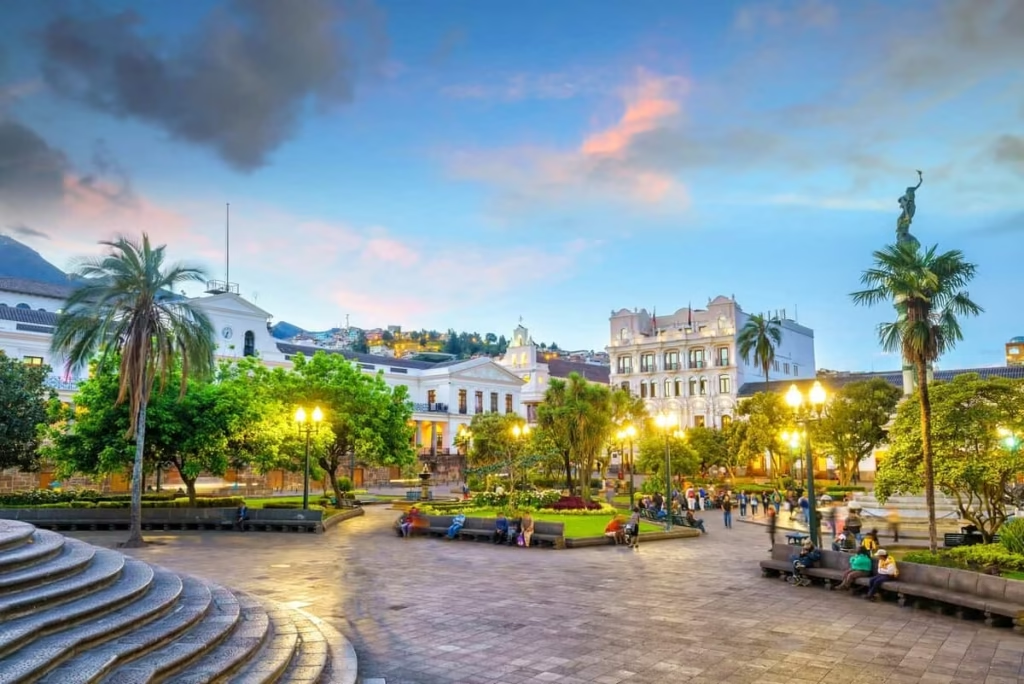
Quito : the capital of the Pichincha province, at 2,850 meters above sea level, a metropolis of 2.6 million inhabitants, also historic, ancient, and culturally vibrant, you will have to be more careful due to its size. Crimes are common to any other large city.
Manta : a small, well-organized, and extremely sunny coastal city in the province of Manabí, on the Pacific Ocean. You'll be happy here if you're looking for easygoing coastal people and a small space to get things done. Some of the best cuisine in the country.
Guayaquil : a megalopolis in the province of Guayas. It has recently suffered from criminal activity due to its strategic location between Peru and Colombia, which makes it, with the largest and busiest port in the North Pacific, a necessary hub for drug trafficking between these two nations. The coastal metropolis has a population well over 2.8 million and is the most industrialized and commercial area in the country. It is definitely the city where a European can least easily adapt to life, due to its disproportionate size, the widespread and mandatory use of cars, and the enormous differences between sectors, from areas like Samborondon, considered Ecuador's most luxurious neighborhood, to areas like Durán, the most dangerous neighborhood in Ecuador.
Geopolitical and Security Situation in Ecuador and Guayaquil
Security in Ecuador has never been a problem. For over 30 years, Ecuador was the most peaceful and safe country in Latin America. Since 2017, the country has suffered a localized escalation of criminal activity due to the arrival of Mexican drug trafficking. Security in Ecuador is being challenged by the presence of gangs seeking to divide up drug trafficking territory. These are two groups of Mexican drug families, the Sinaloa Cartel and the Gulf Cartel. Both have become friends and have made deals with the local criminal gang, which is very small but has risen to the level of criminality with training and weapons of war. The reason is the perfect geographical location of Guayaquil, the country's industrial capital and port, between cocaine-producing Peru in the VRAEM and Colombia, a well-known cocaine producer in the Colombian Andes. The only outlet for cocaine is Guayaquil. The state has therefore engaged in a head-on fight. The damage and potential social dynamics are strictly sectoralized, so when you hear news about Ecuador and Ecuador's security, and the criminal acts in Guayaquil, they are 100% caused in areas where no foreigner or middle-class citizen lives and perhaps doesn't even know about. It's important to say this to avoid the usual misinformation and catastrophism of the Italian and European media in general, which in a matter of seconds would like to explain these localized phenomena inherent in geopolitical dynamics where the supranational interests of other countries and forces collide.
How to send money to or from Ecuador?
Use Remitly , our official partner, to send money abroad instantly.