

Residence in Uruguay
A complete guide to residency in Uruguay for Italian citizens. Uruguay, the "Switzerland of South America," offers temporary and permanent residency with a favorable tax regime: an 11-year tax holiday for new residents (exemption on foreign income until 2036). There are no investment or minimum stay requirements. On this page: types of residency, requirements, documents, the 5-step process, taxation, citizenship, regional comparisons, and FAQs.
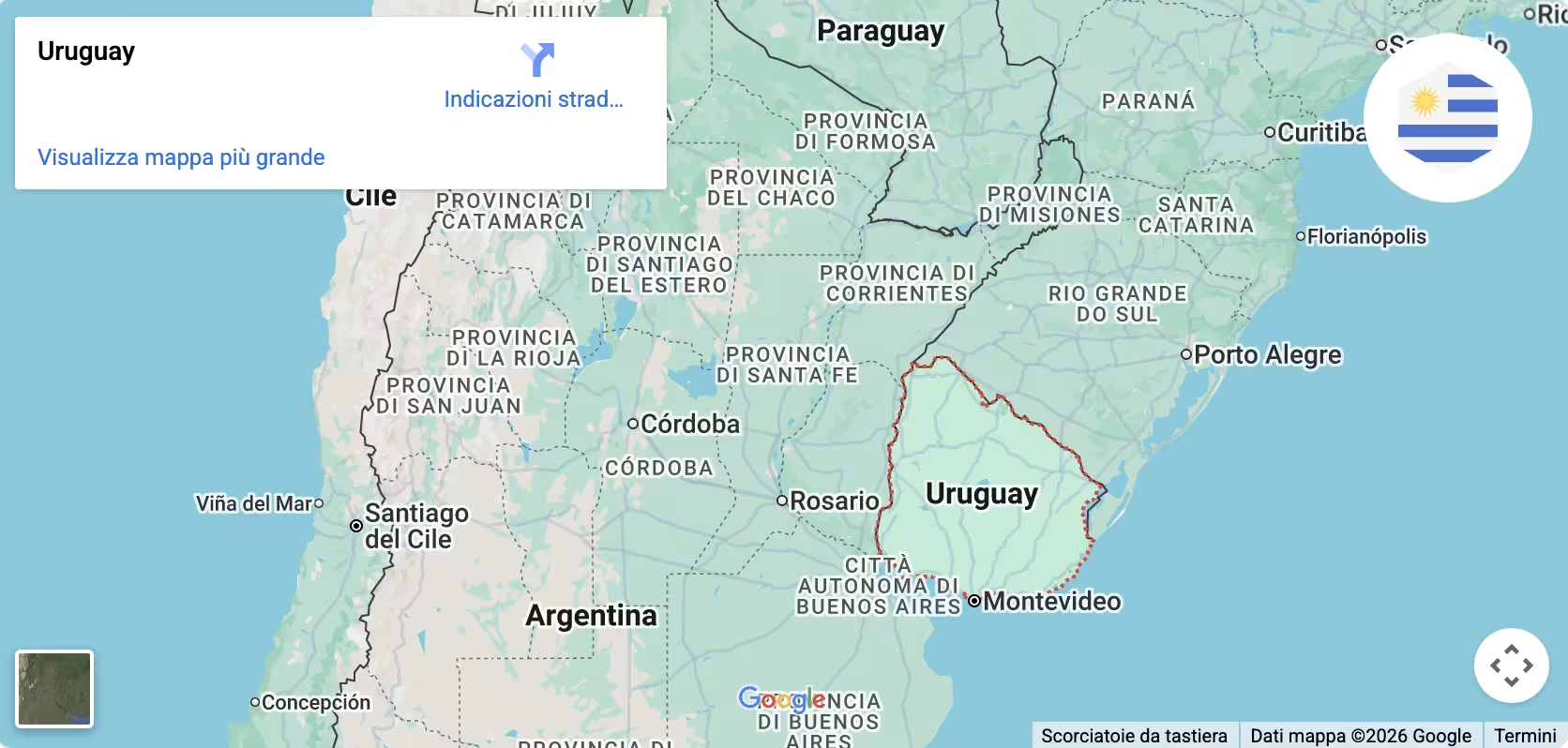
Residency and Taxation in Uruguay: The Switzerland of South America
Uruguay is known as the Switzerland of South America for its political stability, strong rule of law, institutional transparency, and a robust and discreet banking system. The Rio Platanian country is one of Latin America's most desirable residence destinations for those seeking legal security, a high quality of life, and a favorable tax regime on foreign income.
Unlike Paraguay, Uruguay does not apply a purely territorial tax system, but rather a mixed system: Uruguayan-source income is taxed with the IRPF (Personal Income Tax) at progressive rates from 0% to 36%, while foreign-source income enjoys a generous 11-year tax holiday for new tax residents. This means that dividends, interest, and capital gains from abroad can be tax-free for up to 11 years after obtaining tax residency. VAT in Uruguay is 22% (standard rate) and 10% (reduced rate).
We work with a network of professionals in Montevideo and coordinate the entire process, from preparing the documents in Italy to issuing the Uruguayan Identity Card.
Why Uruguay is a great place to live
- 11-Year Tax Holiday — New tax residents can exempt foreign capital gains for the year they change residence plus the following 10 years.
- Political and legal stability — consolidated democracy, low corruption, respect for the rule of law, and an independent judiciary.
- No residence requirement — legal residency does not require a minimum number of days in the country to be maintained.
- Direct Permanent Residency — Unlike many countries, Uruguay allows you to apply directly for permanent residency without going through temporary residency.
- Path to citizenship — After 3 years (couples and families) or 5 years (singles) of residence, you can apply for naturalization with a Uruguayan passport.
- Unrestricted Dual Citizenship — Uruguay allows dual citizenship for all citizens of the world, including Italians.
- Excellent quality of life — first in Latin America on the Human Development Index, with high-level health and education services.
Service Details
| Voice | Details |
|---|---|
| Type of service | Permanent or temporary residence (depending on the profile) |
| Village | Uruguay 🇺🇾 |
| What's included | Comprehensive legal assistance, filing with the National Migration Directorate, sworn translations, legalizations, and on-site assistance |
| General requirements | Valid passport, apostilled and translated criminal record certificate, updated vaccination certificate (for temporary stays), Carné de Salud (for temporary stays) |
| Specific requirements ITA 🇮🇹 | Italians do not require a visa to enter Uruguay. Documents apostilled by Italy and translated by Traductor Público Uruguayo |
| Document issued | Cédula de Identidad Uruguayan (resident in trámite, then definitive) |
| Timings | 30–90 days from submission of the complete dossier |
| Payments accepted | International wire transfer, cryptocurrencies (BTC, USDT, ETH) |
| Next step | After 3–5 years → request for legal Uruguayan citizenship |
Tax Residency in Uruguay and Tax Holiday
Tax residency in Uruguay is achieved by meeting at least one of the following criteria: residence in the territory for more than 183 days in the calendar year, location of the main economic activity in Uruguay, or investment in real estate worth more than 15 million UI (approximately USD 2,000,000 as of the 2026 reform) with a presence of at least 60 days per year. Tax residency is certified by the Tax Residency Certificate issued by the General Tax Directorate (DGI) using Form 5202.
Uruguay's major tax advantage is the Tax Holiday : new tax residents (impatriados) can opt not to pay IRPF on returns on capital from abroad for the year of their change of residence and the following 10 years (IRNR regime). Alternatively, they can choose to pay IRPF at 7% (instead of 12%) on such returns with an indefinite character.
How to obtain residency in Uruguay
The country, like all of Latin America, has a remarkably open immigration policy, where residency can be obtained by demonstrating a fixed monthly income and a minimum of three years of residency history. After five years (three for couples), a resident is eligible to apply for citizenship if, and only if, they speak fluent Spanish and pass a series of linguistic, historical, and cultural exams about Uruguay.
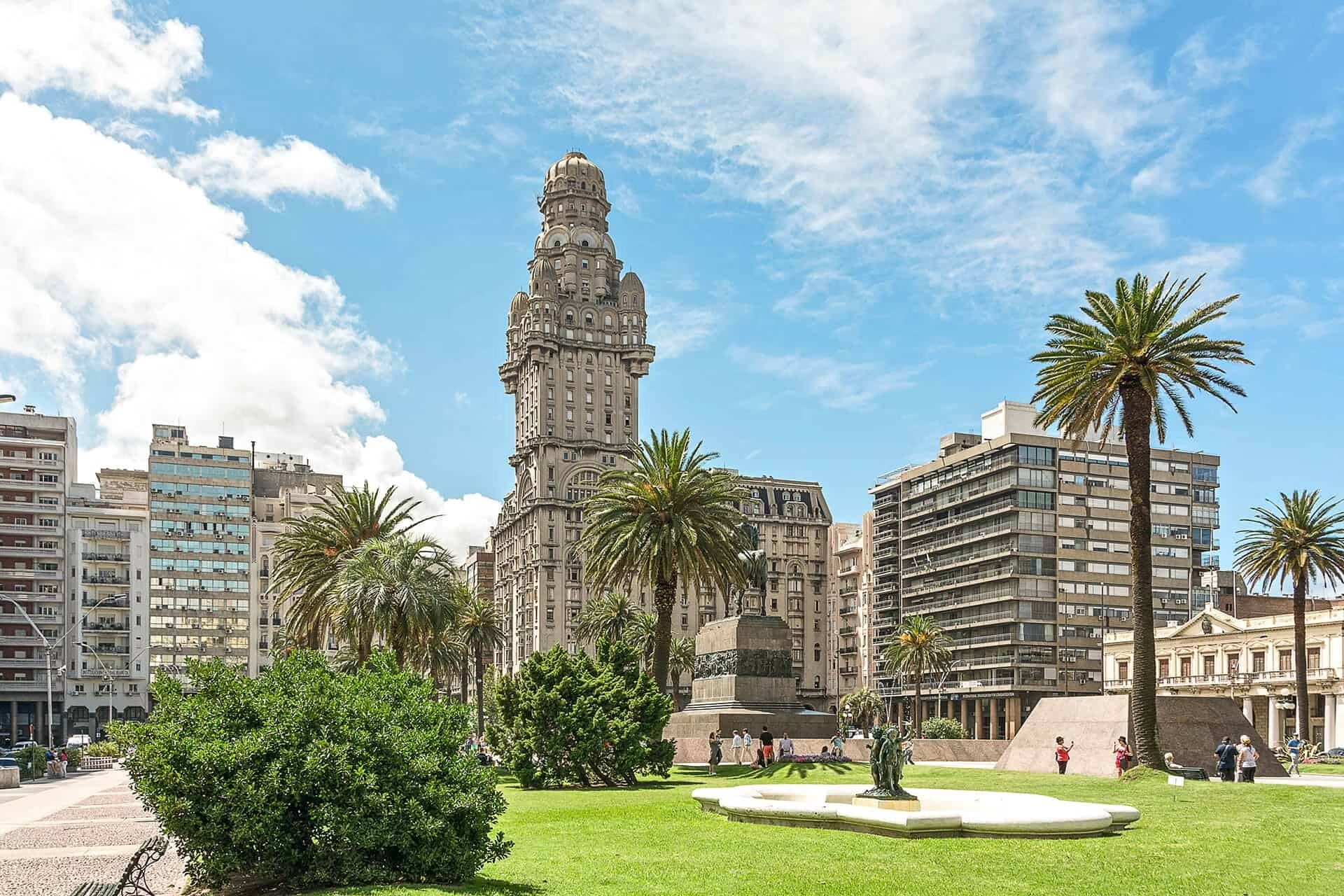
Uruguay is particularly attractive to Italians: approximately 40% of the Uruguayan population is of Italian descent, and its culture, cuisine, and lifestyle have strong Mediterranean affinities. The Italian community is historic and deeply rooted, with associations, schools, and clubs active throughout the country, especially in Montevideo.
Unlike many Latin American countries, Uruguay allows you to apply directly for permanent residency without first obtaining temporary residency. This represents a considerable advantage for those intending to settle in the country long-term. The process is conducted at the National Migration Directorate (DNM), an agency of the Ministry of the Interior.
Types of residence in Uruguay
| Category | Recipients | Duration | Notes |
|---|---|---|---|
| Permanent | Any foreigner intending to reside permanently | Unlimited | Direct access without a preliminary temporary period. Requires apostilled criminal record |
| Permanent MERCOSUR | Citizens of Argentina, Brazil, Chile, Bolivia, Paraguay, Peru, Ecuador, Colombia, Venezuela, Suriname, Guyana | Unlimited | Simplified procedure for citizens of MERCOSUR member and associated countries |
| Permanente per vínculo | Foreigners with ties to a Uruguayan (child, spouse, partner, sibling) | Unlimited | Preferential path for family reunification |
| Temporary | Any foreigner for work, study or other reasons provided by law | From 6 months to 2 years, extendable | Requires documentation of activity (work, study, income). Includes a health certificate and vaccination certificate |
| Temporary MERCOSUR | Citizens of MERCOSUR member and associated countries | Up to 2 years, extendable | Simplified procedure for MERCOSUR citizens wishing to reside temporarily |
| Special Document Fronterizo | Brazilian citizens residing in border cities | Up to 5 years, extendable | For work or education in Uruguay. Includes retirees and newlyweds |
| Residence for income | Pensioners and renters with a stable income | Permanent | Proof of fixed monthly income (≈ USD 1,500) with a history of at least 3 years |
| Residence for investment | Investors who purchase real estate or start businesses in Uruguay | Permanent | No fixed minimum amount, but the investment must be significant and documentable |
Tax details
| Voice | Details |
|---|---|
| IRPF (income from work) | Progressive from 0% to 36%. First bracket exempt up to approximately UYU 576,576/year (≈ USD 13,500). Maximum rate from 36% above UYU 9,417,408/year |
| IRPF (capital returns) | A flat rate of 12% on interest, dividends, capital gains, and rent. This rate can be reduced to 8% with a final withholding tax |
| Tax Holiday for new residents | Option 1: 11-year exemption (year of entry + 10), then 6% for 5 years, then 12%. Option 2: 7% IRPF indefinitely from the start. From 2026, it is conditional on investment in Uruguay |
| VAT (ordinary VAT) | 22% (basic rate), 10% (reduced rate for essential goods) |
| IRAE (corporate tax) | 25% on profits from Uruguayan sources |
| Wealth tax | From 0.2% to 1.5% on assets located in Uruguay exceeding approximately USD 120,000 (individual) or USD 240,000 (family unit). Foreign assets excluded |
| IRNR (non-residents) | From 7% to 25% on Uruguayan-source income. 25% for entities in low-tax jurisdictions |
| DTC with Italy | Not active. No double taxation treaty is in force between Italy and Uruguay |
| Free Zone Regime | Complete exemption from national taxes for businesses conducted in the country's 11 Free Zones. Businesses in free zones pay only 0% IRAE (Income Tax) |
Advantages of residency in Uruguay
Uruguay stands out as the country with the highest quality of life in Latin America, with a Human Development Index (HDI) consistently among the highest in the region. The country offers an open, inclusive, and progressive society, with a free public education system at all levels, including higher education, and a universal healthcare system through the SNIS (Sistema Nacional Integrado de Salud).
In terms of legal certainty, Uruguay is considered the least corrupt country in Latin America, with uninterrupted democracy (except for the period 1973–1985) and an independent judiciary. Freedom of the press is among the highest in the world. This makes Uruguay a reliable jurisdiction for real estate investments, business activities, and estate planning.
Economy and strategic sectors
Uruguay's economy is diversified and open to international trade. The country is a major exporter of beef, soybeans, rice, cellulose, and wool. In recent years, Uruguay has developed a significant technology sector, with Montevideo positioning itself as a hub for IT and fintech companies. The tourism sector is steadily growing, with Punta del Este an internationally renowned luxury destination.
Uruguay is a pioneer in renewable energy in Latin America: approximately 98% of the country's electricity comes from renewable sources (hydroelectric, wind, solar, and biomass). This energy independence makes the country particularly attractive to sustainability-conscious investors.
Residency in Uruguay and favorable tax regime
The Uruguayan tax system, while not based on a purely territorial tax system like Paraguay and Panama, offers significant advantages for new residents through the Tax Holiday. Foreign-source income from movable capital (dividends, interest, capital gains) can remain exempt for a total of 11 years, after which the applicable rate is 12% (or 6% for an additional 5 years with the new 2026 regime).
For those who generate income primarily from abroad, Uruguay offers a longer exemption period than many traditional tax havens, combined with its reputation as a respectable jurisdiction not included in any international blacklist. This makes Uruguay ideal for retirees, investors, digital nomads, and entrepreneurs operating globally.
How to obtain residency in Uruguay
5 steps to obtain residency in Uruguay
Contact us and book your residence in Uruguay
Contact Studio Panama Italia for an initial consultation. We'll evaluate your profile (income, investments, work, family) and identify the most suitable type of residence. We'll schedule the process and your stay in Montevideo.
Prepare documents in Italy
Request your birth certificate, criminal record, and pending charges in Italy. Apostille all documents for Uruguay at the Prefecture or competent court. Send PDF copies to our office to initiate sworn translations through a certified Uruguayan Public Translation Agency.
Translation and preparation of the dossier
Documents are officially translated by an authorized public translator in Uruguay. We prepare the complete file for the National Directorate of Migration. If required by your residency type, you will obtain a health certificate and vaccination certificate from authorized health centers in Montevideo.
Submitting the application to the DNM
We will accompany you to the National Migration Directorate for the formal submission of your application. You can book your appointment online at bpmgob.minterior.gub.uy . During the appointment, you will present your complete file with original documents. The National Migration Directorate will issue a provisional resident identity card (Cédula de Identidad Provisional).
Obtaining Residency and Identity Certificate
After your application is approved (30–90 days), you will receive notification of residency. You can then collect your definitive Cédula de Identidad (Cédula de Identidad) as a Uruguayan resident. The Cédula must be renewed every three years. With legal residency, you can open a bank account, work, invest, and access public services.
How do you live in Uruguay?
Living in Uruguay offers a rare balance between security, freedom, and quality of life. The country is small, with only 3.4 million inhabitants, but this translates into efficient services, a relatively streamlined bureaucracy by Latin American standards, and a cohesive and welcoming society. Montevideo is a human-sized capital city, with a rich cultural offering, excellent restaurants, and neighborhoods like Pocitos, Carrasco, and Punta Carretas that offer a high quality of life.
For those seeking a more exclusive experience, Punta del Este is one of Latin America's most sophisticated beach destinations, with a thriving real estate market and a high-profile international community. José Ignacio, just a few kilometers from Punta del Este, has become a niche destination for investors and artists from around the world.
The cost of living in Uruguay is higher than in Paraguay, Bolivia, and Peru, but comparable to southern Brazil and Argentina. A single person can live comfortably on $1,500–$2,000 per month outside Montevideo, while in the capital, a medium-to-high standard of living costs around $2,000–$3,000.
Guide to Uruguayan Citizenship and Passport for Naturalization
Uruguayan citizenship (ciudadanía legal) is obtained after a period of continuous legal residence in the country. The requirements are established by the Constitution of the Oriental Republic of Uruguay, Section III, Chapter I. There are two categories of citizens: naturalized (born in Uruguay) and legal (naturalized).
Single applicants must have resided in Uruguay for five years. For married couples or established families (including formally registered cohabiting couples and single parents with children), the period is reduced to three years . During this period, applicants must demonstrate actual presence in the country for at least six months per year.
The naturalization exam includes a Spanish language test demonstrating fluency, as well as an interview before a judge with two Uruguayan witnesses (over 25 years of age, with a valid Civic Credential, and not relatives, employers, or employees of the applicant). The witnesses must attest to the applicant's identity, good conduct, and integration into the Uruguayan community.
Open a bank account in Uruguay
Uruguay has a solid and diversified banking system, with public banks such as the Banco de la República Oriental del Uruguay (BROU) and the Banco Hipotecario del Uruguay (BHU), as well as numerous international private banks. Banking secrecy, although relaxed in recent years to comply with OECD standards, maintains a good level of confidentiality.
To open a bank account in Uruguay, you generally need a Cédula de Identidad (also known as a temporary resident identity card), an international bank reference, proof of income or business activity, and a declaration of the source of funds. The main private banks operating in the country include Itaú, Santander, BBVA, Scotiabank, and Heritage.
Unlike Paraguay, the Uruguayan banking system is mature and internationalized, allowing transactions in USD, EUR, and UYU with relative ease. Uruguay is a good place to combine residency and banking.
Setting up a company in Uruguay
Uruguay offers several corporate forms suitable for foreign investors. There are no restrictions on foreign ownership of local companies, and there are no limits on incoming and outgoing capital flows.
- Sociedad Anónima (SA) — equivalent to an Italian joint stock company. Minimum capital of UYU 25,000 (approximately USD 600). Shares can be registered or bearer. Requires at least two shareholders. It is the most common form for medium- to large-sized companies.
- Limited Liability Company (SRL) — similar to the Italian LLC. From 2 to 50 shareholders with liability limited to the capital contributed. There is no minimum capital requirement. Shares are not freely transferable. Suitable for small and medium-sized businesses.
- Simplified Company (SAS) — introduced in 2019, it allows for a single shareholder, a minimum capital of 1 UYU, and flexible management. Ideal for startups and individual entrepreneurs.
- Branch Office (Sucursal) — Foreign companies can open a branch office in Uruguay. Registration with the Registro Nacional de Comercio (National Register of Commerce) and the appointment of a resident legal representative are required.
Comparison: Uruguay vs. Paraguay vs. Chile
| Criterion | 🇺🇾 Uruguay | 🇵🇾 Paraguay | 🇨🇱 Chile |
|---|---|---|---|
| DTC with Italy | No | No | Yes ✓ |
| Currency | UYU (Uruguayan Peso) | PYG (Guaraní) | CLP (Chilean Peso) |
| Tax regime | Mixed + Tax Holiday 11 years | Pure territorial (10-10-10) | World Cup with foreign tax credit |
| Maximum IRPF | 36% | 10% | 40% |
| VAT | 22% | 10% | 19% |
| Company tax (IRAE/IRACIS) | 25% | 10% | 27% |
| Tax Holiday on foreign income | Yes, 11 years (then 6% for 5 years) | Permanent exemption (territorial) | No |
| Direct permanent residence | Yes ✓ | No (temporary 2 years → permanent) | No (temporary → permanent) |
| Time for citizenship | 3 years (couples) / 5 years (singles) | 2 prov. + 3 perm. = 5 years | 5 years of permanent residence |
| Dual citizenship | Yes, for everyone ✓ | Only Italy and Spain | Yes, for everyone ✓ |
| Language exam for citizenship | Yes, Spanish + culture | No | Yes, Spanish + History |
| Mandatory residence due to residency | No (Cédula renewal every 3 years) | No (but risk of forfeiture if absent for 2+ years) | Yes (risk of loss if absent 1+ year) |
| Quality of Life (HDI) | 1st in Latin America | Medium-low | 2nd in Latin America |
| Cost of living | Medium-high | Very low | Medium-high |
| Banking system | Solid and international | In development | Solid and international |
| Population | 3.4 million | 7.8 million | 19.5 million |
| MERCOSUR Member | Founder ✓ | Founder ✓ | Associated State |
Apply for your residency in Uruguay
Contact us for a personalized consultation on the best procedure for your case.
✉️ Write to us on WhatsAppTo obtain residency in Uruguay, you can contact us through the About Us / Contact page. Uruguay is one of the best options in Latin America for those seeking quality of life, stability, and a favorable tax regime on foreign income.
You may also be interested in opening an offshore account with your residency in Uruguay, or in Paraguay for a purely territorial tax solution.
