

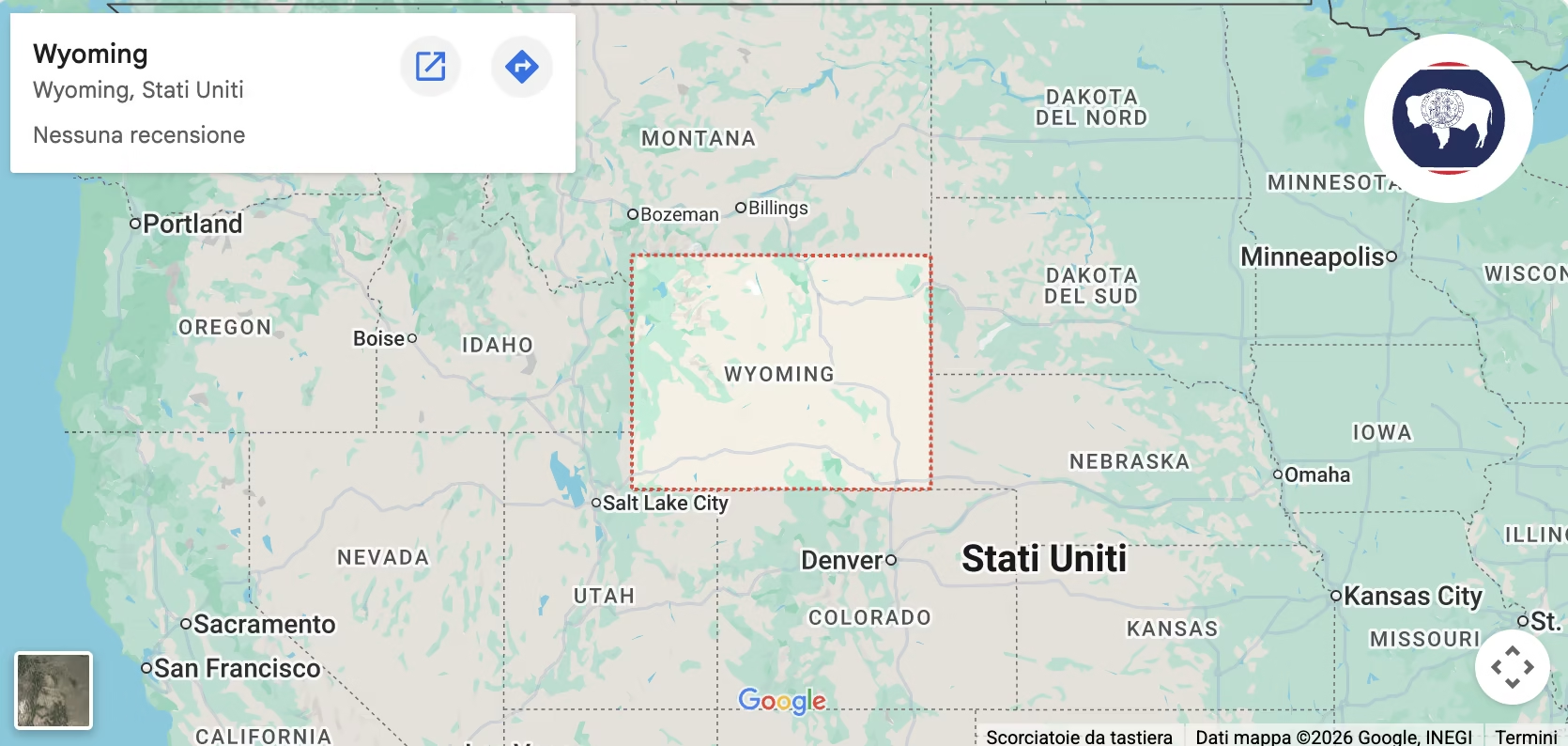
Opening an LLC in Wyoming
- Common Law: Wyoming Limited Liability Company Act (Title 17, Chapter 29)
- Country: United States of America
- Foreign Income Tax: Zero Tax — Wyoming imposes no state income tax.
- Incorporation: Immediate — 1–2 business days
- Anonymity: ★★★★ — Wyoming is the only state with specific legislative protection for single-member LLCs
- EIN: Required to open a US bank account
- Reporting Requirements: IRS Forms 5472 and 1120 annually. Annual report to the state of Wyoming.
- Wyoming LLC Opening Cost: $550 (one-time)
- Annual Renewal: $50 (or $0.0002 per Wyoming asset, whichever is greater)
- Ideal for: Holding companies, trading, forex, e-commerce, merchant accounts, asset protection, startups
How to Open an LLC in Wyoming
Opening an LLC in Wyoming is a simple process that can be completed in less than an hour. To open a Wyoming LLC with Studio Panama Italia, simply provide the desired names for the company. A Wyoming LLC does not require a franchise tax—unlike a Delaware LLC , which has an annual franchise tax of $300.
Wyoming has had a well-established pro-business policy since 1977, when it was the first U.S. state to create the LLC (Limited Liability Company) structure, combining a partnership and a corporation into a hybrid entity that limits owner risk while maintaining the flexibility of a partnership. Starting a business in Wyoming means access to the nation's strongest legislation regarding LLC member protections.
Why Open an LLC in Wyoming: The Main Advantages
Wyoming LLCs are flexible corporate structures: owners are free to determine the operating methods of the LLC in the Operating Agreement. There are no minimum corporate structure requirements, mandatory meetings, directors, a secretary, or minimum capital. A Wyoming LLC can be formed by a single person and can be managed by its members (member-managed) or by appointed managers (manager-managed) with no ownership interest required.
Exclusive Benefits of Wyoming LLC
- Private entity — details of Wyoming LLC members, managers, and officers are not disclosed in any public records.
- Charging Order Protection for Single-Member LLCs — Wyoming is the only US state with specific laws protecting the interests of members of single-member LLCs. The Charging Order prevents creditors from forcing the debtor to sell their stake in the company.
- Strongest Legislation in the U.S. — Wyoming has dedicated time and resources to refining LLC rights and protections, producing the most advanced legislation in the nation.
- Zero franchise tax — Unlike Delaware, Wyoming does not impose any franchise tax on LLCs.
- Zero State Income Tax — Wyoming has no state income tax, either for corporations or individuals.
- Lowest maintenance costs in the US — $50 annual renewal.
- Super fast incorporation — 1–2 business days.
Wyoming LLCs are commonly used for asset protection, e-commerce, Amazon FBA, international professional services, U.S. banking and merchant account access, technology startups, and as holding companies.
Wyoming LLC Taxes and Taxation

Wyoming LLCs can choose to be treated as C-Corporations (subject to corporate tax) or as tax-transparent entities (disregarded entities). Profits of a Wyoming LLC that chooses tax transparency are passed through to its members and taxed at the individual level. Members pay income taxes proportionate to their ownership interest, whether profits are distributed or retained.
A Wyoming LLC is not considered a separate entity for tax purposes: if its members are non-U.S. tax residents, they will be required to pay U.S. taxes only on U.S.-source income (territorial taxation).
| Tax item | Rate / Details |
|---|---|
| Federal Tax (C-Corp) | 21% |
| Wyoming State Tax | Zero — Wyoming has no state income tax |
| Income from foreign sources | Exempt if foreign-owned LLC without ECI |
| Franchise tax | None |
| Long-term capital gains (>12 months) | Applicable federal tax rates |
| Dividends between US companies | 70% deductible; up to 80% if participation is 20–80% |
| Withholding tax on non-residents | 30% on dividends, interest and royalties (reducible via tax treaty) |
| Sales tax | 4% state + any local taxes |
| Property tax | It doesn't exist in the US |
LLC Wyoming vs. LLC Delaware
| Parameter | LLC Wyoming | Delaware LLC |
|---|---|---|
| Anonymity | ★★★★ — maximum privacy, non-public data | ★★★ — good privacy, non-public data |
| Single-member protection | Yes — only single-member Charging Order status | No — limited protection for single-members |
| State income tax | Zero | 8.7% on Delaware-derived income |
| Annual franchise tax | None | 300 USD/year |
| Annual renewal | 50 USD | 300 USD |
| Cost of incorporation (SPI) | 550 USD | 800 USD |
| Court of Chancery | No | Yes — most advanced corporate jurisprudence in the US |
| International reputation | High | Maximum — 65% Fortune 500 |
| Ideal for | Holding, asset protection, maximum privacy, startups, e-commerce | Investors, multi-state holding company, institutional reputation |
Legal Basis for Incorporating a Wyoming LLC
| Voice | Details |
|---|---|
| Country code | USA |
| Legal basis | Common Law |
| Legal framework | Wyoming Limited Liability Company Act (Title 17, Chapter 29) |
| Corporate form | Limited Liability Company (LLC) |
| Responsibility | Limited to the extent of members' capital contributions |
| Capital | No minimum or maximum contribution. More than one membership class is permitted |
| Wyoming LLC Members | One or more members, natural or legal persons, resident or non-resident. Identity not publicly disclosed |
| Manager LLC Wyoming | Members can act as managers or appoint an external manager. Details are not public |
| Registered Agent | Required — with a physical address in Wyoming (no PO Box) |
| General Assembly | No legal requirement for formal meetings |
| Electronic signature | Allowed |
| Redomiciliation | Allowed — Foreign entities and other U.S. companies may continue in Wyoming |
| EIN | Required to open bank accounts and report to the IRS |
| Accounting compliance | Mandatory records that can be kept anywhere. Annual Forms 5472 and 1120 to the IRS. Annual report to the state ($50) |
Wyoming LLC for Digital Nomads, E-Commerce, and Amazon FBA
The Wyoming LLC is the most popular American corporate structure for digital nomads , international freelancers, and digital entrepreneurs who operate remotely without a physical presence in the United States. Thanks to the combination of zero state income tax, zero franchise tax, high anonymity, and minimal maintenance costs, the Wyoming LLC is the ideal vehicle for those running e-commerce , dropshipping, Amazon FBA , online consulting, SaaS, and digital services businesses catering to international clients.
With a Wyoming LLC, you can open merchant accounts on Stripe, PayPal Business, Wise Business, and Amazon Seller Central USA, accessing the American market with the credibility of a US company. For digital nomads operating from countries with territorial taxation—such as Panama , Paraguay , or Mexico —a Wyoming LLC allows you to operate with zero taxes at both the state and federal levels, as long as you do not generate effectively connected income (ECI) with the United States.
Tax implications for Italian residents with Wyoming LLCs
Italian tax residents who own a Wyoming LLC must pay particular attention to the reporting requirements set forth by Italian law, regardless of whether the LLC is tax-exempt in the U.S. The main tax implications for Italians are:
- RW Form (tax monitoring) — Participation in a Wyoming LLC must be declared in the RW Form of the Italian tax return for the purposes of monitoring financial assets held abroad. Failure to do so carries significant penalties.
- IVAFE — The Wyoming LLC is subject to the tax on the value of financial assets held abroad (IVAFE), currently equal to 0.2 percent of the value.
- LLC Income — If the Wyoming LLC is treated as a disregarded entity, income is attributed directly to the Italian member and taxed in Italy at progressive income tax rates, regardless of profit distribution. Italy does not recognize the tax transparency of American LLCs; the LLC may be reclassified as an autonomous tax entity by the Italian Revenue Agency.
- CFC (Controlled Foreign Companies) — if the Wyoming LLC is owned by an Italian resident and operates under a preferential tax regime (as in the case of a foreign-owned zero-tax LLC), CFC rules may apply, with transparency taxation of the LLC's income in Italy.
- Double Taxation Agreement — Italy and the U.S. have a bilateral tax treaty that can reduce or eliminate double taxation, but its application depends on the specific structure of the LLC and the tax residency of the member.
Wyoming LLC Annual Accounting
Every foreign-owned Wyoming LLC is required to file Form 5472 and Form 1120 with the IRS annually, even if there are no income or assets. Failure to file carries a penalty of $25,000 for each missed year. Studio Panama Italia offers annual LLC accounting that include preparing and filing IRS forms, managing deadlines, and ongoing support to keep the Wyoming LLC compliant with federal and state requirements.
Get a real US address in Wyoming
physical address in the United States in addition to the Registered Agent address . Platforms like PayPal USA, Wise, and Revolut require a corporate address other than the incorporation address. Studio Panama Italia offers an exclusive physical address in Wyoming for receiving mail, packages, and correspondence, with international scanning and shipping services. The cost is $350/year with an initial setup fee of $400 (first year total: $750).
Get real proof of address in Wyoming
Banks, credit unions, and government institutions require a physical paper bill or invoice in the name of the LLC. Studio Panama Italia offers a physical telephone line service in Wyoming, with a monthly paper bill sent to the LLC's U.S. address. Contact us to activate this service.
Open your LLC in Wyoming
Quick incorporation, anonymous, zero franchise tax and the lowest maintenance costs in the USA.
Write to us on WhatsApp