

Panama vs. Dubai: A Complete Comparison for Italians Looking to Transfer Their Tax Residency
Panama and Dubai are the two most popular destinations for Italians looking to move abroad to pay lower taxes. Those looking for a place to move to avoid paying taxes in Italy almost always find themselves comparing these two jurisdictions, as both offer zero personal income tax, international banking systems, modern infrastructure, and established expat communities. The differences, however, are profound and significantly impact the choice: residency costs, corporate tax, asset protection, the path to citizenship and a second passport, OECD Blacklist or Whitelist status for Italian taxation, real cost of living, residency requirements, and available corporate structures. This guide compares Panama and Dubai on every variable relevant to an Italian, with updated data, regulatory references, and practical cases.
This analysis is designed for those deciding where to transfer their tax residency: digital entrepreneurs, freelancers, e-commerce owners, investors, cryptocurrency holders who want to avoid the 33% crypto tax in Italy, retirees looking for a country where they can retire abroad without paying taxes, and professionals seeking a tax base outside of Italy. There's no one-size-fits-all answer; the choice depends on your profile, income, assets, and life goals. This page provides all the information you need to decide whether it's best to move to Panama or Dubai.
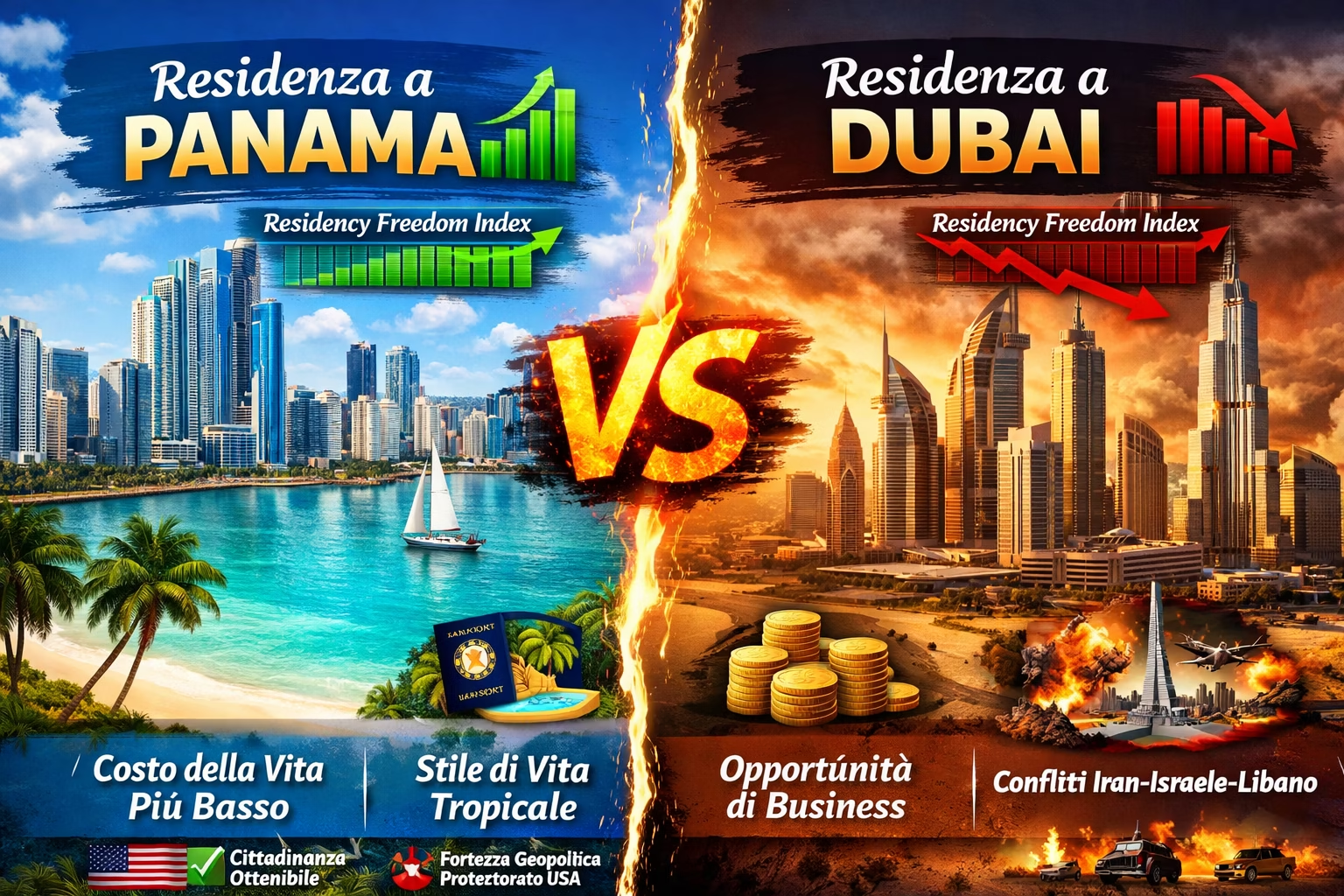
Quick comparison Panama vs Dubai
- Personal Taxation: Panama 0% on foreign income (territorial taxation) | Dubai 0% on all personal income
- Corporate tax: Panama 0% on foreign-source income, 25% on local income | Dubai 9% above AED 375,000 (~€102,000), 0% in Free Zones on qualifying income
- Cost of obtaining residency: Panama ~5,000-8,000 USD (Italy-Panama Treaty) | Dubai 15,000-50,000 USD (visa + Free Zone company or real estate investment)
- Physical residence requirement: Panama: No residence required | Dubai: 183 days/year for international TRC (90 days for domestic TRC)
- OECD Status for Italy: Panama on the OECD White List from 2023 (no reinforced presumption) | Dubai off the OECD Black List (no reinforced presumption)
- Double taxation agreement with Italy: Panama yes (Law 208/2016) | Dubai yes (Italy-UAE Convention)
- Citizenship path: Panama yes, after five years of residency | Dubai no, except in exceptional cases (naturalization nearly impossible).
- Cost of living (single, including rent): Panama City ~1,500-2,500 USD/month | Dubai ~3,500-6,000 USD/month
- Currency: Panama Balboa (pegged 1:1 USD) + USD legal tender | Dubai Dirham (AED, pegged to USD)
- Asset Protection: Panama Private Interest Foundations, Trusts, and Public Limited Companies | Dubai Trust DIFC, Free Zone Companies
- VAT: Panama ITBMS 7% | Dubai VAT 5%
Taxation Comparison: Individuals and Corporations
Personal income tax
The most frequently asked question by those considering relocating is: where do you pay less tax, Panama or Dubai? Both jurisdictions do not tax personal income from abroad, but the mechanisms are different:
Panama applies the principle of territorial taxation : only income generated within Panama is subject to the Income Tax (ISR), with progressive rates of up to 25%. Foreign-source income, such as salaries from international clients, dividends from foreign companies, capital gains on international assets, income from real estate outside Panama, and capital gains on cryptocurrencies, are completely exempt. There is no wealth tax on worldwide assets, nor an inheritance or gift tax for assets located outside Panama.
Dubai imposes no personal income tax, either on local or foreign income. There is no UAE personal income tax. There are no taxes on capital gains, dividends, interest, rent, or personal capital gains. The only exception is the property tax upon registration (4% of the property's value, paid once upon purchase).
For an Italian expatriate, the practical result is identical: zero personal income taxes in both cases, provided that the transfer from Italian tax residence is effective and documented ( AIRE , certificate of tax residence from the foreign country, complete supporting documentation).
Corporate tax: the big difference
For those looking to open a company abroad and pay zero taxes, corporate tax is the key differentiator between Panama and Dubai. The differences are significant and can determine the choice for those running a business:
Panama, company with foreign operations: 0%. A Panamanian company ( SA or SRL ) that conducts business exclusively outside Panama (international clients, foreign revenue) pays no income tax in Panama. There is no need to file a tax return, no ISR (Income Tax), and no VAT (Income Tax on Extraterritorial Operations). The only obligation is to retain a resident agent and pay the annual government tax (franchise tax). Annual compliance costs: approximately $1,500–$2,500.
Dubai, 9% Corporate Tax (effective June 1, 2023). The United Arab Emirates introduced a Corporate Tax with Federal Decree-Law No. 47/2022. The rate is 9% on profits exceeding AED 375,000 (approximately €102,000). For companies registered in Free Zones, qualifying income (income from activities that meet the Free Zone's economic substance requirements) remains exempt. Non-qualifying income is subject to the 9% rate. Compliance requires: certified accounting, annual tax filing, and transfer pricing documentation for intragroup transactions. Annual compliance costs: USD 5,000–15,000 (accounting + audit + filing).
Obtaining residency: requirements, times and costs
How to obtain residency in Panama and how to obtain residency in Dubai are among the most frequently asked questions by Italians looking to move abroad. The options vary greatly in terms of costs, timeframes, and requirements.
Residency in Panama for Italians
Italians enjoy a privileged channel: the Italy-Panama Treaty of Friendship, Commerce, and Navigation (Law 13 of 1963), which allows them to obtain permanent residency in Panama quickly and with accessible requirements. The procedure requires:
Incorporation of a Panamanian company (SA or SRL) with minimum capital, as the company demonstrates the economic/professional reason for the move. Opening of a bank account in Panama with a minimum deposit (typically $5,000–$10,000). Submission of documentation (passport, apostilled criminal record, birth certificate, bank references). Issuance of a temporary residence permit (Cédula E) in Panama City within 5–8 business days. Conversion to permanent residence after 2 years (automatic, with no additional requirements). Estimated total cost: $5,000–$8,000 (legal fees, government costs, company, bank account).
Physical residence requirement: none. Panama does not require a minimum annual stay to maintain residency. The permit is valid indefinitely. For tax residency (for the purposes of the DGI certificate ), at least 183 days of presence or proof of a center of vital interests in Panama is required.
Residence in Dubai for Italians
Dubai offers several paths to residency, all linked to an economic investment or a work/entrepreneurial activity:
Free Zone company + residence visa. The most common route: incorporate a company in a Free Zone (DMCC, IFZA, RAKEZ, Meydan, etc.), obtain a business license, and obtain the associated residence visa. Cost: USD 15,000–25,000 for the first year (license + visa + Emirates ID + medical + deposit). Annual renewal: USD 5,000–10,000. The company must have substantial assets: an office (including a virtual office in some Free Zones), real business, and accounting compliance.
Golden Visa (5 or 10 years). For real estate investors (properties worth at least AED 2 million, approximately €545,000), entrepreneurs with startups earning AED 500,000, and professionals earning AED 30,000/month. Cost: AED 5,000-6,000 (approximately €1,500) for the visa, but the underlying investment is significant.
Freelance Visa. This was the most accessible route for self-employed professionals. Please note: as of July 5, 2025, the issuance of new Freelance Visas has been suspended until further notice. Existing visa holders can renew their visa, but new applicants must focus on incorporating a company.
Physical residence requirement: To obtain an international Tax Residency Certificate (TRC) valid for double taxation treaty purposes, at least 183 days of actual presence in the UAE is required. The "domestic" TRC (with only 90 days) is recognized internally but is not accepted by the Italian Revenue Agency as proof of tax residence. For an Italian, 183 days are mandatory.
Black List / White List Status: Implications for Italian Taxation
Is Panama a tax haven? Is Dubai blacklisted by the Italian Revenue Agency? These questions are crucial because blacklisted or whitelisted status directly affects the burden of proof in the event of a tax audit and the applicable penalties
Panama: included in the OECD White List from 2023. Article 2, paragraph 2-bis of the TUIR (Consolidated Income Tax Code) provides for a strengthened presumption of Italian residency for those moving to countries with privileged tax regimes (Ministerial Decree 4 May 1999). Since Panama has been removed from the list, this presumption no longer applies : the burden of proof of foreign tax residency remains with the Revenue Agency, not the taxpayer. Furthermore, penalties for failure to complete the RW form are applied at a reduced rate (3-15% instead of 6-30%).
Dubai (United Arab Emirates): The UAE is not on the Black List of the Ministerial Decree of 4 May 1999 for natural persons (it was removed with the Ministerial Decree of 21 March 2023). Therefore, the reinforced presumption does not apply to Dubai either. However, the UAE has historically been under scrutiny by the Revenue Agency, and controls on transfers to Dubai are particularly intense, given the high volume of residence transfers in recent years and the perception of it as a "tax haven" among the public and the media.
In short: on this point, Panama and Dubai are currently equivalent in Italian tax matters. Neither jurisdiction triggers the reinforced presumption. The practical difference is that Dubai attracts more media attention and therefore more targeted controls.
Double Taxation Agreement with Italy
The existence of a double taxation agreement between Italy and the destination country is a key factor in avoiding paying taxes twice on the same income. Both Panama and Dubai have agreements with Italy.
Panama: There is a Convention between Italy and Panama (signed on December 30, 2010, ratified by Law No. 208 of November 3, 2016). The Convention provides tie-breaker rules for conflicts of dual residence and specific rules for the taxation of dividends, interest, royalties, and capital gains. It includes a split-year clause to manage the transfer year.
Dubai: There is an Italy-UAE Convention (signed in 1995, ratified by Law No. 309 of 10 August 1998). The Convention covers the same matters but with specific provisions for Free Zones and the taxation of income from employment.
Both jurisdictions have a treaty with Italy, which represents a significant advantage over countries without one. The treaty resolves dual residency conflicts and avoids (or reduces) double taxation on dividends, interest, and royalties.
Cost of living: real numbers compared
How much does it cost to live in Panama and how much does it cost to live in Dubai? This is one of the most striking differences, and one that's often overlooked by those considering moving abroad to pay lower taxes
Cost of living in Panama City
Studio apartment rent in central areas (Obarrio, San Francisco, El Cangrejo): $800–$1,200; one-bedroom apartment rent: $1,000–$1,800. Grocery: $300–$500. Transportation (metro + taxi/Uber): $100–$200. Utilities (electricity, water, internet): $100–$150. Private health insurance: $150–$400. Estimated total: $1,500–$2,500/month for a single person. For a family with two children (including international school): $4,000–$7,000/month.
Cost of living in Dubai
Studio/studio rental in accessible area (JVC, Sports City): $1,500–$2,500; in central area (Downtown, Marina): $2,500–$4,500. Food expenses: $500–$800. Transportation (metro + taxi/Uber): $200–$400. Utilities (electricity with DEWA + cooling + internet): $200–$400. Health insurance: $200–$500 (required for visa). Estimated total: $3,500–$6,000/month for a single person. For a family with two children (including international school): $8,000–$15,000/month.
Asset protection and available structures
Asset protection in Panama
Panama has historically been a global hub for asset protection. Available instruments include: Private Interest Foundations (Law 25 of 1995), asset protection vehicles completely exempt from foreign income tax, with confidentiality for the founder and beneficiaries; Joint Stock Companies (SA), with bearer shares held by an authorized agent; Panamanian trusts (Law 1 of 1984); bank accounts with residual banking secrecy protection, limited by the CRS but still more robust than in many jurisdictions; and offshore safe deposit boxes. The Panamanian offshore ecosystem has been consolidated for over 90 years, since 1927, the year of the first law on joint stock companies.
Asset Protection in Dubai
Dubai offers newer but rapidly growing protection mechanisms: DIFC Trust (Dubai International Financial Centre), a common law trust with its own jurisdiction and independent court; Free Zone companies with corporate asset protection; and ADGM (Abu Dhabi Global Market) Foundation, a structure similar to the Panamanian foundation. The system is modern and well-regulated, but less historically consolidated and with less established case law than Panama.
Path to citizenship and a second passport
Anyone seeking a second passport through residency abroad should know that on this point Panama and Dubai are at opposite ends of the spectrum.
Panamanian citizenship
After five years of permanent residency , a foreign citizen can apply for Panamanian naturalization. The process requires a Spanish language and Panamanian history/geography exam, proof of ties to the country (property, business, family relationships), and renunciation of original citizenship is not required, as Panama accepts dual citizenship . The Panamanian passport offers visa-free access to over 140 countries (including all Schengen Area countries, the United Kingdom, and much of Latin America and Asia).
Emirati citizenship
Emirati naturalization is extremely rare and discretionary . There is no automatic path to citizenship. The UAE government introduced the possibility of naturalization for investors, scientists, artists, and exceptional professionals in 2021, but grants are individual and unpredictable. The vast majority of expats in Dubai will never obtain Emirati citizenship. A residency visa (even the 10-year Golden Visa) does not lead to citizenship.
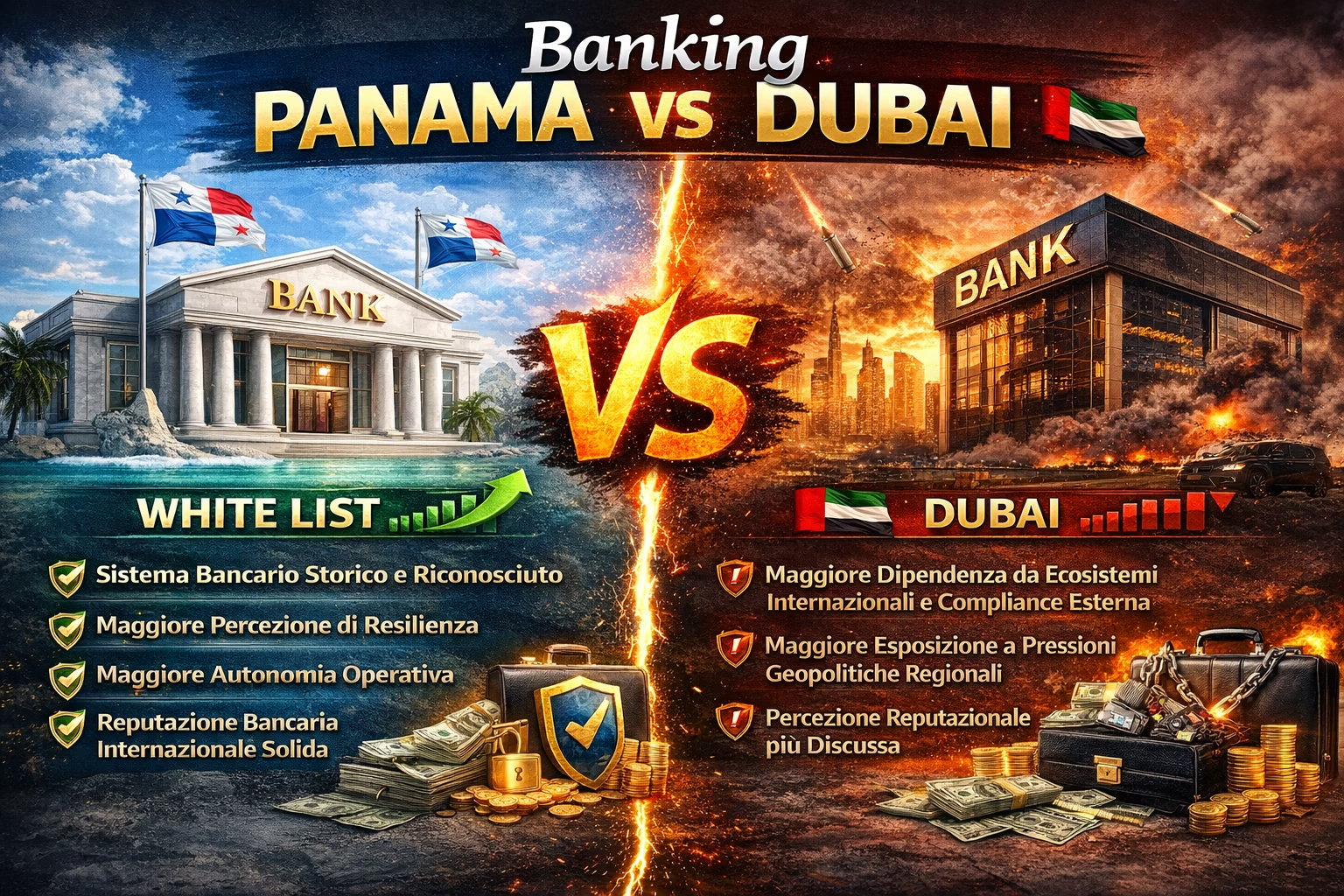
Banking system comparison
For those looking to open a bank account abroad as a base for their international business, the differences between the Panamanian and Dubai banking systems are significant.
Banks in Panama
The Panamanian banking system comprises over 70 banks, including branches of international banks (HSBC, Citibank, Scotiabank). Accounts are opened in USD (the de facto currency), with access to online banking platforms, international debit cards, and investment options through the bank. KYC/AML procedures are rigorous (Panama is subject to FATF supervision), but opening an account is accessible to those with proper documentation. Personal accounts: opening with a minimum deposit of USD 1,000–5,000. Corporate accounts: minimum deposit typically USD 5,000–10,000.
Banks in Dubai
The banking system is among the most advanced in the Middle East (Emirates NBD, FAB, Mashreq, ADCB). Accounts can be opened in AED, USD, or EUR. KYC procedures are very selective: Emirati banks reject a high percentage of account opening requests, especially from Free Zone companies without consolidated revenue. Personal accounts: variable minimum deposit (AED 3,000-25,000 depending on the bank). Corporate accounts: often require a demonstrable minimum revenue and international bank references.
The problem of international banking reputation
Many European and North American banks apply enhanced due diligence (EDD) procedures on incoming and outgoing wire transfers from UAE accounts, due to the historical involvement of some UAE financial institutions in money laundering and illicit financing. In practice, transfers to and from Dubai may be subject to delays, temporary holds, or requests for additional documentation from correspondent banks. For a business owner receiving payments from European or US clients on an account in Dubai, this can result in operational friction. Panama, despite having been the subject of international scrutiny (Panama Papers, FATF lists), has had a decades-long consolidated banking system with stable correspondent relationships with the US and Europe: an account in Panama with proper KYC documentation operates without the reputational friction that currently characterizes Dubai.
Cryptocurrencies: Which jurisdiction is best?
With cryptocurrency taxation in Italy rising to 33% from 2026 and the elimination of the €2,000 tax exemption, more and more Italian holders are looking for a place to relocate to avoid paying crypto taxes. Both Panama and Dubai offer zero personal crypto capital gains tax, but with significant operational differences.
Crypto in Panama
Crypto assets from foreign sources (held on international, non-Panamanian exchanges) are not subject to taxation in Panama. There is no specific tax on cryptocurrencies, nor is there a local reporting requirement for cryptocurrencies. Operational freedom is maximum. However, opening bank accounts with deposits from cryptocurrency sales requires rigorous AML documentation (proof of origin of funds).
Crypto in Dubai
Cryptocurrencies are not taxed at the personal level. Dubai has created a crypto-friendly ecosystem with the VARA (Virtual Assets Regulatory Authority) and special zones such as the DMCC Crypto Centre. Regulated exchanges operate in Dubai (Binance and OKX have UAE licenses). Access to banking services for crypto traders is more structured than in Panama, but a 9% corporate tax applies to profits from crypto trading at the corporate level (except in Free Zones with qualifying income).
For a holder who simply wants to hold and sell cryptocurrencies tax-free, Panama offers the simplest and least regulated regime . For those who want to operate professionally in the crypto sector (exchange, services, professional trading), Dubai offers a more mature regulatory ecosystem .
Climate, lifestyle and Italian community
Living in Panama
Tropical climate year-round (25-33°C), with a dry season (December-April) and a rainy season (May-November). It has no cyclones (it is below the hurricane belt). The lifestyle is relaxed, Americanized, with a strong Latin influence. International cuisine, a well-established expat community (over 30,000 Americans, several thousand Europeans). A small but active Italian community. Time zone: UTC-5 (6 hours behind Italy in winter, 7 hours behind Italy in summer). Direct flights to the USA, with connections to Europe via Copa Airlines (regional hub).
Living in Dubai
Desert climate with extreme summers (40-50°C from June to September) and mild winters (18-25°C from November to March). Outdoor living is only possible for about 6-7 months of the year. Cosmopolitan, modern, luxury-oriented lifestyle. A rapidly growing Italian community (over 21,000 people). Top-notch international cuisine. Time zone: UTC+4 (3 hours ahead of Italy in winter, 2 hours ahead of Italy in summer). Worldwide air connections via Emirates (one of the best global hubs).
Which jurisdiction for which profile?
Should you move to Panama or Dubai? The answer depends on your professional profile, income, and personal goals. Below is an analysis of the five most common profiles among Italians considering moving abroad.
Freelancer/digital nomad with an income of €50,000-150,000/year
Recommended choice: Panama. Low entry costs (USD 5,000–8,000), affordable cost of living, zero corporate tax on offshore companies, and no residency requirement to maintain residency. A freelancer can obtain residency in Panama, register a company, open a bank account, register with AIRE, and operate from anywhere in the world. In Dubai, the same profile would need to set up a company in the Free Zone (USD 15,000–25,000), renew annually (USD 5,000–10,000), spend 183 days in the Emirates for the TRC, and cover double the cost of living.
Entrepreneur with a turnover of €300,000-1,000,000/year
It depends on the market. If the business is aimed at international clients (USA, Europe, Latin America), Panama offers zero corporate tax, lower costs, and a consolidated offshore ecosystem. If the business is aimed at the Gulf, Asian, or Middle Eastern markets, or if the entrepreneur needs a brand image associated with Dubai for positioning reasons, Dubai is the logical choice, despite the 9% corporate tax and higher costs.
Retired with a pension of €2,000-5,000/month
Recommended choice: Panama. For Italian retirees who want to retire abroad tax-free, Panama has a specific program ( Visa de Pensionado ) with discounts on services, transportation, restaurants, cinemas, and domestic flights. The cost of living is compatible with an average Italian pension. In Dubai, a pension of €3,000 a month barely covers the rent for a studio apartment in the suburbs, with no margin for other expenses.
Crypto holder with a wallet > €500,000
Both are valid, with different angles. For pure tax optimization and minimal costs: Panama. For access to regulated crypto services, locally licensed exchanges, and crypto-friendly banking: Dubai. In both cases, zero personal tax on crypto capital gains (provided you are actually resident for tax purposes). Those with a portfolio of over €4 million must consider the exit tax before transferring.
HNWI / family office
The answer could be both. Panama for asset protection (Private Interest Foundations, joint-stock companies, offshore accounts) and as a tax base. Dubai for operational presence, networking, and access to Asian and Gulf markets. Many HNWIs structure a multi-jurisdictional setup with residence in Panama and operations in Dubai (or vice versa). Studio Panama Italia assists in structuring these complex structures.
The most common mistakes when choosing Panama vs. Dubai
Those considering moving to Panama or Dubai to save on taxes often make mistakes that can cost tens of thousands of euros. Here are the five most common ones.
1. Choosing Dubai for the lifestyle without considering the actual cost. The difference in living costs over five years (USD 120,000–500,000 depending on the profile) often exceeds the tax savings achieved. The move should be evaluated in terms of net savings, not gross tax savings.
2. Believing that 183 days are not required in Dubai. The "domestic" TRC obtainable in 90 days is not recognized by the Italian Revenue Agency. For an Italian, 183 days of actual presence are required for the international TRC. In Panama, there is no requirement to stay for residency (but 183 days outside Italy are required for Italian tax residency).
3. Ignore Dubai's corporate tax. Before 2023, Dubai had zero taxes, even for companies. Today, the 9% corporate tax changes the calculations for those with non-qualified income or operating outside the Free Zones.
4. Ignore the citizenship route. Those planning a permanent move with the goal of a second passport should choose Panama. Dubai does not offer this route.
5. Don't check the suspension of the Freelance Visa in Dubai. Starting in July 2025, new Freelance Visas will no longer be issued. Anyone planning to move to Dubai as a freelancer must now set up a company, which entails significantly higher costs.
Moving to Panama: Personalized Consulting
Studio Panama Italia assists Italian entrepreneurs, investors, freelancers, and retirees in transferring their tax residency to Panama. From preliminary analysis (comparing Panama vs. Dubai vs. Paraguay vs. other jurisdictions) to complete structuring: treaty residency , company incorporation , bank account opening , AIRE registration, DGI tax residency certificate and compliance with Italian tax authorities ( exit tax , RW form , risk of foreign taxation ). We have been operating from Panama City since 2010, license no. 14465.
✉️ Write to us on WhatsAppFrequently Asked Questions about Panama vs. Dubai
Where do you pay less taxes, in Panama or Dubai?
On a personal level, both offer zero income taxes. On a corporate level, Panama is more advantageous: 0% corporate tax for companies with foreign operations, compared to Dubai's 9% on profits over €102,000 (with the possibility of exemption in the Free Zone for qualifying income). The choice depends on the type of business and the target market.
Is it cheaper to live in Panama or Dubai?
Panama is significantly cheaper: 40-60% less than Dubai. A single person can live comfortably in Panama City for $1,500-2,500/month (including rent). In Dubai, the same lifestyle costs $3,500-6,000/month. For a family with children in international school, the difference is even more pronounced.
Which of the two is considered a tax haven by Italy?
Neither in 2026. Panama has been on the OECD White List since 2023, and the UAE was removed from the Black List of the Ministerial Decree of May 4, 1999. The enhanced presumption of Italian residency does not apply to either. However, transfers to Dubai attract increased scrutiny from the Revenue Agency due to the high volume of recent transfers.
Can I get citizenship in Dubai?
In practice, no. Emirati naturalization is exceptional and discretionary, reserved for extraordinary cases. The Golden Visa (10 years) does not lead to citizenship. In Panama, however, after five years of permanent residency, you can apply for naturalization, obtaining a second passport with visa-free access to 140+ countries. Panama accepts dual citizenship.
How many days do I have to stay in Dubai for tax residency?
For the international TRC (the only one valid for the Italian Revenue Agency): at least 183 days of actual presence in the Emirates. The 90-day TRC is only for domestic purposes and does not protect against Italian inspections. In Panama, there is no residence requirement, but for Italian tax purposes, you must still prove that you have not been in Italy for more than 183 days in the year.
Are cryptocurrencies taxed in Panama or Dubai?
In both jurisdictions, capital gains on cryptocurrencies are not taxed at the personal level. The difference: in Panama, there are no specific regulations on cryptocurrencies and the regime is more liberal. In Dubai, there is a more structured regulatory framework (VARA), with regulated exchanges and crypto-friendly banking services, but the 9% Corporate Tax applies to crypto profits at the corporate level except in Free Zones with qualifying income.
Can I have residency in both Panama and Dubai?
Yes, it's possible, and many HNWIs do. Residency in Panama offers asset protection, a second passport, and a tax base. A Dubai visa offers access to the Gulf market and an international lifestyle. Tax residency will be in the country where you spend the most time and have your center of vital interests. Planning must be coordinated to avoid dual residency conflicts.
Is the Freelance Visa in Dubai still available in 2026?
No, not for new applicants. Effective July 5, 2025, the issuance of new Freelance Visas has been suspended until further notice. Existing visa holders may renew their visa. For new arrivals, the alternative is to set up a company in the Free Zone, which entails significantly higher costs. In Panama, the residency path for freelancers remains open and accessible through the Italy-Panama Treaty.
Find out how to obtain residency in Panama in 6 steps , register with AIRE , obtain a tax residency certificate , avoid foreign investiture , manage the exit tax , calculate IVAFE and IVIE , and complete the RW form asset protection structures and Private Interest Foundations , consult the dedicated guides.
